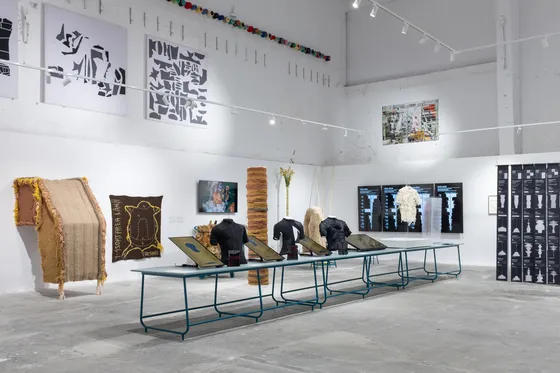
From socialism to integration into the global supply chain, Romania’s textile industry has witnessed a number of transformative shifts over the past six decades. Through analysing data collected during this time period, sociologist and researcher Norbert Petrovici has gained insight into Romania's evolving–and in many ways increasingly vulnerable–role in textile markets worldwide. In the process, his research has helped define and guide the focus of the Woven Secrets program as a whole.
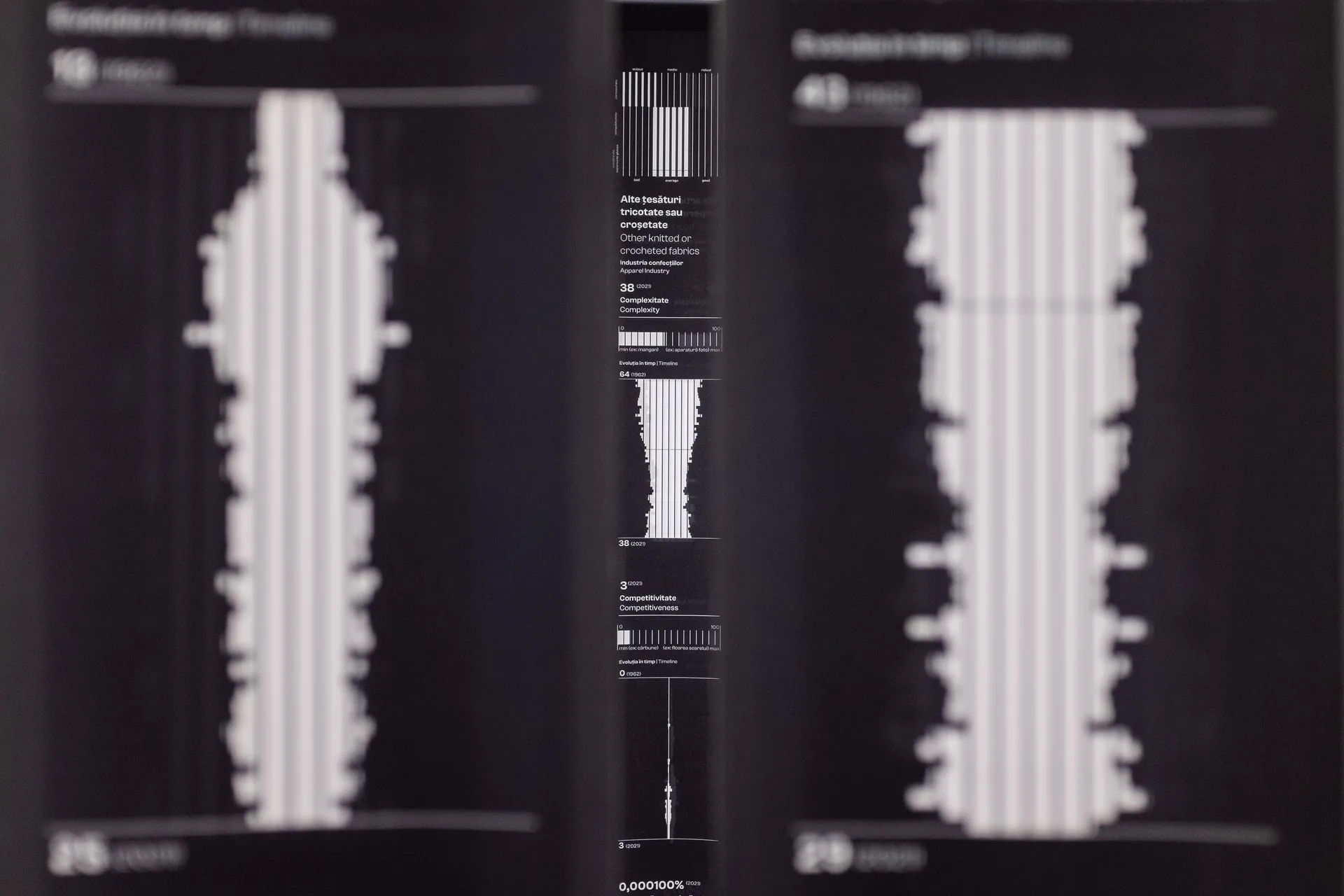
‘Shifts in Global Textile Markets: Romania’s Role in the Global Value Chain from 1962 to 2022’ sees Petrovici partnering with data visualisation designers Studio Interrobang and animator Victor Ionichi, to present a nuanced exploration of the sector’s journey. He examines Romania's adaptation to changing economic landscapes, its integration with high-value sectors, and the impact of multinational corporations on local industry. In a recent interview, he spoke about the sometimes surprising insights the data revealed.
To start, it seems that this year’s Woven Secrets project is more focused than last year’s Bright Cityscapes, where you were doing broader research on Timișoara and its design landscape. Now, there’s a specific focus on the textile industry. How has this more defined scope influenced your research techniques?
Norbert Petrovici: While it’s true that the work I did for Bright Cityscapes cast a wider net, studying the urban and design landscape of Timișoara as a whole, and it’s true that the the focus here has somewhat narrowed, we still approached the project from a broad perspective–some would say broader than last time around– because we were embedding the textile sector of the whole of Romania within global, national, and local frameworks.
For example, I explored the global textile industry as well as Romania’s role, trade partners, and the complexities of the industry. We also examined the socialist period, which added a lot of historical depth. For this, I had to work with extensive data, including the entire database on global exports from Harvard Growth Lab’s Atlas of Economic Complexity, encompassing all products worldwide. So, rather than narrowing, the research expanded, making it challenging to then scale down the findings to a company level or even a specific geographic scope. Even though Romania’s textile sector is small in terms of workforce and revenue, the broader perspective required for the project added substantial layers of complexity.
Could you elaborate on how Romania transitioned from its socialist economy to today’s globalised market?
NP: Given that I had global-level data, I was able to approach it with a broad statistical perspective, somewhat setting aside the socialist context. I clustered data by decades, comparing Romania’s overall export portfolio and its share of GDP in the global textile trade.
Surprisingly, I found that the 1980s and 1990s were quite similar for Romania in terms of export composition and, when adjusted for inflation, the volume of exports. Similarly, the 1970s resembled the 2000s in terms of export volume, and it wasn’t until after 2010 that the textile industry in Romania regained the level of complexity it had during socialism.
The 1980s brought significant challenges, particularly with inflation in the U.S. and the subsequent adjustments by the Federal Reserve, which created widespread currency issues. Eastern European countries, including Romania, had entered the 1970s with substantial financial ties to the West. Countries like Romania, Poland, Czechoslovakia, and Hungary accrued considerable debt in what were called Eurodollars. When the U.S. raised interest rates, Eastern Europe faced significant pressure to repay these debts. Mexico later became the first to default, followed by financial crises across Latin America, but Eastern European nations like Romania, due to Ceausescu’s strict debt repayment policies, managed to avoid this fate. However, focus on repaying this debt placed significant pressure on Romania’s textile industry throughout the 1970s and 1980s, and this focus on repayment continued into the 1990s.
In terms of textile export complexity, the 1970s, 2000s, and 2010s show similar levels of diversity in product types. However, the 1980s and 1990s can be grouped as a more turbulent period, reflecting both the economic instability and debt pressures. This shift from socialism to a globalised market economy is complex and multilayered, but it’s a transition well-documented in the literature.
When compared to Romania's exports during socialism, the textile sector appears to make up only a small percentage of the national economy, or GDP, today. However, in the 1960s and 70s, the majority of global trade—around 80%—was concentrated among just three major economic areas: Western Europe, the U.S., and Japan.
In the 1970s and especially the 1980s, Romania’s exports, including textiles, expanded rapidly on the global stage. There is often a perception that socialist economies focus on internal production for an internal market. In fact, Romania’s economic policy in the 1970s was strongly export-oriented, and the level of exports adjusted for inflation wasn’t matched again until after 2010. This pattern is mirrored even in the textile sector, which is interesting because, for a non-researcher, it might be tempting to make quick assumptions about the impact of socialism. But as researchers, we have to set aside assumptions and let the data tell the story.
What story does the data tell regarding why trends in the 1970s and 2000s reflect each other, despite their drastically different political contexts?
NP: It's all about the types of economic growth we see. This is actually a widely debated topic in socialist studies. There are emerging perspectives now that challenge the old view of socialism as a completely closed economic system. Some of these new paradigms refer to ‘global socialism’ or ‘uneven and combined exchange.’ These analyses are now possible thanks to the data we’ve compiled—data that was unavailable in the 1970s and 80s.
Back then, some economists did argue against the conventional wisdom, pointing out that socialist states like Romania were very much export-oriented, but these voices were relatively suppressed in the 1990s, when the tendency was to portray socialism as a closed system. That narrative made it easier to imagine that the post-socialist period was a new 'opening.' Yet, looking at the data now, we can see that it was more of a transition between two phases of high export activity—the 1970s and post-2010. After 2010, Romania, like much of Eastern Europe, shifted economically in ways that parallel the export orientation of socialism in terms of GDP share, but not in ideology. Today, exports represent nearly half of Romania's GDP, which is quite significant for Romania and other Central and Eastern European countries.
While the textile sector’s export value is comparable to that of the early 2000s, it now represents a smaller share of Romania’s overall exports due to growth in other sectors. Romania has become a leader in this export-driven growth model, similar to Germany’s, and it's largely fueled by foreign direct investment (FDI). In fact, about 80% of Romania’s exports come from foreign-owned companies, and that figure rises to around 92-94% when we include mixed-ownership firms.
As a researcher, what conclusions do you draw from the textile industry’s shift toward multinationalism?
NP: It's a complex issue to interpret ideologically and politically. Both nationalists and left-leaning critics are scrutinising this shift. As someone who identifies ideologically with the left, I find that the nationalist perspective often argues for sovereignty, suggesting Romania should reclaim economic independence from Western capital, foster local ownership, and develop its own capitalist class. Meanwhile, the left argues that this is still capitalism, driven by the same global market logic, and that focusing on whether it’s ‘local’ or ‘global’ capitalism can be limiting. From a leftist standpoint, we’re more concerned with labour relations and working conditions, questioning how employees in Romania’s labour-intensive sectors—like textiles—are being compensated.
In the 1990s and 2000s, textiles were labour-intensive but part of a low-cost economy. Today, that sector remains labour-intensive, though product complexity has evolved. Now, textile products are not limited to apparel but extend into other industries, like automotive, furniture, and electronics. While wages and working conditions have improved, collective bargaining is still discouraged in Romania, creating challenges for workers across major industries.
How do you account for potential bias when analysing data from such as the Harvard Growth Lab?
NP: The data I use is rigorously peer-reviewed, especially at institutions like Harvard. Scholars continuously refine and expand on these datasets. But it's worth noting that historical datasets come with specific challenges. For example, Romania’s accounting practices in the 1960s and 70s differed from Western standards—there was no GDP metric, only national income. Today, researchers have established reliable conversions, and institutions like the World Bank now offer GDP data for Romania.
For contemporary data, which in this study covers the period starting from 2008, we have balance sheets from Romanian companies, and I use this firm-level data extensively, aggregating it to see how trends evolve at a larger scale.
Your work uses a methodology called the product space network. What is this in simple terms, and what can it reveal about Romania's role in the textile value chain?
NP: It’s a scholarly trick (laughs). The "product space" is essentially a method that uses time and space to deduce the similarity between products based on the skills and infrastructure required to produce them. We look at each country and each year to see what they export, then examine correlations. We analyse which products a country exports simultaneously, seeing if these relationships hold at a global level. For example, if a country exports one type of textile, we check if it tends to export another type in the same year, and across years.
In this way, we use “space” (meaning different countries over time) to examine patterns of co-production. Now, we might not know for certain if producing yarn requires the same infrastructure as producing linen yarn, for instance, but we can hypothesise based on these observed correlations. There’s also been a lot of recent research, both qualitative and regional, testing these assumptions. Initially, it was somewhat speculative, but now we know that these relationships tend to hold up across both time and space. The product space, derived annually and globally by Hidalgo and Hausmann, maps how products are interconnected, though researchers can apply this method separately. Fundamentally, it's a data-reduction technique—similar to principal component analysis—that simplifies thousands of products into a few central variables.
You mentioned some surprising findings, like the similarities between the economic trajectory in the textile industry during the 1970s and 2010s. In what ways did your research challenge your views about how the past has shaped the textile industry?
NP: The biggest surprise, which became a central theme of the exhibition, was how the textile sector evolved. Initially, it was tightly connected to the apparel industry. But now, it has branched off into other sectors and become more integrated into industries like automotive, where it’s almost invisible. For instance, in Timișoara, we found that the local development followed a path of "related development" (a concept conceived of by economist Ron Boschma and researcher Kees Frenken), where the textile industry helped establish a foundation for the chemical sector. This was especially significant during socialism when shared infrastructure and knowledge supported this branching.
After Romania joined the EU in 2007-2008, outsourcing surged. Textiles, which were Romania’s top export sector in 2000, became a springboard for diversifying into other sectors using the same infrastructure and knowledge. We observed that in areas where textile manufacturing was once prominent, there’s now a diversification into different industries, especially automotive. In short, while the apparel sector has faded, textiles are still present but in a new form, embedded in other industries.
How do you see this shift from apparel to sectors like automotive impacting the social landscape of Timișoara?
NP: For the apparel sector, a major issue is that the local supply chains of the 1970s—created under socialist Romania with imported equipment—no longer exist. Now, the textile sector operates within broader, often cross-continental supply chains dominated by sectors like the automotive and chemical industries. This shift suggests that any attempt to re-establish local supply chains would likely struggle. Instead, Timișoara’s fate is closely tied to European and global developments.
For policymakers, this change underscores the need for resilience. While it’s important to support continental integration, it’s also crucial to foster local initiatives, like startups and more integrated ecosystems, to build resilience against the fragility of long supply chains.
Both last year’s Bright Cityscapes and Woven Secrets this year brought researchers such as yourself and designers together in a collaborative space. How did you find this experience?
NP: I loved it. One reason I joined this project was my background with the independent cultural sector in Cluj, especially with the Paintbrush Factory collective. While I’ve collaborated with the cultural sector before, this was the first time research played such a central role in an exhibition’s concept. Martina and Oana pushed for thorough, ongoing research, which was time-consuming but immensely rewarding. This collaboration allowed me to explore the material in ways I wouldn’t have otherwise, making it a very unique experience.
Do you hope the methods established conducting this kind of collaborative research will shape your future work?
NP: Yes, previous research identified three sectors as key to Timișoara’s diversification: textiles, chemicals, and agriculture. Each has become a significant topic for exhibitions and new programs. Personally, I’ve turned my research report into books and am working to publish articles based on this material. The project’s flexibility, even with its modest funding, allowed for an in-depth exploration I wouldn’t have had in a typical research grant. Another unique aspect was the opportunity to present findings to the people I interviewed and get feedback. This dialogue with my sources has been eye-opening and transformative. Unlike in standard applied research, where you write a report and move on, in this project, I am able to continually re-engage with the material, which transforms and evolves over time.