It is tempting to imagine a garment as having something of a life cycle; like an animate being, born from the factory. It is worn close to the body, it ages, and time leaves marks, cotton fades, wool frays, nylon disintegrates. It is then discarded, and this is where it gets a little obscure. Is it recycled? Does it end up in a landfill, or as rags, or as a new garment? Even if consumers donate their clothes, hoping that the textile will re-enter the cycle, a kind of garment nirvana, the chances they can be repurposed are slim. Only 14.7 percent of clothes were reclaimed in 2018, according to the United States Environmental Protection Agency. Consumers have no information on the afterlife of a garment, in the same way things that happen before production remain in the dark. The textile industry is anything but simple, and to think of it in linear and organic terms is deceitful.
Supply chains lead up to the birth of a garment, and they are complicated entities. They can resemble rhizomes, they can be interconnected and intricate, non-linear, largely invisible, but never entirely subterranean. Many companies, distributors and suppliers have a hand in creating one product, an item of clothing, say. Designing the garment, sourcing the raw materials, producing the fabric, which is usually the most environmentally taxing step, the manufacturing, and finally retail, many actors are involved.
Frequently, production of the fabric and the garment manufacturing take place in the Global South. The old market-liberal dogma of division of labor for efficiency is in full effect here: cotton may be grown in China, woven in Cambodia, sewn elsewhere, and assembled in Italy, which is where the label is added. The claim “Made in Italy,” for example, can obscure a long assembly line that stretches over two continents. For the sake of efficiency and profit maximization, the steps involved in producing an item of clothing—and, beyond that, anything, really—are divorced from each other. It’s usually at the very moment when an idea like “craft” is on the verge of extinction that it becomes obsessively evoked, perhaps even fetishized, and the garment industry is no exception.
When in late April of 2013 an eight-storey building collapsed at Rana Plaza in Dhaka, Bangladesh, the interconnectedness of textile production was dragged into the light, as if the market woke up to a harsh reality. The structure gave in, likely as a result of skirted safety regulations. It was crowded with workers who, on a minuscule wage, sewed clothing for the mass market, and over 1,100 people were killed in the accident. Fashion companies are often far removed from accountability, and obscured supply chains are not a bug but a feature. And although pressure on textile manufacturers mounted, realistically, the revelation of inhumane labor conditions has proven to be mainly a PR issue.
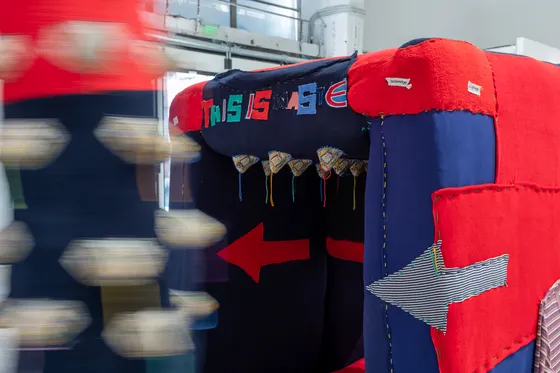
“We absolutely don’t need any more clothes in the world,” writes the journalist Jonah Weiner in his fashion and culture newsletter Blackbird Spyplane. “If I pause for ~5 seconds to consider the hyperabundance of garments currently in existence,” he continues, “a hyperabundance whose creation and perpetuation has poisoned ecosystems, drained aquifers, annihilated species, turned arable land to desert, pumped carbon into the atmosphere, plastic into the seas (…), literally enslaved and otherwise immiserated millions of workers (…)—I find myself party to a moral obscenity so grody, vast, and seemingly irreversible that all I can do is feel an intense, paralyzing sadness.” Weiner speaks about something that affects much more than the textile industry, as if the sector was a cursed hyperobject, an fuzzy-bordered entity that bleeds into ecosystems and societies alike, while overproduction to the rhythm of relentlessly fast trend cycles continues perpetually. As Alesia Cîdă demonstrates with her installation, Caution! Rotating Blades, textile waste and recycling are complex issues. The designer recreates the machinery used to sort, shred, and press textile waste out of those very rags, as a sort of soft, playground-like interactive piece. But the underlying takeaway is that purity in waste is rare, and that recycling itself creates an abundance of waste.
Economic constraints on the industry are enormous, and the hunger for fast fashion, which inevitably ends up in landfills, has not receded. Although Romanian textile exports have seen two significant moments of growth—one in the late 1970s, at the same time when Western European countries embarked on a long and steady process of deindustrialization, and another in the 2000s, after Romania joined the European Union—manufacturing sites are relocated to low-income countries, such as Bangladesh. Throughout the past decades, the European textile industry has changed. The luxury sector keeps producing in Europe, at least nominally, industrial textiles are still manufactured within the Union, and although much of apparel production has moved away, it remains an important area. Italy, and more recent member states, such as Romania and Poland, are among the main employers in the sector.
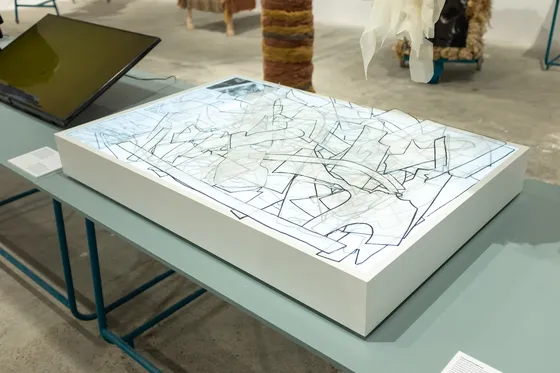
The production of wearing apparel is labor intensive, and there is little room for technological innovation, as sewing techniques have barely changed throughout the past hundred years—in capitalism, manufacturers only innovate if it promises more profit. An OECD report from 2011 classified the textile sector as a low-technology industry. But this is only the macro-economic perspective. There is another one, the design point of view—which is grounded in the imperative of innovation almost by definition—and it looks very different. Take Andreea Pleșa and Mihaela Vișovan’s work Unsolved Patterns that takes on textile waste. Blended materials are difficult to recycle, which is why this project investigated the factory Cottontex in Timișoara. The designers repurposed cuttings from the production process to make new garments, even from the difficult to recycle composite materials, as if this was some form of modernist collage that does not go against the grain of rationalist productivity, but instead offers a way out of its waste conundrum. Is it a coincidence that the pieces look like something worn by the creative class to a rave?
Designer and consumer occupy two ends of the supply chain, and there are fundamental, ethical questions buried in this relation. Since industrial mass production, design seeks the good form, the good standing in for efficient, useful, beautiful, each according to the conviction of the designer. But ethics? “Not so long ago,” writes Vilém Flusser in the early 90s about moral and design, “this would have been an unnecessary question.” Morals don’t apply to things, writes the philosopher, ethical judgments are passed by authority or by consensus, and moral responsibility resides with the person using an object, not with the one devising it. The philosopher, who was born in Prague and was forced to flee Nazi persecution as a young man, writes this under the impression of the Gulf War, a highly mediated conflict, which, viewed from Europe and North America was remote. It seemed to take place on television, and it existed in the public imagination as much as on the battlefield.
Flusser invokes a vague sense of the postmodern: At the end of the 20th century, with a fractured public sphere, the authority of moral guidelines had eroded. At the same time, the networks necessary for industrial production, including design, spread further and had become more complex. Who has an overview anyway: “The mass of information available to a producer goes way beyond the capacity of individual memory,” says Flusser. Design is no longer the work of a single, artist-like creator, or even a collective, but it is carried out along intricate supply chains that stretch globally; authorship is dispersed. Perhaps this entails a shift in moral accountability; while it lay in the past with whoever used a product, it is, at the time Flusser wrote, much more diffuse.
Flusser’s essay, which is just over three decades old, seems dated in many ways—we have become so accustomed to the fractured public sphere that it barely needs mentioning, and the idea that there is an ethical aspect to design appears self-evident to the point of cliché. But the shift of authorship—from the individual to the collective—seems intensified, and moral questions are heightened. A new type of consumer has emerged, too—remember how Jonah Weiner writes that he feels party to a moral obscenity when buying clothes? The sense of responsibility is deeply internalized. Consumption is no longer just conspicuously denoting wealth, but tangible buying choices reflect intangible things like identity, personality, and morality, as systemic ethical questions are increasingly reframed as individual responsibility.
Design is a self-inquisitive discipline, and its tasks are routinely being remapped. Only a few years ago, when design’s future was being envisioned, the focus was often strikingly different from ethical concerns. Optimism pervaded; technology was expected to solve problems. For example, an exhibition at the Victoria and Albert Museum in London, presented in 2018, was titled The Future Starts Here, and it was rife with promises: drones were expected to bring internet access anywhere, Silicon Valley luminaries vowed to abolish aging, 3D-printing was to do away with scarcity. The self, the digital, the globe were expected to change. Innovation seemed inevitable, and the new world was supposed to look radically different from the old one.
Not much later, the vibe has shifted to a different sentiment. At least since the 2020s, the fragility of supply chains and the very material threads that bind international trade and production have come into focus. Shortages, wars, global crises were as contagious as the pandemic. When in March 2021 the Ever Given, a giant container ship, got stuck in the Suez Canal between the Red Sea and the Mediterranean, the frailty of the network was exposed. No matter how long the distance, if one thread is touched, the whole web quivers.
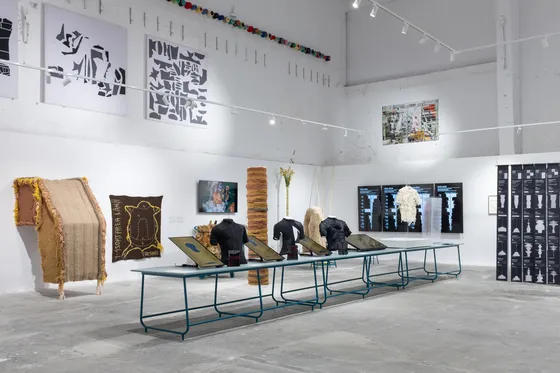
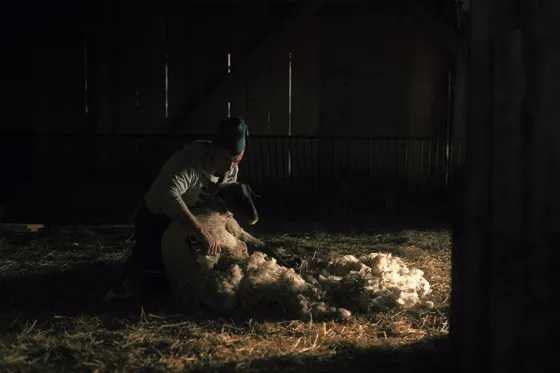
Perhaps what designers envision for the future has evolved from the tech-optimist schemes of a few years ago, but maybe the idea of shorter, more resilient supply chains has also been around for a long time. Lavinia Ghimbășan and Studio Nalba’s project demonstrates why the ideal of local proximity can be complicated. Wool is at the centre of their work, and at the outset, the designers were surprised that Romanian wool is not used in garment production in Romania (or elsewhere). Raw wool, after being shorn, is burnt or buried, because the facilities to ready the fibres for the next step are lacking. It is complex to process wool, which makes it less profitable. Ghimbășan took it upon herself to make a yarn out of local Romanian wool, in collaboration with a manufacturer from Timisoara. Farmers provided the raw material for free, but the production proved challenging. It was not possible to create yarn made out of pure wool, so the designers settled for one that was forty percent wool, sixty acrylic. But, Ghimbășan concedes, in the future a higher percentage could be produced. Ghimbășan demonstrates that wool might as well be used for thermal and acoustic insulation in buildings. Sometimes the supply chain creates dead ends, and for this particular one, the designer found a way out. The exhibition Woven Secrets might seem like an assembly of artefacts, and in a way it is. It also presents processes and proposals that are still in flux. Will there ever be a 100 percent wool thread from Romania? There might well be.
Designers are facing a puzzle. Supply chains come with a heavy ethical charge, and to design means to position oneself in regard to it. Timisoara is a unique place because different threads cross here. The words fabric, Faber, and Fabrik, the name of the old industrial quarter, which is rapidly gentrifying, bear this in their name; making, weaving, and industry share an etymological origin, everything is here. Likewise, the local and the global meet in this place, where textiles are produced for the world market, with material sourced from across the globe.