Chemical Bonds: A Curatorial Essay
Martina Muzi
Chemical processes form the basis of modern life. From the clothes we wear to the devices we touch, from the water we drink to the food we grow, chemistry is the silent infrastructure beneath almost every manufactured object and industrial system. Its influence is so widespread that it’s easy to forget it’s there—until it fails. Today, as climate targets drive a global push toward green transition, the chemical industry finds itself at a crossroads. On one side, it is an indispensable enabler of decarbonisation—providing the materials for renewable energy, batteries, insulation, electric vehicles, and more. On the other, it is one of the most resource-intensive, polluting sectors on the planet, slow to adapt, and structurally dependent on fossil inputs.
The contradictions at the heart of the chemical industry—its invisibility, its necessity, its entanglement in both progress and harm—are not just technical, but political. The sector is increasingly shaped by multinational actors, rigid regulatory regimes, and globalised standards that often overlook local capacities or knowledge. It is one of the most outsourced and standardised sectors in Europe, and its logic is not easily legible to those outside of it.
This is particularly true in Romania, a country rich in geological resources. Once home to fully integrated chemical platforms—where research, production, and policy were inseparably linked—the country now hosts a patchwork of fragmented sites: partial processing units, logistical centres, and distribution hubs that remain disconnected from each other and from national policy. Much of the innovation, ownership, and strategic vision has shifted elsewhere. What remains, however, is something no less significant: a network of skilled workers, researchers, technicians, and engineers who continue to sustain an industry despite its constraints.
Geographic particular
Timișoara offers a specific and situated lens through which to observe these dynamics. As a city shaped by manufacturing, engineering, and extractive industries—many of which remain active but undervalued—it is both context and method for the ongoing inquiry that is Design Signals. Since 2023, during the city’s year as European Capital of Culture, the research and design platform has treated Timișoara as a site of encounter: between cultural practice and industrial production, between inherited infrastructures and emergent knowledge. The approach has always been infrastructural: how do invisible systems materialise a place, and how can design help trace their effects and open them to encounter?
Each edition of the programme investigates a different sector—automotive, textiles, and now the chemical industry. The choice of sectors has not been thematic or symbolic. They are areas where design is already embedded—often invisibly—within systems of production, training, and logistics. And they are industries that, despite their apparent decline or obscurity, still hold forms of knowledge, expertise, and relevance that can be reactivated. The intention is not to use design to fix what is broken, but to map what is already there, to prototype new relationships, and to test how to hold open spaces where complexity is made visible and dialogue becomes possible.
My role as curator is to create a provisional infrastructure for collaboration—one that, even if temporary, can fill gaps in the system and allow for independent research, policy, design, and local expertise to converge and explore alternative paths. This is not about glorifying independence. It’s about understanding and supporting new forms of interdependence—through nurturing connections between agents that would otherwise remain unlinked.
Each edition operates as an episode within a larger structure: sequential, cumulative, and generative. Curating these episodes becomes a way of building a narrative over time—one that gains energy as it moves, like a dynamo. Timișoara, in this sense, is not a backdrop, but a geographical particular: a context whose specificity reveals wider dynamics of production, regulation, and peripheral position-making within Europe. By working from within, we begin to see how nuance, resistance, and alignment emerge not despite the periphery, but through it.
Chemistry as Lens
The chemical industry became crucial for Design Signals to address because it underpins both of the previous sectors—automotive and textile—as well as future ones, including agriculture and real estate. But perhaps most importantly, it is a sector through which Romania’s industrial position within Europe becomes especially visible—revealing both historical continuities and structural asymmetries in the present.
Romania is often treated as a standardised periphery—a region shaped to meet the regulatory and infrastructural expectations of the European centre, rather than to develop its own capacity. But this project pushes against that framing by insisting on the geographical particular of the so-called periphery: the skills, expertise, and forms of care that persist within local infrastructures. These are not remnants of a past system—they are active, if often undervalued, parts of today’s industrial ecosystem. By working within these specifics, the project challenges the idea of the periphery as generic or passive. What we see instead is a system in which innovation struggles to travel: companies operate in isolation, research centres are disconnected from production, and public investment remains limited. Innovation does not disappear; it becomes structurally trapped.
This fragmentation is not accidental. It is a result of historical processes: the dismantling of the socialist-era platforms that once integrated research, production, and policy; the sell-off or closure of key infrastructure; and the consolidation of value around foreign-held patents and logistical hubs. At the same time, the chemical sector is being reanimated by the green transition and its material demands. New standards, driven by EU regulation and global investment, are reshaping what chemical production looks like—and who gets to participate. In this way, the force of global capitalism is double-edged: it fractures national infrastructure while also creating moments of strategic urgency that may open new possibilities.
It is precisely within this tension that design becomes relevant—not to offer resolution, but to hold space for inquiry, and to make visible the dynamics at play. But for design to take on this role, it must be grounded in conditions that are real, not speculative. This requires research—not as academic framing, but as infrastructural groundwork.
Research as Starting Point
Each edition of Bright Cityscapes begins with a commissioned research report, not a curatorial concept. This decision is central to how the programme works. Research sets the parameters for engagement: it identifies actors, gaps, and frictions; it gives form to otherwise invisible systems; and it provides a foundation for collaborations between designers, engineers, institutions, and publics. It is a way of curating conditions, rather than outcomes.
For Chemical Bonds, sociologist and data analyst Norbert Petrovici continued as research lead, mapping the post-socialist evolution of Romania’s chemical industry. Once composed of vertically integrated platforms—where extraction, research, production, and distribution happened together—the sector is now fragmented across disconnected sites. Some companies retain the capacity to develop and patent new materials. Others perform only production or distribution functions, often for foreign-owned firms. What appears as a network is in fact a set of isolated units, often unable to build knowledge collectively or act strategically across policy, industry, and research.
This disconnection is not due to a lack of material resources. Romania’s geological composition makes it extraordinarily rich in extractable substances—salt, copper, limestone, rare metals. But without the infrastructure to integrate these materials into production and innovation ecosystems, that richness remains latent. Even where potential exists—for example, in bioplastics—there are few mechanisms to translate technical capacity into viable industrial processes.
Petrovici’s research doesn’t simply describe what’s broken. It maps the structural conditions that shape the sector: the gaps in infrastructure, the disconnection between research and production, the fragmentation left by privatisation. It forms the foundation for curatorial work that does not impose themes, but curates conditions—opening gates into industrial sites, building relationships with workers and institutions, and identifying the points where something else might be possible. This is not research for citation or extraction. It’s part of a longer process of producing knowledge that stays.
Mirroring the Ecosystem
Knowledge that stays means more than producing reports. It’s about creating proximity—between sites, people, and disciplines—and building points of contact for future collaboration. This phase of the project, which we refer to as ‘Mirroring the Ecosystem’, involved over 20 visits across Romania, where we quite literally opened the gates to extraction sites, sprawling plants, mountain ridges, and logistics corridors. It moved beyond the boundaries of Timișoara—but what is a city, if not its interdependencies?
We didn’t visit these sites to extract content for an exhibition. We went to start conversations. These encounters—with engineers, workers, managers, and landscapes—produced an evolving archive of interviews, photographic essays, and material samples. Together, they help disclose dynamics that are often obscured by scale, regulation, or standardisation: how risk is distributed across space; how maintenance happens without investment; how knowledge is practiced even when it isn’t formally recognised.
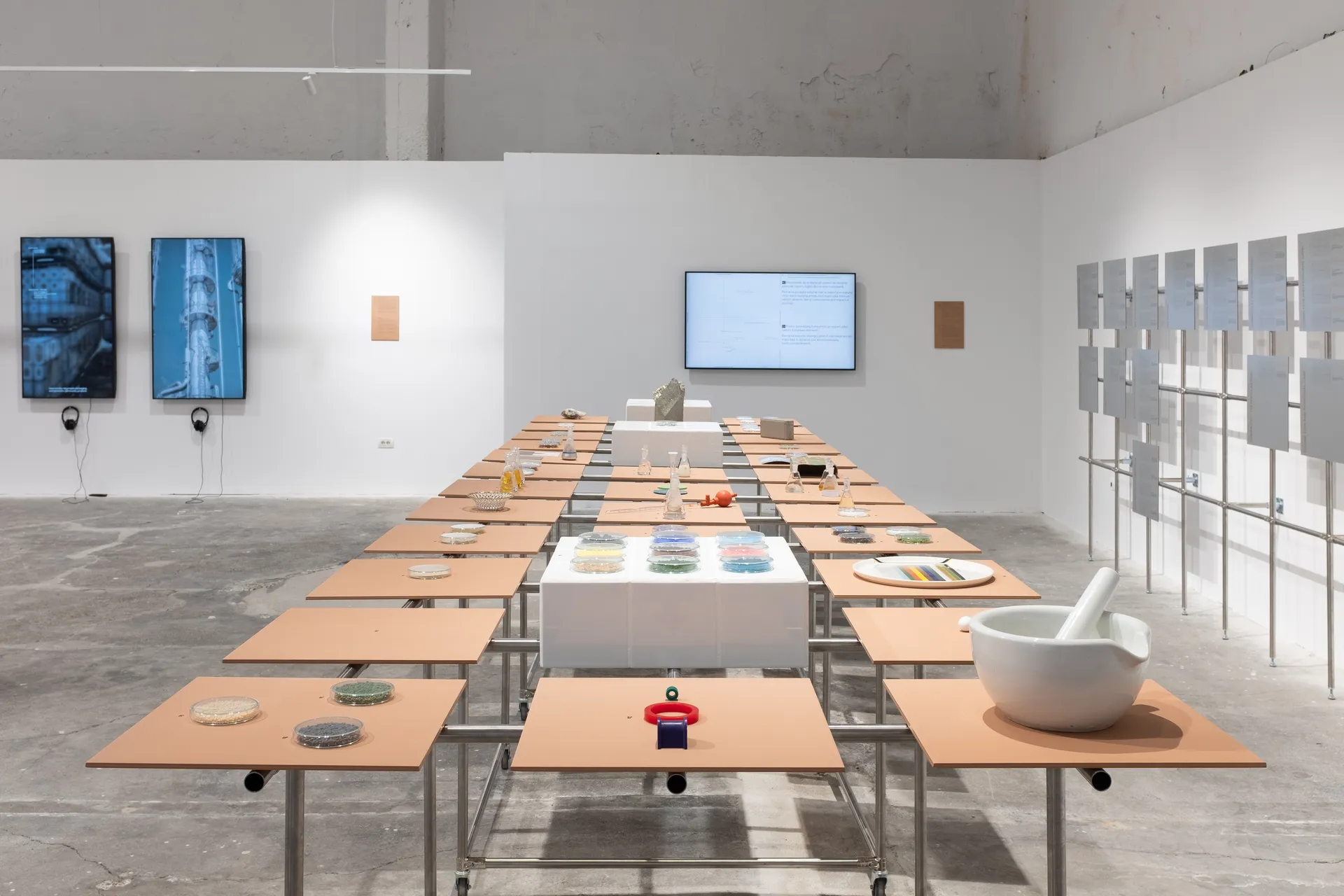
When this material enters the exhibition space, the chemical industry shifts from subject to context—something ongoing and embedded. The exhibition takes place in the former Azur factory, once a site for detergent and varnish production, still marked by its industrial past. The furniture is built from local materials—pipes, tiles, adhesives—sourced through the same production networks we’ve studied. The venue and furniture aren’t simply aesthetic choices, but representative of the same chemical system that is invisibly involved in materialising so much of daily life. The exhibition becomes a continuation of the research: temporary, partial, materially and geographically situated. Timișoara is not a backdrop—it is a city shaped by these infrastructures.
Knowledge that stays is not just a principle—it’s the starting point for how the curatorial process unfolds. It means keeping research in motion, embedding it locally, and allowing it to evolve into collaboration. This approach is not about reorganising information into fixed displays, but about curating the conditions for new engagements to take place. It is a strategy of connecting points, of opening space for proximity—between people, tools, institutions, and policies. Documentation is part of this strategy: not as passive evidence, but as an active step in building relationships that might allow other forms of design to emerge. The goal is not to fix a system from outside, but to navigate it from within—amplifying what is already there, and making space for new interdependencies to take root.
Designing as Amplification
In addition to the research and site work, an open call invited designers to respond to the complexities of Romania’s chemical sector—not by illustrating its problems, but by proposing ways to engage with its realities. The selected projects each embed themselves within existing processes, institutions, and materials. Each begins with a question of access: how to enter a system shaped by patents, regulation, and fragmentation—and how to work within that complexity without flattening its nuances.
Developed in close collaboration with local partners—ranging from bioplastics producers to extraction sites and independent researchers—each project explores a different relationship to chemistry. One treats salt as both an industrial mainstay and a bodily source of care, producing a therapeutic device that reflects the dual logics of wellness and production. Another pushes the potential of locally made bioplastics, asking how alternative materials might take shape across everyday uses and speculative design. A third produces ceramic surfaces from mineral waste, allowing heat to reveal the composition of residual materials—speaking to both the physical content and the secrecy that surrounds the industry. The fourth examines galvanisation processes as a form of industrial protection that is both sacrificial and vital.
None of these projects attempts to redesign the chemical industry. Instead, they work within its constraints to amplify overlooked knowledge, connect fragmented processes, and make visible the dependencies that quietly shape our material world. They function as rehearsals for interdependence—temporary alignments between design, production, and research that test what kinds of engagement are possible under conditions even slightly different from those we’ve come to accept as standard.
Together, they extend the curatorial aim of building provisional infrastructures: not finished systems, but situations where different agents can meet—however briefly—and where new forms of collaboration can be prototyped.
Journalism as Design Method
One of the new collaborations facilitated in this edition is between journalism and design. The choice was deliberate. The chemical industry sits at the heart of the green transition, yet the transition itself has not happened—it is a horizon, filled with both urgency and uncertainty. How, then, to talk about an industry whose future is being contested in real time, and whose impact is both intimate and systemic?
Journalism was turned to as a method for navigating this extremely delicate and central social turning point. Journalists have the capacity to construct narratives around case studies and contexts, distilling complexity into stories that reveal key nuances often lost in technical reports or conceptual communication. By working in conversation with designers—who bring methods of image-making, visual anthropology, and spatial translation—these investigations become more than reportage. They test how systemic issues might be articulated in ways that are publicly legible, emotionally resonant, and open to critique.
The result is not prediction, nor solution, but perspective: an attempt to visualise and interrogate the chemical industry’s role in shaping possible futures. In doing so, the exhibition positions journalism as a design method—one that extends the curatorial aim of making hidden infrastructures visible, and opening them to public debate.
Education and Continuity
If journalism expands design into the public sphere, pedagogy extends it forward in time. Each edition of Design Signals includes Young Matters, a summer school where design students from different faculties and tutors from Romania and abroad collaborate. These workshops are not speculative exercises but context-driven engagements: chemistry is explored where it is lived, whether by prototyping visualisations that make air quality legible, tracing copper through histories of extraction and energy, or mapping the city’s chemical ecologies through embodied, sensorial practices.
Continuity here is not about repeating a format, but about investing in how knowledge carries on. Pedagogy becomes a design method in itself—shaping future practitioners, embedding case studies and methods into curricula, and creating institutional exchanges that can be taken up again in years to come. Working across local and international contexts, students and tutors build networks that move beyond a single project, seeding perspectives that may reappear elsewhere. In this sense, Young Matters functions as a pedagogical form of ‘paying it forward’: embedding methods and collaborations that can be reused in curricula, carried into future practice, and kept alive by the next generation of designers.
Curatorial Practice as Provisional Infrastructure
Across its episodes, Bright Cityscapes has not sought to deliver solutions, but to construct the conditions in which other possibilities can be glimpsed. Each edition accumulates: first automotive, then textiles, now chemistry. Together they trace not only industries, but a methodology—curating as a way of opening gates, disclosing dynamics, and creating proximity between agents that would otherwise remain apart.
This curatorial practice is provisional by design. It fills gaps in the system with temporary infrastructures that enable research to circulate, collaborations to take shape, and knowledge to stay. It treats documentation, conversation, and pedagogy as active tools—ways of amplifying what already exists rather than imposing new frameworks from above. In this sense, designers become agents of amplification, making visible the values embedded in interdependence, and showing how even within tightly standardised systems, alternative connections can be rehearsed.
To curate here is also to move between scales: from the micro story of a residue in a glaze or a breath in a salt chamber, to the macro forces of patents, policies, and global standards. This jumping between scales is not ornamental—it is the only way to understand how the periphery is produced, contested, and reimagined. It shows how the geographical particular of Timișoara can reveal wider dynamics of capitalism’s double edge: fragmenting local infrastructures while also opening strategic opportunities within the green transition.
Curating as provisional infrastructure does not close systems or resolve contradictions. It holds them open. It builds spaces where research, design, journalism, and education can converge, however briefly, and where overlooked practices and knowledge can gain resonance. These are not conclusions, but beginnings: signals of how design might continue to act—across sectors, disciplines, and scales—not as a promise of change, but as a practice of staying with complexity.