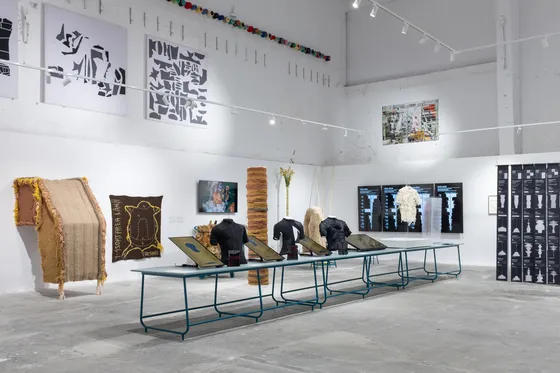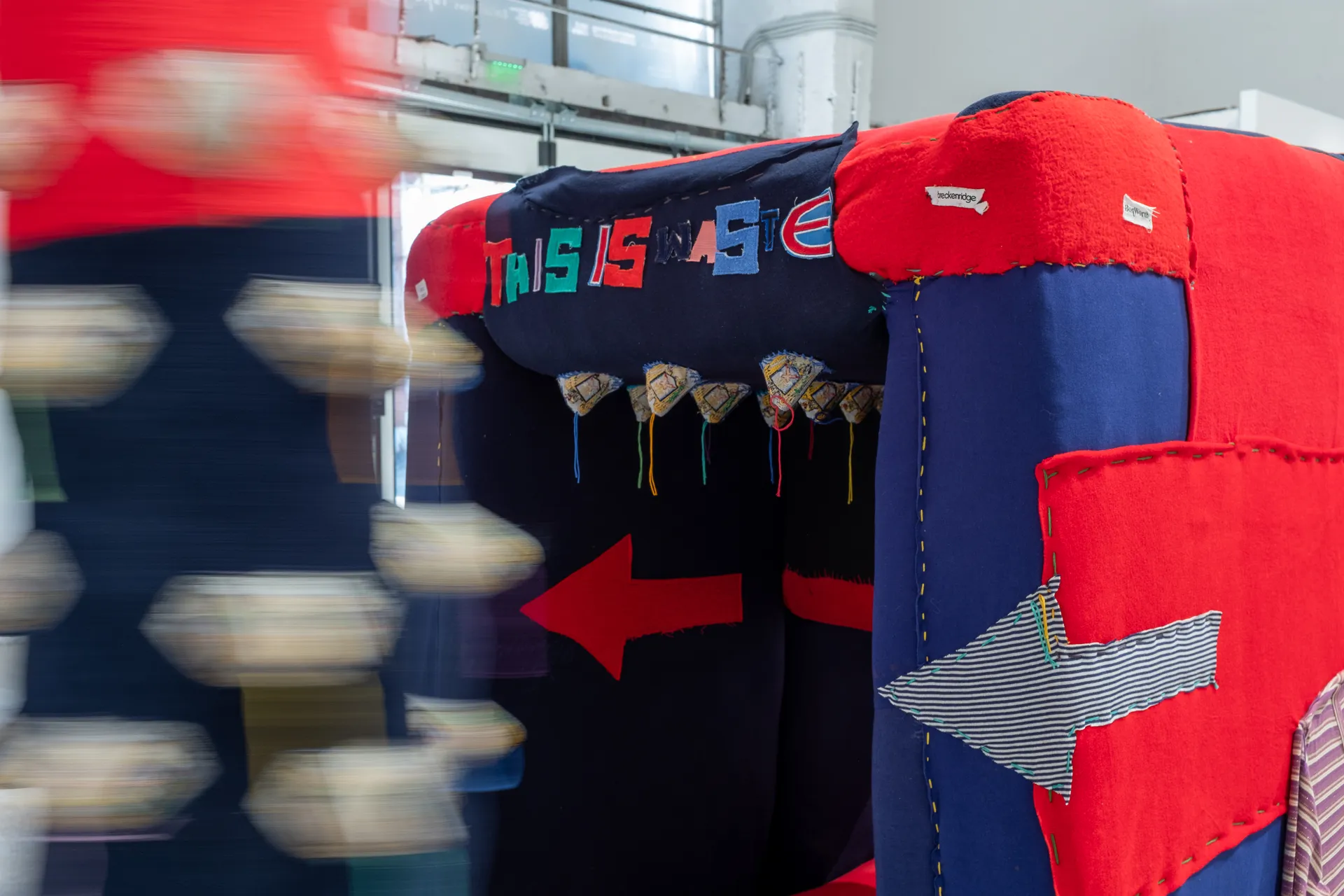
Alesia Cîdă’s Caution! Rotating Blades was inspired by the industrial textile shredders she encountered while researching the complex process of recycling textiles. The installation transforms the journey of unwanted garments into a children’s playground, provoking questions about the labour- and energy-intensive nature of recycling, as well as the urgent need to find better solutions for dealing with textile waste. Here, she discusses her creative process and why she approaches complex ideas in a playful manner that encourages interaction, even from children.
You have a particular approach to design, which includes having built up a collection of ‘junk’ over the years. How does your relationship with discarded materials inform your design practice?
AC: My interest in junk started not as a part of my work, but as a form of self expression in high school. I was attending an art school and, for the first time, I didn't have to wear a uniform anymore. I wanted to express myself through my clothing, but I couldn’t find anything I liked at the mall. That’s when I started visiting second-hand shops. I’d buy clothes and alter them to fit my style.
Over time, I started noticing other things—bedsheets, curtains, even fabric scraps. I also began visiting flea markets, where I’d find objects that nobody seemed to want. It was all cheap, so I’d collect anything that caught my eye. It became a hobby, something I’d do with my classmates, but it was also the beginning of what would become my design practice.
How did that hobby evolve into an integral part of your design practice?
AC: It just happened naturally. I always had this stash of materials that I could dip into whenever I wanted to create something. I never thought, "Oh, I need to go buy new fabrics." Instead, I’d dip into my collection of random things and figure out how to use them.
For instance, I had this idea for creating hats out of bra cups back in 2019, but it wasn’t until 2022 that I had enough bra cups saved up to actually make them. Some of the hats still have the actual bra cups, while others just use the shape. I never feel stuck for material, because my collection is like my own personal library, and it's full of potential.
For Caution! Rotating Blades you worked with two factories—Eco Cinix and IMP—both of which are involved in textile recycling. How did you find the experience of working with them, especially since they come from such a different side of the industry to the more creative, design-based approach you’re more accustomed to?
AC: I was nervous at first because I’d never collaborated with actual factories before. But it ended up being a great experience. The teams at Eco Cinix and IMP were very helpful and open to the project. For instance, when I saw bags of what they considered trash—like waistbands and zippers—I asked if I could have them, and they were happy to give them to me. It was exciting to find all these industrial materials that I could incorporate into my work.
The title—Caution! Rotating Blades—reflects the dangerous machines involved in the shredding process. Why did you choose to model the installation as a playground?
AC: The idea came from looking at the lifecycle of textiles. I wanted to show different stages of textile waste, from whole garments to shredded material. I thought, "What if people could interact with the process?" So I turned the textile shredder into a playground. I wanted kids to engage with the installation, touching the textures and learning through play.
The title comes from a warning sign that I saw on a real shredding machine. By turning something dangerous into something fun and safe, I hope the installation teaches kids that recycling doesn’t have to be boring. It can be something engaging and even enjoyable. My ideal scenario is that the experience stimulates children to start asking questions—where did this fabric come from? How was it made? If they leave feeling inspired or curious, that would be amazing.
How did you go about constructing the actual playground installation?
AC: The playground was quite a challenge! I only had two weeks to build the entire installation from scratch. A wooden frame forms the core structure and a lot of time was spent testing it to make sure it was sturdy enough for kids to use safely. Once the frame was secure, it was covered in leftover mattress padding from IMP, to make it soft and safe. After that, I spent a lot of time sewing by hand to cover the frame with textiles. My mom even came to help me on the last day, and we stayed up late to get everything finished.
Your mom helped you with the installation, and you also interviewed your grandmother as part of the project. Is exploring themes around family and community an important part of your practice?
AC: Definitely. In my interview with my grandmother, she told me how, back in the day, everything was reused—nothing went to waste. People were effortlessly sustainable because they had to be. Even the smallest scraps of thread were saved for later use. It was interesting to realise how resourceful people used to be without even thinking about it. They didn’t call it ‘sustainability’, it was just how things were done.
The conversation strongly influenced my thinking on this project, but my grandmother is also the one who taught me how to sew, and she’s one of the main reasons why I’m doing this kind of work. My dad is also an engineer, so he helped with the technical aspects of the project. My practice is very much about community, and involving my family in this process feels natural. It brings everything full circle.
What do you think are the biggest obstacles to creating a less wasteful textile recycling process?
AC: One of the biggest issues is that many items, like zippers and elastic bands, can’t be recycled. I saw this firsthand at Eco Cinix. A simple solution would be to stop using these non-recyclable materials, but it’s not that easy. The bigger problem is that we consume too much. The recycling process is labour-intensive, and even then, most recycled textiles need to be combined with virgin materials. We can't solve the problem just by improving recycling—we have to reduce consumption. People need to buy less, and when they do buy, they should choose second-hand or upcycled garments.
Do you feel like you’re part of a larger movement against fast fashion, or do you feel more isolated in your approach?
AC: Personally, I feel like I’m in an echo chamber because everyone around me buys second-hand and upcycles. It’s becoming trendy, which is great, but in the broader fashion industry, it’s still easier for designers to follow traditional methods—buying whole fabrics, creating collections, and so on. I don’t blame them; it’s how the industry works. But I’m starting to move away from the fashion industry because that approach doesn’t resonate with me anymore.
What role do you see for yourself as an independent artist and designer in Romania’s textile industry?
AC My role, as I see it, is to educate consumers. Instead of encouraging them to buy more, I want people to be more mindful of what they already have. My work focuses on showing how much waste is out there and how it can be repurposed. I want to put resources—especially discarded ones—at the core of my practice. The goal is to not create more, but rather to work with what already exists.