Fashion designer Dinu Bodiciu combines a traditional crochet technique— known as Romanian lace—with mass-produced modern sportswear in a single garment. The juxtaposition of these two disparate approaches in the resulting collection, titled Balkan Baroque, highlights the tension between handcrafted and mass-produced items, tradition and modernity, as well as local techniques and the production chains of globalisation. In this interview, he reflects on his design process, uncovering the many layers through which the project can be understood.
Balkan Baroque juxtaposes handcrafted crochet textiles, known as Romanian lace or macramé, with mass-produced sportswear. What is macramé and what is its significance in your project?
Dinu Bodiciu: Let me first clarify that what we’re talking about is not actually macramé. In Romania, people often refer to these crocheted table runners or decorations as macramé, but technically, they aren’t. They’re just crocheted pieces. There is a specific type of crochet called Romanian lace, which is what I use in this project. Macramé is actually a different technique altogether.
These crocheted pieces were once considered valuable heirlooms, passed down from mother to daughter. They were an important part of domestic life, decorating furniture like wooden cupboards filled with the family’s best porcelain. This fashion persisted into the 1980s, but after Romania’s revolution in 1989, their popularity waned. Now, they’re mostly found in thrift markets like the Aurora market in Timișoara, sold alongside hardware, tools, and second-hand clothes, including sportswear. I find it fascinating how these objects, once symbols of cultural and familial value, have been devalued and displaced by mass-produced fashion, which is why I bring them into conversation with sportswear in my work.
So when you say the project juxtaposes these two elements, are you actually merging them into one garment, or are you keeping them separate?
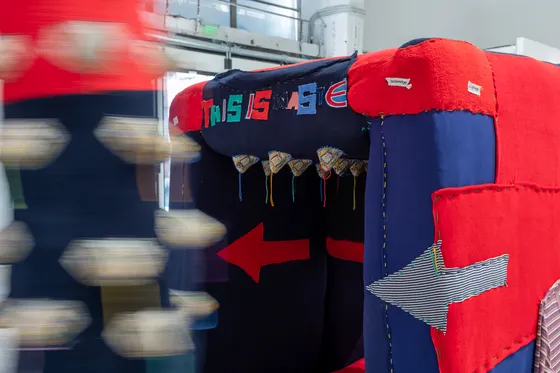
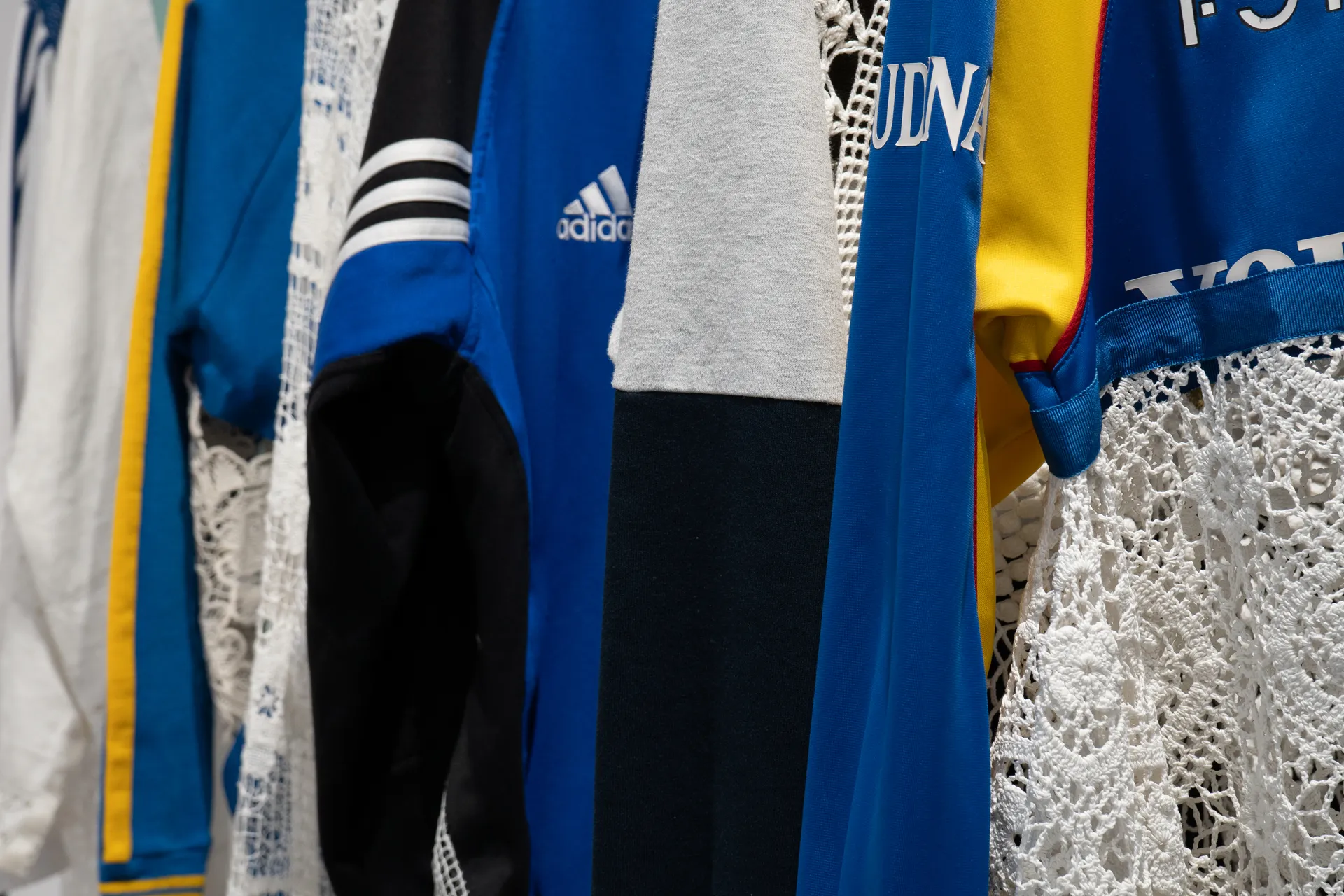
DB: I don’t merge them in the sense of layering one fabric over the other. Instead, I cut the fabrics and replace parts of the sportswear with sections of crochet or lace, creating a stark contrast. It’s a radical juxtaposition. The goal is to maintain the integrity of each element, highlighting the collision between local traditional craftsmanship and the globalised industrial production of sportswear. It’s not about blending the two; it’s about letting them confront each other in a very visible way.
What inspired you to use these crocheted pieces in combination with sportswear? What does this juxtaposition represent for you?
DB: For me, this juxtaposition symbolises the tension between the local and the global, between slow hand-made traditions and fast industrial production. These crocheted pieces, which I’ve been collecting for a few years, are deeply rooted in local traditions, but they're now seen as outdated or even worthless in the modern context. Meanwhile, sportswear represents something very global—mass-produced, industrially made fashion that’s everywhere. By placing these two elements together, I’m asking questions about how global capitalism impacts local traditions and crafts, and whether these once-valuable items still hold meaning in a world driven by fast fashion and consumerism.
Your work makes a strong statement on the devaluing of traditional crafts. Do you see this work more as clothing to be worn, or are you making an overtly political statement?
DB: There are definitely multiple layers to the project. For some, the work might just be a playful mix of materials, but for those willing to look deeper, there’s a more serious commentary. I’ve written conference papers and texts on this topic, delving into the political and cultural implications. On the surface level, my brand, Made With Time, seeks to give new value to objects that have lost their significance. It’s about rescuing and repurposing these pieces in a creative, fun way. So, I’d say it’s both a reflection on the state of modern fashion and an attempt to elevate these cultural artefacts that are at risk of being forgotten.
What about the future of these traditional crafts? Do you think Romanian lace or similar techniques will survive, or are they at risk of being lost completely?
DB: It’s hard to say. There are still communities in Romania and elsewhere that practise these techniques, but their presence is shrinking. Some brands are incorporating Romanian lace into modern designs, but the overall aesthetic has shifted. The craft will probably evolve, but whether it survives in its traditional form is uncertain. In my work, I try to preserve the original character of these textiles while giving them new life. I don’t want to transform them so drastically that they lose their identity. It’s important to me that they remain recognisable as the cultural artefacts they are.
Is each piece you create unique?
DB: Yes, each garment is one-of-a-kind. The crocheted pieces I use are all second-hand, often stained or damaged, and I restore them using natural dyes like coffee or avocado. The goal is to maintain their authenticity without completely altering their appearance. I don’t want to erase their past; I want to build on it. Some pieces can even be detached from the garments, allowing them to be preserved as they are. It’s a delicate balance between preservation and reinvention.
You mentioned earlier that the sportswear and traditional textiles don’t overlap physically in your designs. How do you handle the contrast between these two worlds—fast fashion and traditional craftsmanship—in your process?
DB: It’s about creating tension, really. I don’t want to blend the two into a harmonious whole. Instead, I make deliberate cuts in the sportswear and insert the crocheted pieces. The contrast is striking—on one side, you have this mass-produced, synthetic material, and on the other, a hand-crafted textile with deep cultural roots. I think this visual and conceptual clash makes people stop and question the value of both elements. It’s about forcing the viewer to confront the dissonance between these two worlds.
Do you think fast fashion has affected how people in Romania and elsewhere view traditional crafts like crochet or lace?
DB: Absolutely. Fast fashion has completely changed the way people consume clothing. The younger generation, in particular, is used to the idea of constantly buying new things, but they don’t necessarily value what they buy. Everything is cheap and disposable, and that’s affected the way people think about craftsmanship. I’ve noticed that even at the thrift markets, where I buy these crocheted pieces, you find more and more fast fashion brands like Zara and H&M. The perception of value has shifted, and traditional crafts are no longer seen as special or worth preserving.
Speaking of fast fashion, many people are concerned about the environmental impact of this industry. What role does sustainability play in your work?
DB: Sustainability is central to Made With Time. I refuse to use new raw materials. Everything I work with is second-hand or upcycled. I’m also trying to challenge the traditional fashion cycle—no seasonal collections, no mass production. It’s all about slow fashion, taking the time to create something meaningful from what already exists. I see my work as a radical reaction to the fast fashion system. By using what’s already out there, I’m testing whether fashion can exist in a different way.
It seems like there’s a fine line between your work being wearable fashion and being art. How do you see that balance?
DB: That’s a great question, and it’s something I think about a lot. Some of my pieces do blur the line between art and fashion, and I think that’s intentional. I want people to wear them, but I also understand that they might be seen as art objects because of the intricacy of the crochet and the boldness of the designs. That said, I design them to be worn. These aren’t meant to be displayed in a glass case—they’re meant to be out on the street, making a statement. People often tell me the pieces are too bold or too delicate to wear, but I think that’s part of the challenge—learning to embrace something different and unique.
How does Balkan Baroque reflect Timișoara’s cultural history as a meeting point between the Ottoman and Habsburg Empires?
DB: The title, Balkan Baroque, reflects that intersection of cultures. Timișoara has been shaped by both the Ottoman and Austro-Hungarian Empires, and that influence can still be felt, especially in the architecture. By combining the term ‘Balkan,’ which evokes the Ottoman influence, with ‘Baroque,’ which speaks to the European, Austro-Hungarian side, I’m acknowledging the cultural intersections that define this region. It’s a way of exploring how these histories coexist and continue to influence the present.
How do you see Balkan Baroque evolving in the future?
DB: Balkan Baroque will continue to evolve, but its core will remain the same—upcycling these traditional textiles in a way that respects their history while giving them a contemporary voice. Moving forward, I want to expand the project, but always with the focus on preserving and reinterpreting these cultural artefacts in a modern context. There’s a quirky, clashing aesthetic to the work, and I think that’s what makes it relevant and exciting.