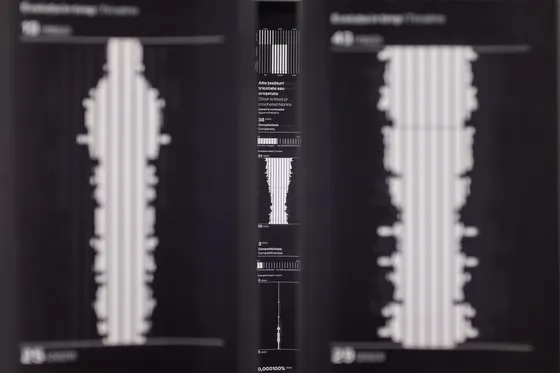
What’s Next sees fashion designer Maria Dombrov and product manager Rada Maria Gabriela explore where the Romanian textile industry is headed, by drawing on interviews with workers at Uniunea Tehnologiilor Textile (UTT)—one of Timișoara’s last remaining yarn spinning mills. In this interview, they speak about their process, what they learned from their interview subjects, and how the true value of the textile industry lies beyond simple considerations around economic productivity.
What is your relationship with UTT and how did this collaboration come about?
Rada Maria Gabriela: It started with me, because I’ve been working with UTT for almost seven years. After I graduated, someone I knew worked there and suggested I try it out, as it aligned with my field of study—fashion design. I started as a business developer and stayed on for six and a half years. During that time, Maria also had an internship there, as we studied fashion design at the same university. That’s how our collaboration began. We worked together, experimenting with various textiles and projects.
UTT is one of Europe’s last remaining producers of industrial knitting yarn. How do you think globalisation and fast fashion have affected them?
RMG: Globalisation has had a significant impact on UTT. Many customers who used to buy locally produced yarn have shifted their production to cheaper markets, often outside of Europe. The rise of fast fashion and ultra-fast fashion has made it harder for local producers to compete. UTT has had to find new markets and products to stay afloat. They’ve had to adapt by improving efficiency and sustainability, but it’s a tough landscape when global competition is so fierce.
What is UTT’s place in the local community of Timișoara?
RMG: UTT has been in Timișoara for over 25 years and is one of the last remaining spinning mills in the city. It’s unique because it’s owned by a French company, with the parent company based in northern France. However, the local workers are deeply rooted in the community. Some have worked there for over two decades. In a time when so many factories are closing, UTT has managed to adapt and stay relevant, constantly looking for ways to innovate and improve. Their willingness to embrace challenges is what keeps them motivated and allows them to continue operating in a difficult industry.
You’ve interviewed eight factory workers as part of the What’s Next project. What inspired you to focus on these personal stories?
Maria Dombrov: I was deeply inspired by the workers when I first visited the factory. It was amazing to see how passionate they are about their work. Each person has a unique relationship with the yarn and the machines they operate. We wanted to capture those individual stories because they reflect not only the technical side of textile production but also the emotional connection these workers have with their craft.
RMG: It was also interesting to see how each worker approached the same questions in different ways. For example, one worker associated the colours of the yarn with fields of flowers from his childhood. Another worker spoke about how he never imagined he could operate such complex machinery and how it opened a whole new world for him. And another recalled how his grandmother would be amazed at the speed of modern machines compared to the slow, meticulous work of handweaving. These insights made us realise how personal the relationship with yarn can be, how it transcends mere production to evoke memories, emotions, and even a sense of pride in their craftsmanship.
What role did the stories play in What’s Next?
RMG: The workers’ stories were crucial in shaping the project. Initially, we weren’t sure how to present everything, but by listening to their experiences, we realised that their voices needed to be at the centre. They provided insights, ideas, and even a vocabulary that guided the project’s development. Their enthusiasm and willingness to share their stories made it what it is.
What was the workers’ response to the project?
RMG: The workers were so excited to participate in the interviews because they wanted people to know that textiles are still being produced in Timișoara. One of the workers even mentioned the idea of starting a school for those wanting to learn how to produce textiles, so that future generations can learn this craft. I hope that this project helps highlight the importance of UTT and inspire people to take more interest in the local textile industry.
The project seems to challenge the idea that the value of the textile industry lies solely in economic efficiency. What would you say is the real value of the textile industry?
MD: The real value goes beyond just economic output. Clothing is something deeply personal—it’s something we wear every day. The emotional connection to textiles is significant. In Romania, textiles are part of our cultural heritage, something that’s been passed down through generations. There’s a deep sense of pride in the craft, and that adds value to the products we create. It’s not just about making something to sell; it’s about continuing a tradition.
What is behind the title What’s Next?
RMG: The title reflects the uncertainty that many people in the industry are feeling right now. Everyone is asking, ‘What’s next for the textile industry? What’s next for our community? What’s next for the workers?’ This title captures both the anticipation and anxiety around what the future may bring, as well as the need to think about the future, not just for UTT, but for the entire textile sector.
What do you think has allowed UTT to keep its doors open while so many other factories have closed?
RMG: Honestly, it’s the passion of the owners. UTT is part of a family business that’s been running for generations. They’re committed to keeping the textile industry alive, both in France and in Romania. They’ve made strategic investments to weather difficult times, and they care deeply about the workers and the community. That dedication is what has kept UTT going when others have had to shut down.
What do you think the future holds for UTT?
RMG: UTT is flexible and creative. Their future lies in their ability to adapt. They’re focusing on improving their machinery to reduce energy consumption and make their production processes more sustainable. For example, they are working on reducing gas usage due to rising costs and are exploring how to produce yarn more efficiently with fewer resources. These improvements help them stay competitive without sacrificing quality, even in a market that’s increasingly driven by fast fashion.
You both have international experience, having studied in places like France and China. Do you think this has altered your understanding of Timișoara’s textile sector?
RMG: Definitely. Studying abroad gave us a new perspective on what we have here in Timișoara. When I studied in China, I learned about knitwear and yarns, and it made me realise that the same kind of production was happening right at home. Coming back to Romania after studying abroad made me appreciate our local textile traditions even more. We sometimes undervalue what’s in our backyard because it seems so familiar. Studying abroad helped us see the value in keeping these traditions alive.
MD: I agree. After studying in France, I became more aware of the importance of preserving local traditions. There’s something special about having a distinct cultural identity, and it’s important not to lose that in the push towards globalisation and uniformity.
How do you balance the creative and commercial aspects of your work, especially in a project like this that has a specific cultural and social value?
RMG: It’s a challenge, for sure. Maria focuses more on the artistic side, while I handle the business and economic aspects. But what we’ve realised is that business isn’t just about numbers—it’s about people. The success of UTT comes down to the relationships between the workers, the community, and the owners. That’s what keeps everything running smoothly. It’s the human element that bridges the gap between creativity and commerce.