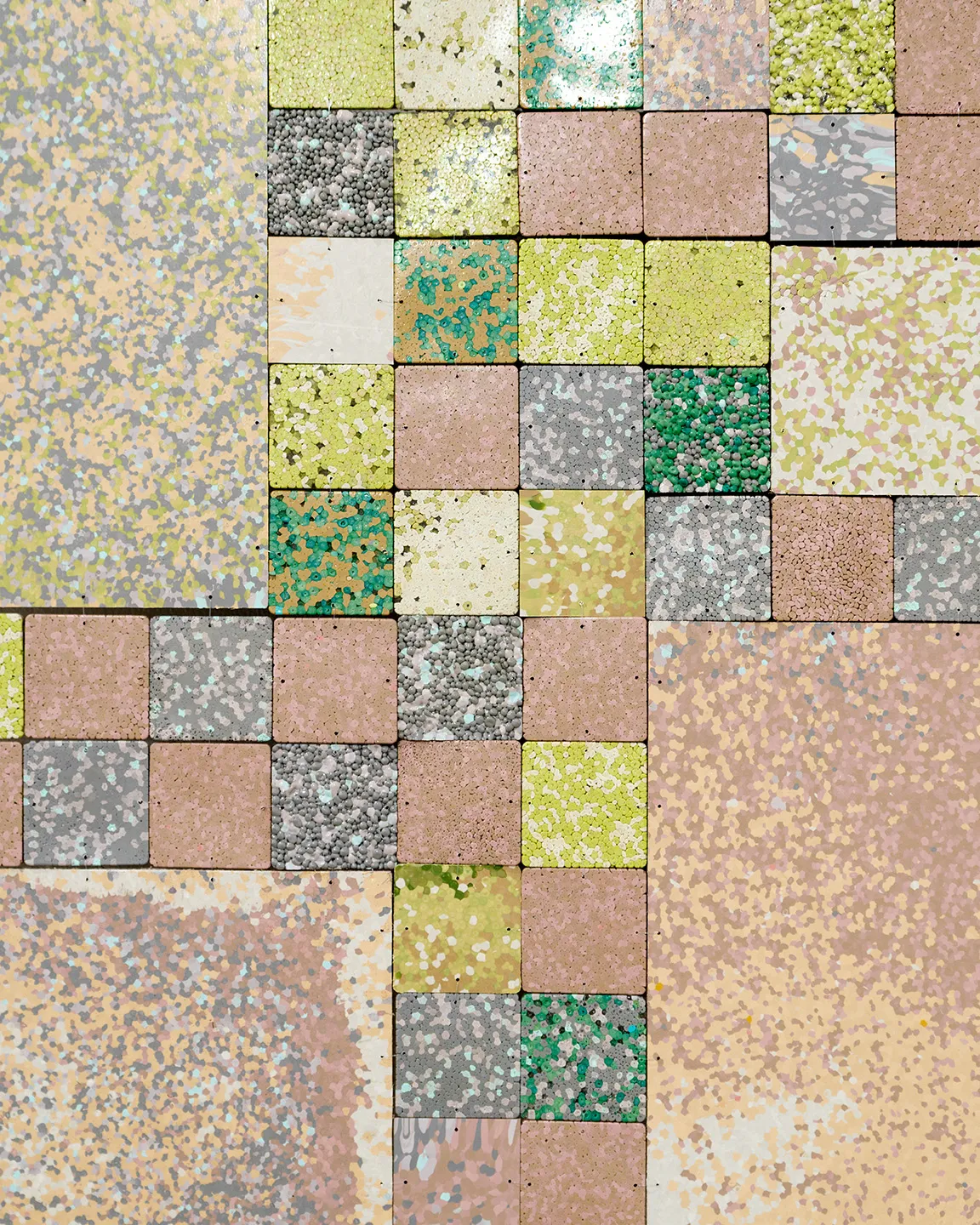
Uncommon Material: Plastic Futures in Decay is a design investigation that challenges the perceived limitations of industrial surplus. The project centers on a specific starch-based granulate—a compostable biomaterial used by the Romanian producer Promateris for shopping bags and films. During production, offcuts and quality-control rejects are reprocessed, but some batches, marked by uncommon colours and a distinct starch scent, are deemed unsuitable for the market.
Designer Andreea Tron brought her signature blend of craft, technology, and regenerative design to the project, in collaboration with Promateris R&D Lead Andreea Șachelaru. She explores these very qualities as a starting point for new aesthetic and functional possibilities. Through a process that bridges handcraft, industrial thermoforming, and exploratory 3D printing, the project translates this "waste" material into a series of surfaces—a tile-like floor, a laced pergola, and a translucent curtain—asking us to reconsider beauty, utility, and the very lifespan of the materials we use.
Nadine Botha: Andreea Tron, the concept of Uncommon Material is about finding beauty and utility in industrial surplus. What was the pivotal moment that sparked your connection with Promateris and led to this collaboration?
Andreea Tron: I first visited the factory with the FABER team, and we met with the CEO and with Andreea. Through our conversations, we discovered they had this surplus material, which is both recycled and biodegradable. For me as a designer, this sparked immediate interest, of course, precisely because it’s also a difficult material to work with. Its recycled nature means the properties are not as consistent as virgin material. But that difficulty was the attraction. That was the starting point.
NB: Andreea Șachelaru, from your side at Promateris, how did you feel when first approached about a collaboration that would take your work from an industrial setting into the realms of art and academia?
Andreea Șachelaru: I was really happy to hear the proposal. I think it’s really needed to collaborate with other fields and to find new applications for a material that you’d think doesn’t have any application anymore, or has only a single one. To be honest, I thought it was very ambitious. Our recycled material comes from bags and films, and in theory, it would be very hard to transform it into something else unless you modify it chemically. So I thought, "Wow, that’s really ambitious, but let’s give it a try." I was happy they were willing to work with it, but also a little suspicious that it might not work.
NB: Andreea Tron, what was the biggest challenge or surprise in working with these distinct circular materials compared to more conventional ones?
AT: I'm used to working with unconventional materials and leftovers, but I had never worked with real industrial surplus. This was completely new. I also hadn’t worked with bioplastic granules before. The most interesting part was receiving this raw material with ambitious but naive plans. I thought, "I want to make filament for 3D printing, I want to make tiles, maybe do some handcraft." It was the process of finding the right people to help me—connecting with specialists who could actually make this happen—that was so revealing. The material was challenging, and I was naive about it, but I think that helped. For me as a designer, it's very important to have challenges. This project was a lot about making impossible things happen.
NB: To what extent was the final work a fulfillment of those ambitious plans, and to what extent did you have to compromise?
AT: To be fair, I didn’t compromise so much on the vision, but a bit on the final designs. The development phase—transforming the material—took longer and was more challenging than expected. But I did manage to create a 3D printing filament and print with it, which was a significant challenge. The results are still a work in progress, open to further development. I also made tiles. What’s missing now is the technical testing to see how they could be used functionally. For now, they are beautiful surfaces that demonstrate a transformation, but the next step would be to validate their functionality.
NB: Andreea Șachelaru, how could this work influence Promateris's approach, not just environmentally, but in terms of seeing new potential for your products?
AȘ: It came as a really nice, fresh perspective. We are very focused on shopping bags and films, so we haven’t looked a lot into different applications, which would require investment in R&D and new equipment. This feels like a beginning point to put more attention on what else we can do with what we have. I would be very happy to continue, to test the materials with our possibilities and see where we can go technically. It’s something needed for us to grow as a company, but also from a sustainable point of view, to put more applications to the product.
NB: Andreea Tron, the project employs a fascinating range of techniques, from traditional crochet to industrial thermoforming and high-tech 3D printing. Why did you choose to test the material across such a broad spectrum?
AT: It was a long process of thinking about what to do with a material that is a replacement for plastic but is designed to biodegrade. How do you design an object that isn’t meant to last forever? My idea was to test it in three different ways to see its potential: handcraft, which is my base as a designer; established industrial processes like thermoforming; and more experimental, technological processes like 3D printing. It was a big exploration. Now we can see where the most potential lies for a functional application.
NB: A key part of the installation is the sensory experience—the smell of starch, the softness of the 3D-printed objects. How important was it to engage with these material qualities that are often seen as flaws?
AT: For me, these qualities are beautiful. The smell is a popcorn-like starch scent. When you heat the material, it comes out. I understand clients might be bothered, but I think we need to change this perspective; natural materials have their own smell. In terms of touch, the material is amazing—super soft and flexible. The 3D-printed objects resemble textiles, which was my goal, and the tiles are warm, unlike traditional plastics. I wanted to highlight these qualities, to express the potential of this material beyond its commercial constraints.
NB: Finally, looking to the future, to what extent do you see this work expanding into the real world? Andreea Tron, do you think there will be a time when clients are no longer freaked out by bioplastics?
AT: From my perspective, a personal challenge was to take this material out of the plastic universe—to not see it just as a replacement. But all the processes I used, like injection molding and 3D printing, are based on a plastic infrastructure. I didn’t manage to find a way to use it completely outside of that. I think that’s a bigger project, about what new infrastructure is needed. My role is to show the potential, to make people visiting an exhibition wonder, "Oh, this is a possibility." We need to work on it, but the material is there.
AȘ: I definitely think bioplastics are a viable alternative for many applications. The battle is often with policymakers to see the potential on a bigger scale. It’s difficult to invest without a larger push. But it makes sense in many fields, like agriculture or gardening, where you need biodegradable alternatives that don’t leave toxic residues or microplastics. The tiles, for example, could be an opportunity there, replacing plastic options. It’s very interesting to continue exploring this, combined with design creativity and a shift in perspective.