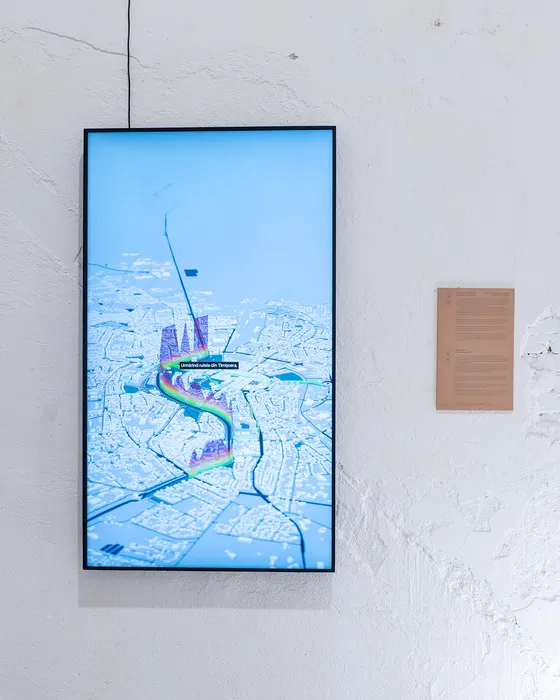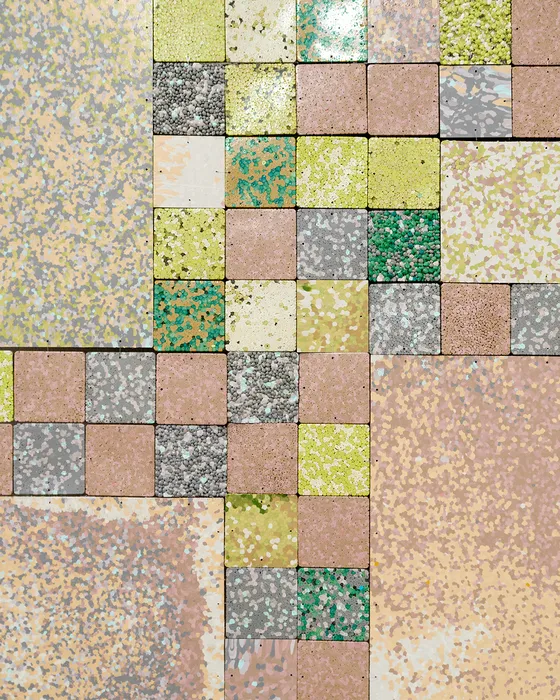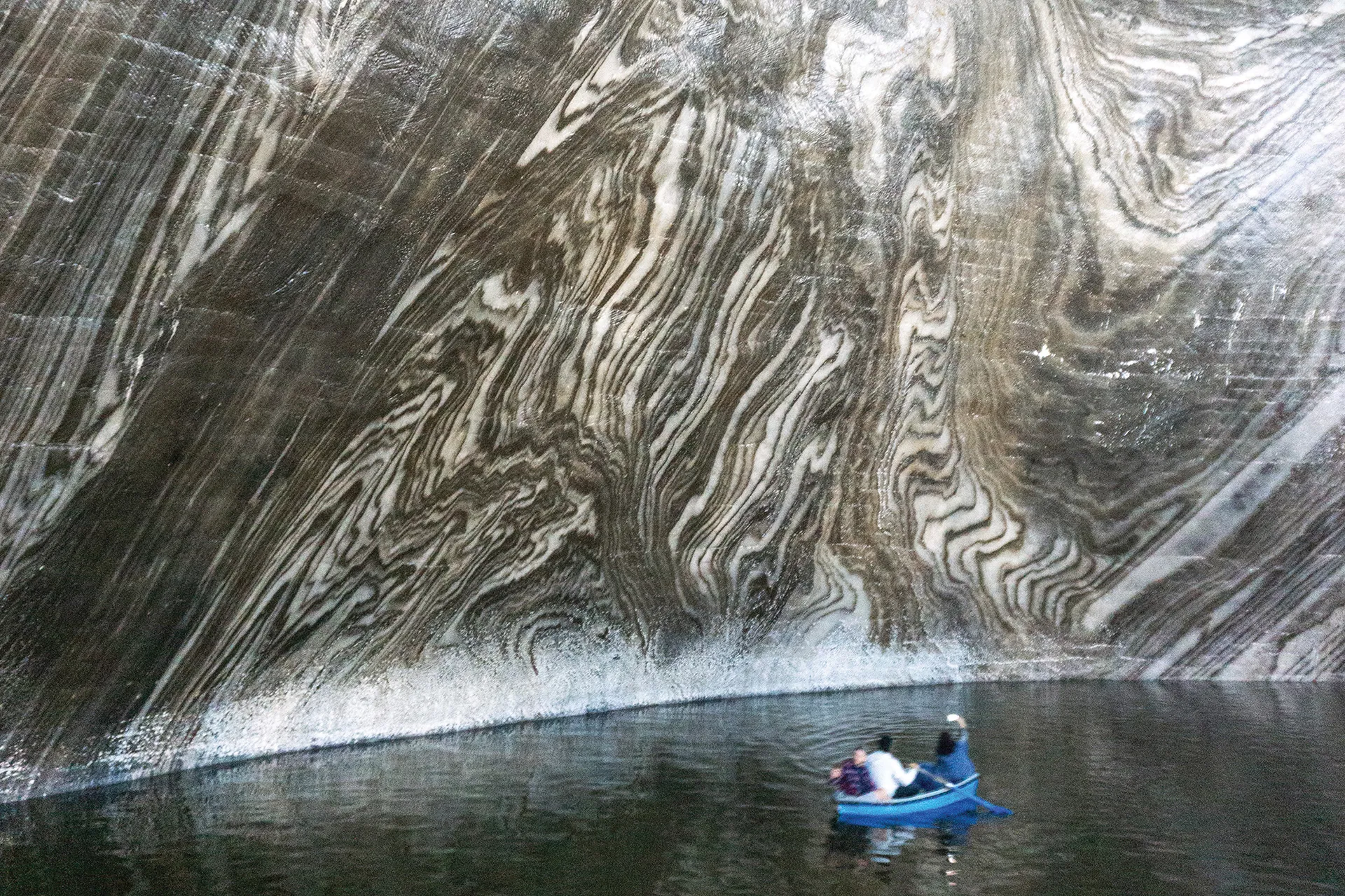
Salt in Motion: The Body’s Ionic Exchange sees Rotterdam-based designer and researcher Gaia D’Arrigo explore the profound yet overlooked significance of salt, drawing on field work in Transylvanian mines and collaborations with ethno-archaeologists and industrial partners. Through her practice of investigating how production systems and culture manifest in the material world, D’Arrigo examines salt through the critical lenses of toxicity and contamination. In this interview, she speaks about her multidisciplinary process—which blends situated research with fact-fictional storytelling—and how ancient myths and modern chemistry inform her work.
Her interactive installation is the culmination of this research for the 2025 edition of FABER’s Design Signals program. The work transforms a medical halogenerator into a central artistic element, using transparent tubing to connect it to a salt-block mask. Activated by a viewer’s proximity, the system releases aerosolized salt particles, creating a visceral experience that bridges traditional healing practices—from salt spring soaking to speleotherapy—with the material’s modern industrial grades and commodified forms. Nadine Botha spoke to her as well as her collaborator, ethno-archeologist Marius Alexianu, on why this essential mineral offers a critical lens for understanding our relationship to the environment, the body, and the hidden socio-environmental narratives that shape our world.
Nadine Botha: It’s great to chat to you about your installation, Gaia. Your practice repeatedly returns to salt as a medium. What is it about this material that holds such a persistent fascination for you?
Gaia D’Arrigo: Salt represents balance. In different projects, I’ve encountered it as both a beneficial agent and a toxic one, depending on the context. I'm drawn to its hygroscopic nature—its chemical capacity to absorb humidity—which contributes to its perception as a kind of ‘magic’ material, beneficial for both the environment and the human body. This project continues that core investigation: analyzing salt’s chemical processes alongside the cultural imaginaries it creates. I’m interested in this balance; in excess, it’s extremely toxic, but in the right quantity, whether in the body, soil, or air, it reacts with other materials and becomes extremely beneficial. This duality is my starting point.
NB: Your work masterfully layers the biological, chemical, industrial, and mythical. How do you approach building these narratives so they expand rather than flatten into a single story?
GD: I always try to find a hook—an image people can relate to and access. For instance, with a previous project on pollution in Milan, I started by looking at the urban context, its history, and the politics, then zoomed into the material itself. Both pollution and salt are often invisible materials, found in particles. I look at their chemical characteristics, how they exist in the environment, and how the body relates to them, creating a hybrid narrative that connects these three aspects. I often use a literal embodiment of this relation. What does it mean to embody an environment, especially when it's toxic? This project follows a similar method: a specific environment (Romania’s salt landscapes), a material that reacts with both the environment and the body, and the cultural traditions of its use.
NB: Mythology and alchemy seem to be powerful lenses in your work. What is it about these frameworks that helps you explain complex phenomena?
GD: I love that mythology allows for different layers of meaning to coexist simultaneously. The importance isn't related to what is strictly true or false. In a complex narrative, this allows me to create layers of meaning so an audience can relate to or capture some of them—or all. Mythology has always been a way to explain phenomena. And with alchemy, my big love is that it used scientific, spiritual, and psychological domains all at once. What fascinates me is that these three aspects could coexist in what was considered a science. Contemporary chemistry has less emphasis on its symbolic value; it’s categorized. I hope my practice can create bridges between these disciplines.
NB: The installation invites a visceral, bodily experience with salt in all its states: solid rock, liquid brine, and aerosol particles. What do you want the audience to feel or question in this space?
GD: I feel there is something about experiencing a material in your own skin, in your own body, that is a powerful tool for connection. The installation features a halo generator—a machine used in modern halotherapy that grinds pharmaceutical-grade salt into particles for inhalation, simulating the effect of a day at the beach or in a salt mine. This connects to a mask, allowing people to inhale the particles. Alongside this is a large tank with a crystallizing brine solution, reconstructing those historical vessels. I want to highlight the value and narrative of this material, which is so present yet so given for granted. We see it every day but don’t recognize its profound importance in our lives, from food preservation to industrial processes.
NB: You engaged with industry partners, from state-owned salt mines (Salrom) to chemical distributors. What did you learn about the industry's structure and the "invisibility" of salt within it?
GD: Tracing the full chain was essential. We started with the raw material and followed it through extraction, retail, and industrial use. It was impressive to see how many industries use it: water treatment, food, disinfectants, de-icing, medical, and wellness. But in each step of the way, we gained something and lost something. At the mine, there is knowledge of the history, the geology, the site, and the invisible labor. When it gets to a stockist or retailer, it stops being a mineral from an underground cave and becomes chlorine or a chemical among other chemicals. It loses its history and relation to the site. The invisibility is also due to the material’s reactivity—it transmutes and changes form. I was even looking at research on where salt aerosols go when they evaporate in the air.
NB: Norbert Petrovici’s research, which underpins this exhibition, talks about "residual knowledge" in Romania's chemical industry—expertise that is overlooked or stuck after the fragmentation of the socialist-era integrated system. Did you encounter this in your research?
GD: I saw it in the way knowledge becomes segregated. There is a disconnection between the historical, geological knowledge held at the extraction site and the purely chemical, application-based knowledge at the end of the chain. The value of the material is in its commodification, but the process of commodification itself hides the journey. In the past, the practices surrounding salt were an open, explicit system to the people and community using it. Now, it’s a very hidden process. We don’t know where it comes from. In both cases, it’s a commodity, but once, you were at the center of the process. My project is about highlighting that value and making that hidden journey visible again, reconnecting the residue of knowledge with the material itself.
NB: This project is deeply rooted in Romanian salt landscapes and healing practices. How did your engagement with the place, and specifically with ethno-archaeologist Marius Alexianu shape the work?
GD: Meeting Marius was pivotal. I’ve never met someone so passionate about salt. His work is a very holistic, interdisciplinary, and warm approach to archaeology. He creates mapping systems to see how populations developed around natural salt sources, which roads emerged, and how societies were built. He joined me in Transylvania, showing me salt lakes with fragments of vessels from the Bronze Age still used for therapeutic soaking. His research is about not looking at a material as an isolated agent, but according to where it’s situated and who interacts with it. He narrates a story. This rounded, situated research was a huge influence. The installation explicitly reconstructs the tage—ceramic pots used historically to collect brine—based directly on his work.
NB: Thanks for speaking to us, Marius. Your work has fundamentally shaped a new field: the anthropology of salt. Can you describe what this discipline encompasses and how it came to be?
Marius Alexianu: The anthropology of salt does not deal solely with archaeology; it encompasses all disciplines whose object of study is salt. I attempted to structure these disciplines according to types of human behavior toward salt, defining cognitive, spiritual, pragmatic, social, and societal behaviors. This laid the foundation for a new, complex approach that studies not only the physical and spiritual aspects but proposes a coherent framework for addressing all these behavioral responses. This is why it is an emerging discipline. While most participants in our congresses come from the humanities, the aim is to incorporate scientific evidence from materials science and other fields. It is a holistic picture.
NB: Your journey began with ethno-archaeology. What first drew you to focus specifically on salt springs?
MA: It was a very personal discovery. In the 1980s, an English and Romanian ethno-archaeologist named John Andrish had an idea: where there are sheepfolds today, there must also have been seasonal human settlements in prehistory. I was impressed, but I noticed on our journeys that the sheepfolds were consistently located next to salty springs. I thought, "This is the key element." The springs attract animals, and where there is a concentration of animals, people also come—to hunt or to raise them. Domestic animals, as is well known, require salt. I began systematic research and in 1992, published my first article on salt water springs in Moldova. This was the genesis of everything.
NB: Your fieldwork uncovered specific historical practices for obtaining salt. What can you tell us about the process and its significance?
MA: We documented the obtaining of recrystallized salt, which in Romanian is called pușcă. There are two main strategies. The first, less common, involves going to a spring with a large metal cauldron, boiling the brine there for a day, and taking the crystallized salt home. The second, easier method was to transport large quantities of brine in barrels back home to process there. Why did they do this? For their own use, for therapeutic purposes, and crucially, for trade. During severe droughts in mountainous areas where cereal agriculture was impossible, people would travel up to 300 kilometers to exchange this salt for grain. It was an essential economic and survival tool.
NB: Beyond its economic role, what spiritual or cultural significance did you uncover?
MA: Salt most often has positive connotations. There is a custom, which also exists in Sicily, of placing rock salt at the base of a window in a room with a newborn. Why? To keep the devil away, because the devil does not like salt. As an American colleague told me when I presented this at UCLA, he smiled and said, "Yes, the devil likes sweets." We also documented various systems for protecting the purity of the springs, from hollowed tree trunks (buduroi)—a system dating back to the Neolithic and still used in India today—to wooden beam structures and small protective houses of Saxon origin in Transylvania. These practices show a deep cultural reverence for the source itself.
NB: Your collaboration with designer Gaia D’Arrigo bridges your academic research with contemporary design. What is the value of translating this ethno-archaeological knowledge into a sensory, artistic installation?
MA: The value is in making the invisible visible again. My research shows that salt was never just a commodity; it was the center of a process that connected people to the landscape, to their health, and to each other through trade and ritual. The modern industrial process severs that connection, hiding the journey and the labor. Gaia’s work, in reconstructing the vessels (tage) and representing salt in its three states, re-centers that narrative. It asks the audience to physically experience what it means to interact with this material—to inhale it, to see it crystallize—and in doing so, it rebuilds the lost connection between the body, the material, and its source. It is a powerful, necessary translation.