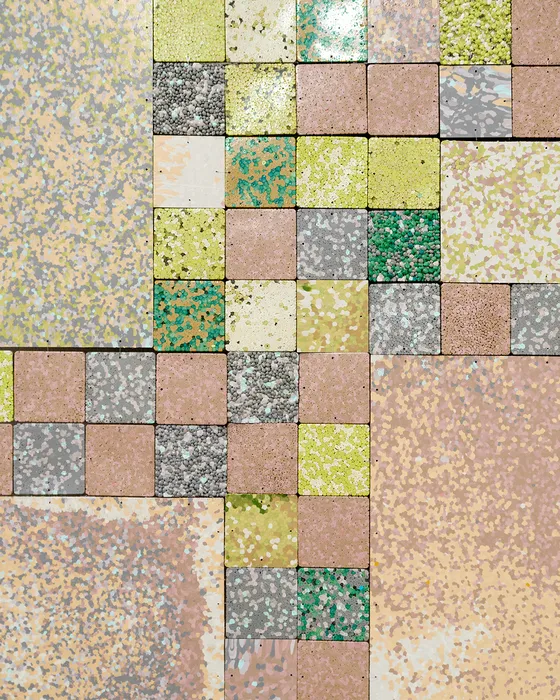
Le Sere (The Evenings) sees material designer Benedetta Pompili explore the latent potential of Romania's industrial landscape. Working with byproducts from copper mining, stone cutting, and steel galvanization, Pompili assembles a family of side tables and benches that serve as deep material portraits of place. In this interview, she speaks about her process of crafting a revelatory glaze from industrial dust—a material alchemy that acts as a chemical "pH strip" to uncover the hidden compositions and unresolved consequences of the region's chemical industry. She reveals how her work, which incorporates collaboratively woven copper baskets from local Roma artisans, is a practice of care-taking, transforming toxic residues and fragmented knowledge into objects of resilience, beauty, and traceable narratives.
Nadine Botha: Your practice is deeply rooted in the properties and politics of materials, especially clays and glazes. How did this approach first emerge for you?
Benedetta Pompili: It began during my time at the Design Academy Eindhoven. I had a background in ceramics, but it was a collaboration with a ceramicist who was also an archaeologist that changed my perspective. He taught me to see the material not just on a macro level, but to go down to its microstructure. For my graduation project, I combined this technical knowledge with an architectural situation, specifically the issue of asbestos. I wasn't interested in endangering myself, but in understanding the mining consequences of making. What fascinates me about ceramics is the direct contact with raw, unprocessed materials. You acquire these raw ingredients and craft a body or a surface, which immediately brings you to their sources and the processes they’ve undergone. This led me to collaborate with a company that treats asbestos cement, using their byproduct to lower the amount of virgin clay I needed, thereby reducing the amount of mined material.
NB: You’ve worked with wild clays, residuals, ashes, and industrial waste. What have you learned about toxicity, craft, and care through that work?
BP: I’ve learned that working with secondary materials is a way to dive deep into the process itself. Purity makes things easy for industry, but reality is different. These materials come with so many unexpected elements and impurities; they force you to understand the entire chain. In Japan, I worked with hama, the single-use porcelain dishes used to prevent cracking during firing. That project was about working within a large-scale production system and proposing a redesign where the waste element could be reused as part of the final object. It was a precise, communal way of thinking about waste. But the amounts we work with in ceramics are small—a few hundred kilos a year. We can’t solve the landfill problem, but we can propose new narratives and applications that industries might adopt.
NB: Your project CHIMICA for Bright Cityscapes is assembled from industrial byproducts across Romania. What are these materials and what stories do they tell?
BP: The selection was a collaboration with the FABER team, based on availability and their chemical content, which ties back to the theme of Romania's chemical industry. We worked with several key partners:
- Vinmar: A governmental company that provided an earthy material containing 20% copper, a crucial element for both Romania's industrial history and a traditional component in ceramics.
- A galvanization factory: They provided waste byproducts from steel galvanization baths, rich in iron oxide and zinc oxide—again, classic ceramic materials that the factory considers an issue.
- CMC Bio: Stonecutters who generate a mud waste from cutting local marble and granite. This silica-rich material is a perfect base for glazes and exists in massive quantities, piled meters deep in their factory.
The fascinating part is that these materials come from precision industrial processes and are already in a perfect, dust-like form for immediate reuse. I don’t need to invest extra energy, water, or electricity to process them; I can recoup and test them right away.
NB: The glaze in CHIMICA plays a crucial symbolic role, not just a technical one. How does it work, and what does it reveal?
BP: The glaze is the protagonist. It’s what brings every industry I’m collaborating with together. These companies are often reluctant to share the precise chemical analysis of their byproducts; they protect their knowledge, their secrets. But the kiln doesn’t lie. My role is to use my knowledge to act almost like a pH strip or a camera. I put these blended materials into the kiln, and the firing process reveals what is there. For example, zinc from the galvanization process will hyper-saturate blues if copper is present. These chemical relationships thrive with each other and show each other. The glaze doesn’t cover; it reveals the truth of the material—its composition, its history, its hidden value. It makes the invisible, visible.
NB: This resonates strongly with Norbert Petrovici’s research for this exhibition, which identifies “residual knowledge” and fragmented innovation as a key blockage in Romania’s chemical sector. Do you see your work relating to this?
BP: Absolutely. The closedness, the lack of shared knowledge—I experience it directly when I can’t get analyses from the companies. But the materials carry that knowledge chemically. When I take a piece out of the kiln, it’s like archaeology. I find myself with an object and I start to deduce: Why does it look like this? What process did it go through? These inorganic traces are invaluable. If you can read them, it’s a form of knowledge that can be shared and grown by others; it’s not completely idiosyncratic. My work is about tapping into that residual knowledge stored in the material itself and creating a common process for understanding it.
NB: How do you regard waste and byproducts more generally in your practice? What is design’s role in relating to it?
BP: My reasons are multifaceted—political, cultural, and financial. Sourcing secondary materials is often free, which allows me more freedom to research. But more deeply, I find it a way to enter processes and understand what remains of them. For me, ‘waste’ is the wrong term; I prefer ‘secondary material’ because it implies it still holds economic, creative, and cultural value. I’ve chosen to work at the end of the industrial line instead of the beginning to better understand the process and bring my part into it.
I don’t see myself as a designer who streamlines production for efficiency and purity—that assumes the public always wants the same outcome. I am happier in this role: discovering, changing opinions about these materials, and showing their beauty and the narratives they carry. They have a more human part to them. I think our role is to be more human in the way we look at objects and the systems that produce them.