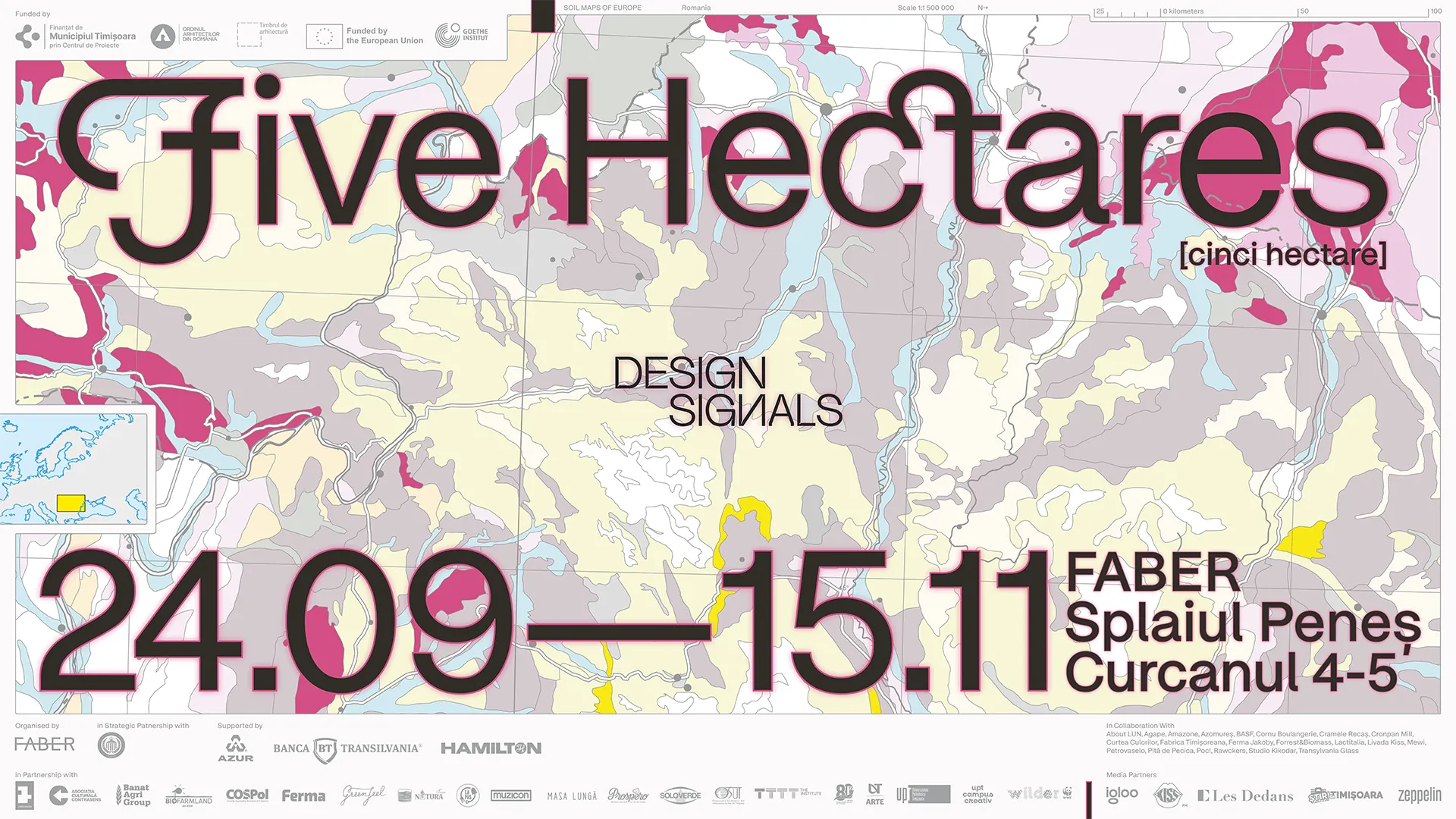
An exhibition exploring Romania's agri-food industry through the technologies, infrastructures and forms of knowledge that connect soil to food.
Design Signals presents Five Hectares, an exhibition exploring Romania's agri-food industry through the technologies, infrastructures and forms of knowledge that connect soil to food. Opening at FABER in Timișoara on 24 September, the exhibition combines a data-led visualisation of original research by sociologist Norbert Petrovici, three thematic investigations into digital agriculture, water and fertilisers, and newly commissioned design research developed on site in Timișoara and the wider Banat region.
"Food can appear completely separate from the land, labour and technologies that produced it," says curator Martina Muzi. "The exhibition works through specific crops, tools and practices to reconstruct these relationships. Each project provides an entry into a much larger system, beginning with the knowledge and conditions we encountered in Banat."
The Title
The title refers to a defining threshold in Romanian agriculture. According to the 2023 Farm Structure Survey, 90% of the country's 2.82 million agricultural holdings occupy less than five hectares, yet together they cultivate only 22.9% of its agricultural land. Farms of 50 hectares or more represent just 1% of holdings but cultivate 53.1% of the land.
"Five hectares is a way of entering a much larger system through a concrete measure," Muzi explains. "It allows us to look closely at how land, technology, infrastructure and knowledge are distributed, and at how decisions made far beyond the farm become present in a particular field. Design can help us trace these relationships from Timișoara, bringing different forms of expertise into contact and making the structure of the agri-food system easier to see."
The Research
The exhibition draws on original research led by sociologist Norbert Petrovici into the structure of Romanian agriculture, including the concentration of land, the international formation of cereal prices and the unequal distribution of financial and environmental risk. His research follows the path of cereals from the farm to processing facilities, storage networks, commodity traders and international financial markets.
A data-led visualisation traces the architecture of the agricultural economy, following the movement of crops, prices and risk between farmers, processors, storage and logistics networks, commodity traders and international financial markets. It shows how the price of Romanian cereals is largely established elsewhere, while much of the resulting uncertainty is absorbed by farmers and their households.
Three Thematic Investigations
Three thematic investigations bring parts of this system into closer view.
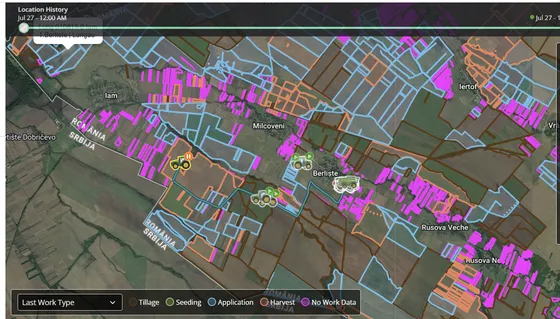
Ground examines the expanding role of data in agriculture. Sensors embedded in fields and machinery record soil conditions, seed distribution, weather and the progress of agricultural operations. Farm-management platforms assemble these measurements into digital models through which production can be monitored and automated. The exhibition considers how these systems alter agricultural labour, who can access them and where the information they generate travels.
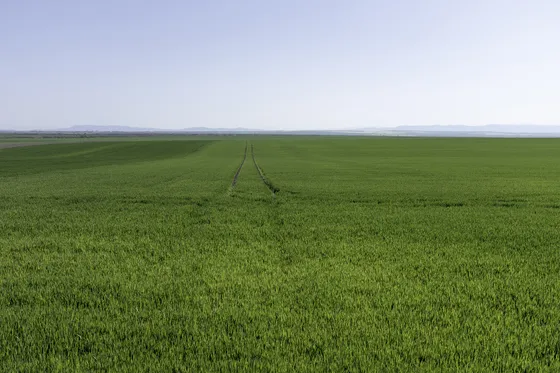
Water provides a second route through the changing agricultural landscape. Irrigation infrastructure and increasingly unstable rainfall influence which crops remain viable in the region. The exhibition follows a spectrum of growing conditions, from open fields exposed to drought to greenhouses in which water, temperature, humidity and insects are carefully regulated. These controlled environments can sustain production while creating new dependencies on imported technologies, plants and expertise.
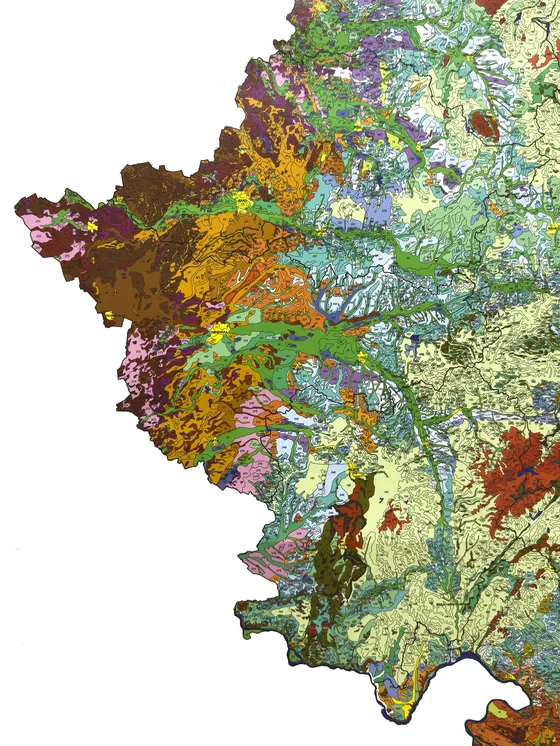
Gas considers soil fertility and the industrial role of fertilisers. Banat's productive black soils have supported large-scale cereal cultivation for centuries, but soil is neither uniform nor inexhaustible. Its composition can change within a single field and is affected by intensive cultivation, water availability and chemical inputs. The exhibition approaches soil as a living material while examining the global industries developed to measure and maintain its productivity.
The Designers
Six international designers and collectives were selected through an open call to develop research-based projects through residencies, fieldwork and collaborations with local partners.
Alina Turdean is developing a project combining a workshop and dining experience to explore food sovereignty, agricultural traditions and economic structures in Banat. She is collaborating with Noemi Hugel in Armeniș, who is connecting her with farmers from their cooperative to collect recipes and develop a menu for the final dining event. The project unfolds in three phases: collecting stories and recipes from small-scale farmers; developing unconventional eating utensils through material experimentation using clay, flour, hay and grain; and hosting an interactive food experience.
Studio Noff is investigating plum cultivation in Banat, approaching grafting as a form of craft that preserves local varieties while enabling commercial production. Working with locally sourced plum wood and in dialogue with local practitioners, the project translates agricultural knowledge into object-making.
Bruno Baietto is investigating two bread producers in Timișoara—Pită de Pecica and Prospero. The project asks each bakery to produce a bread that explores the limits of its production system, then uses these breads as temporary moulds for ceramic and glass objects, treating a loaf of bread as a material record of the infrastructures involved in producing it.
Studio Eidola is exploring soil acidity by casting agricultural lime in direct contact with different soils. Variations in grain, moisture, mineral content and porosity leave their traces on the cast elements, recording chemical relationships that usually remain invisible across agricultural fields.
IAY — Alexandra Lăcătușu, Ioana Man & Jingyuan Meng are working with agricultural sidestreams to create a lime-cellulose-ash composite. Placed in the way of water, these artefacts cultivate moss and other strata of life while registering the conditions around them—functioning as instruments for monitoring biodiversity over time.
Roberta Di Cosmo is following the journey of cheese from pasture to city, comparing industrial production with smaller pastoral producers. The project asks what changes when cheese moves from a local system to an industrial one, tracing the people, tools, gestures and relationships involved at each step.
The Exhibition
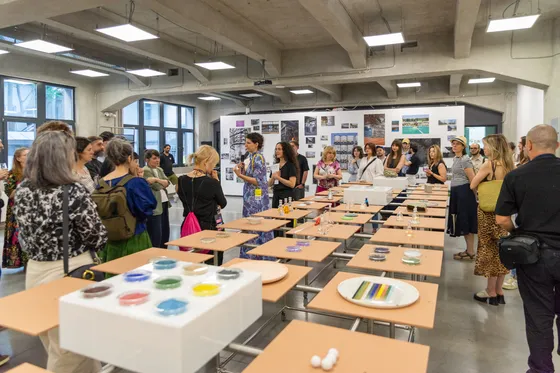
The exhibition is organised spatially as a market. Agricultural products appear alongside data, tools and records of their movement, bringing different parts of the supply chain into one setting. Monitoring devices and other technologies associated with agricultural control connect the exhibition to sites beyond FABER. Its graphic and spatial language draws on the measurement, repetition and standardisation that organise contemporary farming.
A Kitchen Programme extends the exhibition, where agricultural products continue their transformation into food. Workshops, meals and events will engage with local practices including fermentation, pickling and preservation. Participating designers will also extend aspects of their projects into the kitchen, connecting industrial production to taste, digestion and the body.
"The kitchen allows us to follow the supply chain beyond production," Muzi explains. "It creates a space where technical and economic questions can be encountered through processes people already know: preparing, preserving, sharing and eating food."
About Design Signals
Developed by FABER and curated by Martina Muzi, Design Signals is an annual research and design programme that takes Timișoara as a lens through which to examine wider economic, industrial and political transformations. Each edition begins with original research led by sociologist Norbert Petrovici, followed by fieldwork, site visits and conversations with people working across the sector under investigation. Local and international designers selected through an open call then develop projects in collaboration with local researchers, producers and institutions.
The programme uses design to make complex systems more legible, amplify existing expertise and forms of everyday design, and create relationships between people and organisations that rarely work together. Its first three editions investigated the automotive industry in 2023, textiles in 2024 and the chemical industry in 2025.
Visitor information
Exhibition: Five Hectares
Venue: FABER, Timișoara
Opening: 24 September 2026
On view: 24 September — 15 November 2026
Admission: Free
Website: faber.ro