Five Hectares: A Measure of Agriculture
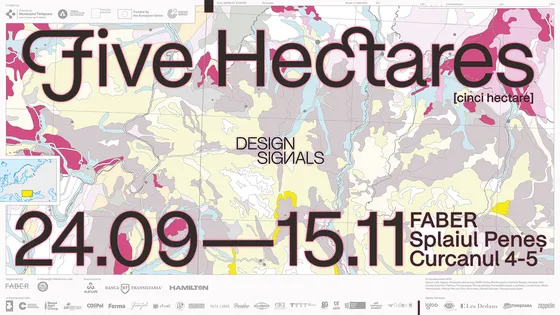
Design Signals returns for its fourth edition with Five Hectares, a research and exhibition programme examining Romania's agri-food industry through the structures that connect farming to finance, technology, infrastructure and international markets.
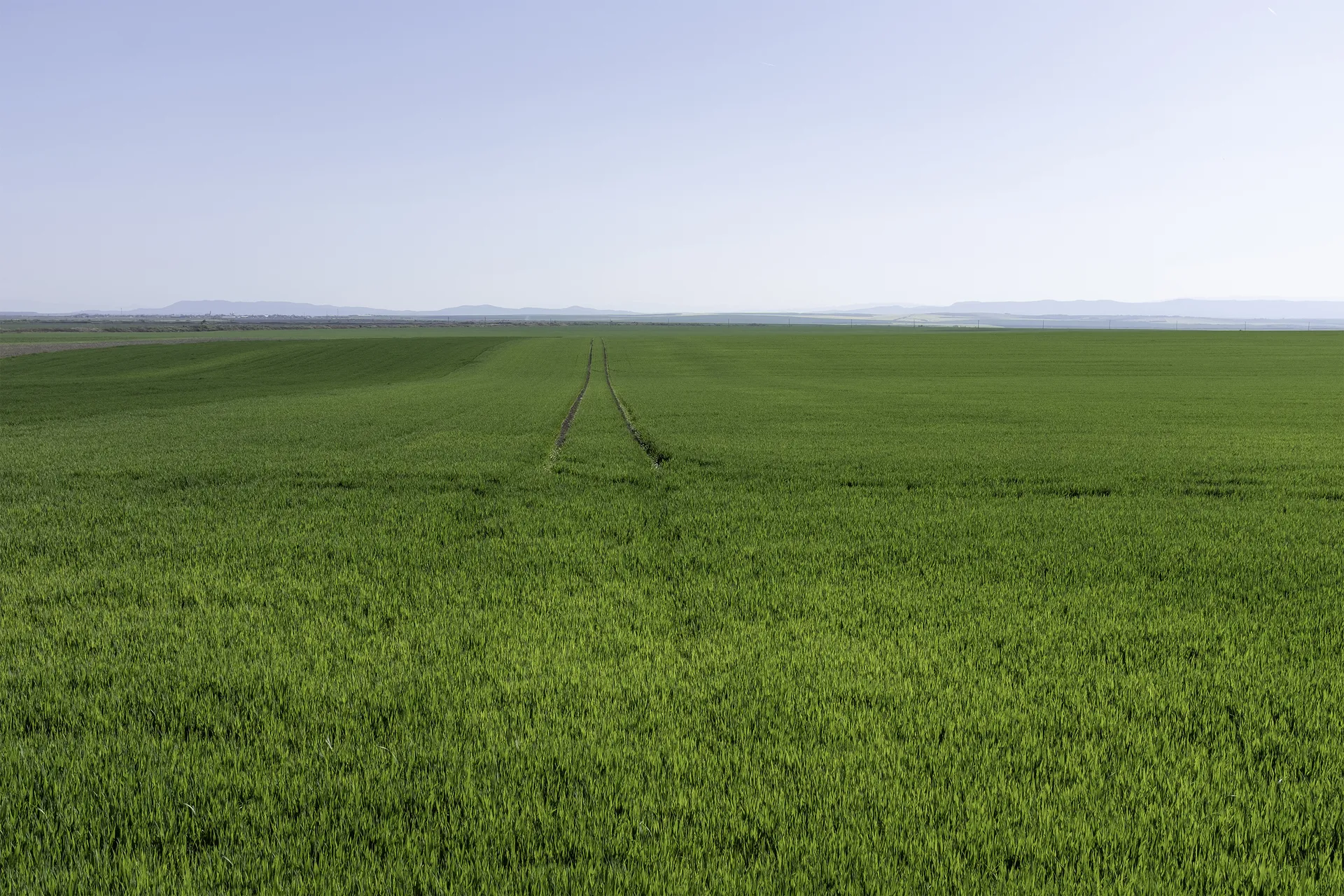
The title refers to a defining threshold in Romanian agriculture. According to the 2023 Farm Structure Survey, 90% of the country's 2.82 million agricultural holdings occupy less than five hectares, yet together they cultivate only 22.9% of its agricultural land. Farms of 50 hectares or more represent just 1% of holdings but cultivate 53.1% of the land. Five Hectares begins with this highly polarised landscape and asks how differences in scale affect access to machinery, data, finance, storage and markets.
"Five hectares is a way of entering a much larger system through a concrete measure," says curator Martina Muzi. "It allows us to look closely at how land, technology, infrastructure and knowledge are distributed, and at how decisions made far beyond the farm become present in a particular field. Design can help us trace these relationships from Timișoara, bringing different forms of expertise into contact and making the structure of the agri-food system easier to see."
The Architecture of Agriculture
The programme draws on new research led by sociologist Norbert Petrovici into the organisation of Romania's agricultural economy. His research follows the path of cereals from the farm to processing facilities, storage networks, commodity traders and international financial markets. It reveals a system in which the price of Romanian grain is largely established elsewhere, through global benchmarks and trading networks, while much of the resulting uncertainty is absorbed by farmers.
Producers commit to seeds, fertiliser, fuel and other inputs months before a crop can be harvested. During that time, they remain exposed to weather, exchange rates and changing market conditions. Access to infrastructure determines how this uncertainty can be managed. Farmers without sufficient storage may have little choice but to sell immediately after harvest, when supply is high, while those with silo capacity can hold crops back and choose when to enter the market. Petrovici describes this arrangement as one of externalised price formation and internalised risk: value is determined elsewhere, while uncertainty accumulates at the level of the farm and household.
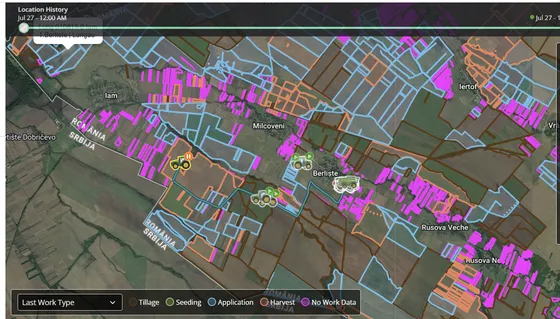
The research also looks at the expanding role of digital agriculture. Machinery telemetry, satellite mapping, precision farming platforms and subsidy systems increasingly mediate decisions about how land is cultivated and how farms participate in the market. These technologies can improve efficiency and provide farmers with new forms of information, while also introducing dependencies on proprietary equipment, software, data standards and dealer networks.
Ground, Water, Gas
Three thematic investigations bring parts of this system into closer view. Ground examines the expanding role of data in agriculture—sensors, machinery telemetry, precision farming platforms—and the dependencies they introduce alongside efficiency. A large arable operation reads its own fields to the centimetre. A grey antenna on a tractor cab holds the machine on track. The farm sees and controls its production more precisely every year—while its margin falls.
Water follows the changing availability of irrigation and the infrastructure—both public and private—that determines who can adapt to a drier climate. A farmer runs a public drainage network backwards and irrigates from it. The storage basin at the centre of the system took five months to build. The permission took seven years.
Gas traces the fertiliser supply chain from a chemical plant to the farm gate. A fertiliser plant that could cover most of a country's nitrogen needs cannot produce at the price set by imports arriving at a port. Eighty per cent of the cost of a bag of fertiliser is the gas that went into making it.
Design as a Way of Seeing
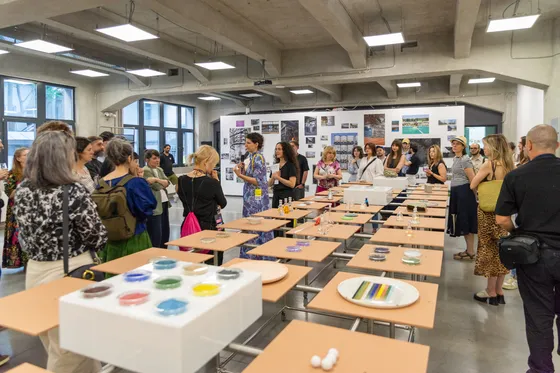
The commissioned design projects work within this complexity. Studio Noff investigates plum cultivation in Banat, approaching grafting as a form of craft that preserves local varieties while enabling commercial production. Studio Eidola explores soil acidity by casting agricultural lime in direct contact with different soils, recording invisible chemical relationships. IAY works with agricultural sidestreams to create bioreceptive habitats that cultivate moss and register biodiversity. Bruno Baietto uses bread as a material record of the infrastructures involved in producing it, casting loaves in ceramic and glass. Roberta Di Cosmo follows the journey of cheese from pasture to city, comparing industrial and pastoral production. Alina Turdean combines a workshop and dining experience to explore food sovereignty, agricultural traditions and economic structures.
A Kitchen Programme extends the exhibition, where agricultural products continue their transformation into food through workshops, meals and events engaging with fermentation, pickling and preservation. "The kitchen allows us to follow the supply chain beyond production," Muzi explains. "It creates a space where technical and economic questions can be encountered through processes people already know: preparing, preserving, sharing and eating food."
From Timișoara to the Global Food System
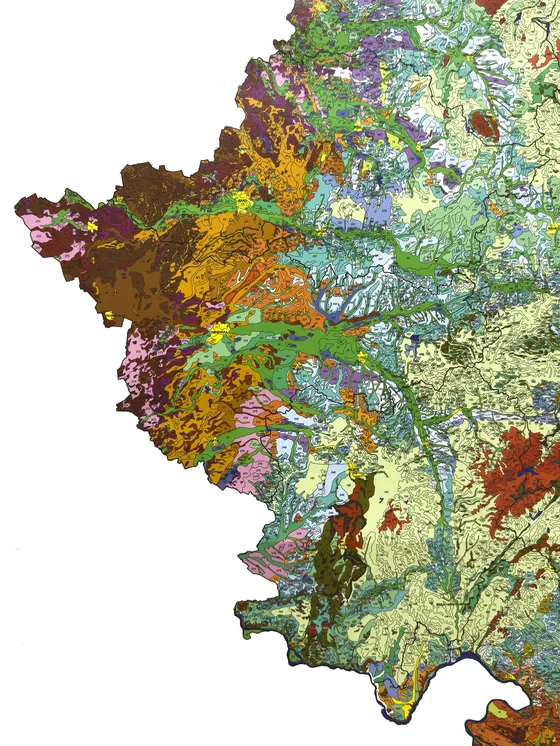
Timișoara and the wider Banat region provide the programme's point of entry into these questions. Its agricultural landscape brings small holdings into proximity with capitalised farms, machinery dealerships, research institutions, processing facilities and logistics networks. Design Signals uses this specific geography to understand broader changes in European agriculture, tracing how international markets and policies take material form in local fields, businesses and households.
Developed by FABER and curated by Martina Muzi, Design Signals is an annual research and design programme that takes Timișoara as a lens through which to examine wider economic, industrial and political transformations. Each edition begins with original research led by Norbert Petrovici, followed by fieldwork, site visits and conversations with people working across the sector under investigation. Local and international designers selected through an open call then develop projects in collaboration with local researchers, producers and institutions.
The programme uses design to make complex systems more legible, amplify existing expertise and forms of everyday design, and create relationships between people and organisations that rarely work together. Its first three editions investigated the automotive industry in 2023, textiles in 2024 and the chemical industry in 2025. Through exhibitions, publications, journalism and pedagogy, Design Signals builds a cumulative body of knowledge grounded in Timișoara and connected to wider European and global developments.