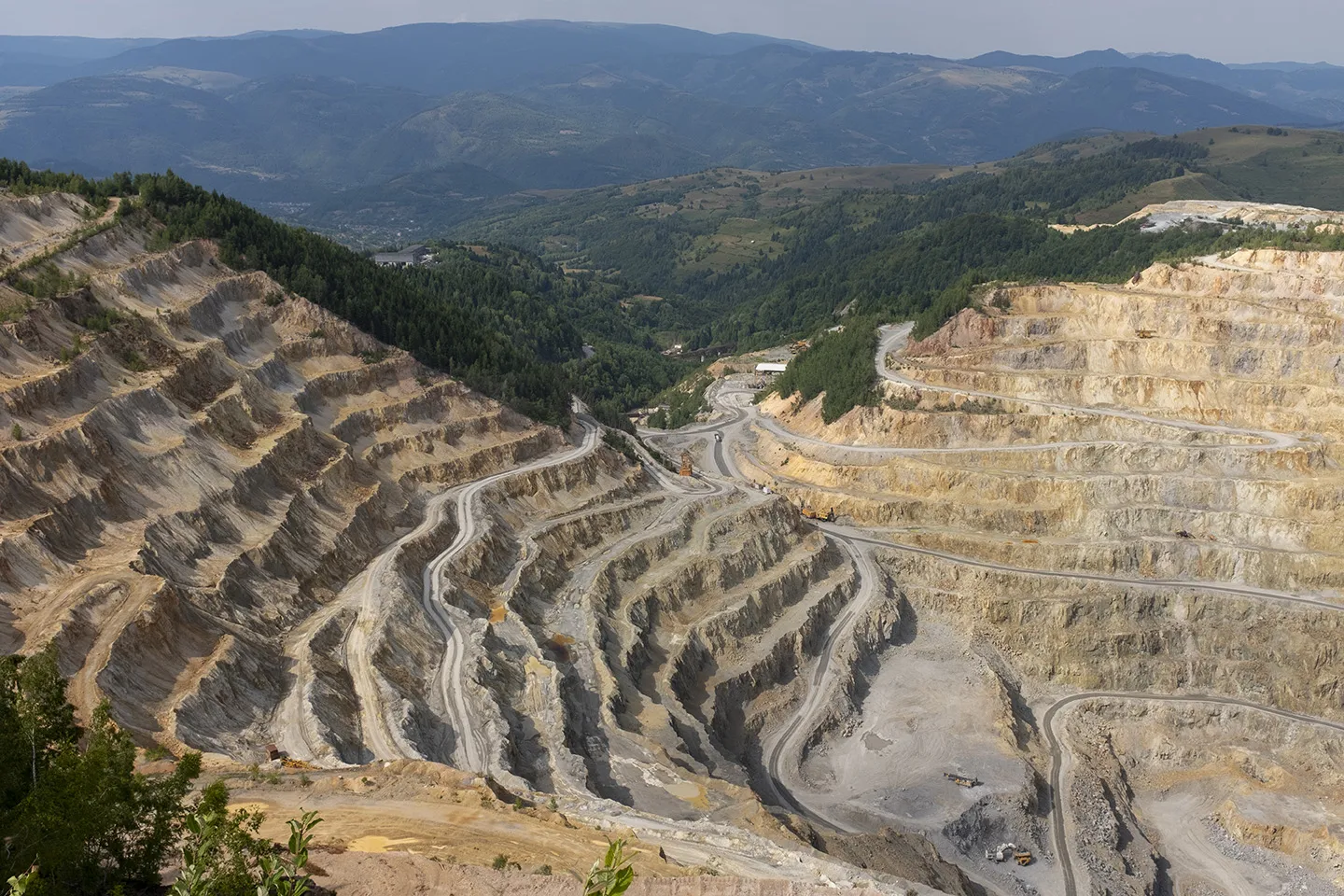
The Roșia Poieni mine is located in the Apuseni Mountains and contains Europe’s second-largest copper deposit, with over one billion tonnes of ore grading 0.36% copper and traces of gold. The ore body, a porphyry deposit of chalcopyrite and pyrite, was discovered during the industrial push in the 1960s. Open-pit mining began in the 1970s, and since 2002 the state-owned company CupruMin has managed operations.
Today, around 550 people work on the site. Every day, the mine blasts through 14,000 tonnes of rock. The process begins with massive mills that crush the raw rock into fine dust. From there, the material is mixed with water and special reactives, preparing it for the next stage: flotation. In this foaming process, copper-rich particles rise to the surface, where they are collected. The procedure is repeated several times until the concentration reaches about 20 percent. What remains at the end is a mixture of water and tailings — the waste material left behind after extraction.
Since the 1980s, CupruMin has disposed of its waste in surrounding valleys. Villages paid the price: first Curmătura, then Geamăna, where more than 300 families were forced to leave. The Şesii Valley was transformed into a tailings impoundment now covering more than 220 hectares. Geamăna disappeared under rising toxic sludge.
What fills Valea Șesei is not inert waste but a slurry of crushed rock mixed with chemicals. When sulfides oxidize, they produce acid mine drainage — acidic waters carrying dissolved metals. CupruMin counters this by adding lime to neutralize acidity. Officially, the company stresses that the facility is stable, monitored daily, and compliant with EU waste management rules.
However, satellite data reveal land subsidence and slope instability in waste rock dumps, with movements of up to 200 millimeters per year. Vegetation indices show long-term decline around the mine.
For locals, the story is one of repeated contamination, barely documented. Hundreds of cubic meters of polluted water spilled into the Arieș River in 2004, with impacts recorded as far as Turda, 80 kilometers downstream. Thousands of dead fish floated in the Arieș after CupruMin failed to activate control systems in 2008. A burst pipe released hundreds of tonnes of mining waste into local rivers in 2011. And six thousand cubic meters of tailings escaped Valea Șesei due to corrosion in a long-abandoned pipe beneath the dam eight years ago. Each time, the company paid small fines — €2,500 in 2004, derisory compared to the scale of damage.
In 2012, Romania attempted to privatize CupruMin under International Monetary Fund pressure. The government chose Roman Copper, a Canadian vehicle with no mining experience, but negotiations collapsed when the company refused to post a €32 million environmental bond. Since then, privatization has stalled.
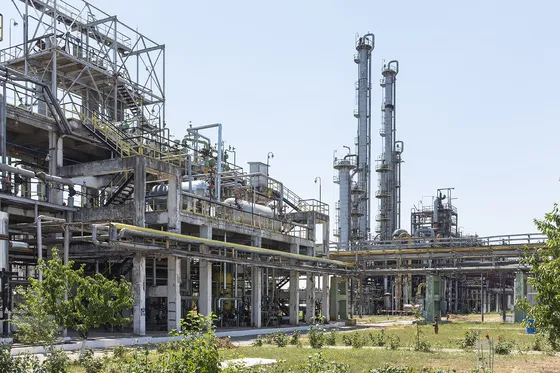
Meanwhile, the European Union has declared copper a strategic raw material, central to the green transition. The Critical Raw Materials Act contains targets for increased domestic mining, processing, and recycling by 2030. Yet Romania today mines copper but lacks a functioning smelter or refinery. Concentrates from Roșia Poieni are shipped abroad, while waste and liability stay at home.
CupruMin’s management insists there is no pollution risk. Authorities rarely comment on accidents. Local associations struggle to amplify their warnings, while the image of Geamăna’s drowned church has become a symbol of what is lost when mining’s promises outweigh accountability.
In 2017, the European Court of Justice condemned Romania for failing to meet EU standards on waste. A decade later, the issues remain unresolved.
Europe demands more copper for electrification and renewable energy. Romania delivers the ore but absorbs the damage. Valea Șesei stands as both a cautionary tale and a test of whether mining in Europe can ever align with environmental justice.
CupruMin is also one of Romania’s last major operating mines, while the country still holds significant mineral resources. Yet the lack of domestic capacity to process them responsibly leaves Europe relying on raw materials from Russia, China, and other authoritarian states. In effect, Europe has exported its environmental burdens abroad while deepening its dependency on unstable suppliers.
Mining will never be fully sustainable. At best, it can become less harmful through stricter waste management, cleaner technologies, and stronger community oversight. But we do need minerals, yet very few societies want to bear the scars of extracting them. The process is inherently harsh, no matter how many improvements are made. That is why Europe must also confront its own overconsumption, invest far more in recycling, and ensure that where mining does happen, it causes the least possible damage — even if achieving that is extraordinarily difficult.