Chimcomplex is known in Romania for being one of the biggest chemical players at the national level, operating two industrial platforms in Onești and Râmnicu Vâlcea. Founded in 1954, the company has more history during communism than outside of it. Its very existence today is an accomplishment as many factories closed shortly after the fall of the regime.
But now a new change is threatening the life of many industrial actors: the green transition and the harsh geopolitical forces shaping the race towards competitiveness. Chimcomplex is no exception, traversing periods of both exponential growth and loss, but remaining an important company in the field.
However, the journey is not yet done. European policies are in constant change, energy prices are still high, and demand for low-carbon products pressing. How is this company holding up and navigating these challenges and what is their story telling us about the bigger picture of industrial transformation during the climate crisis?
Becoming a powerhouse
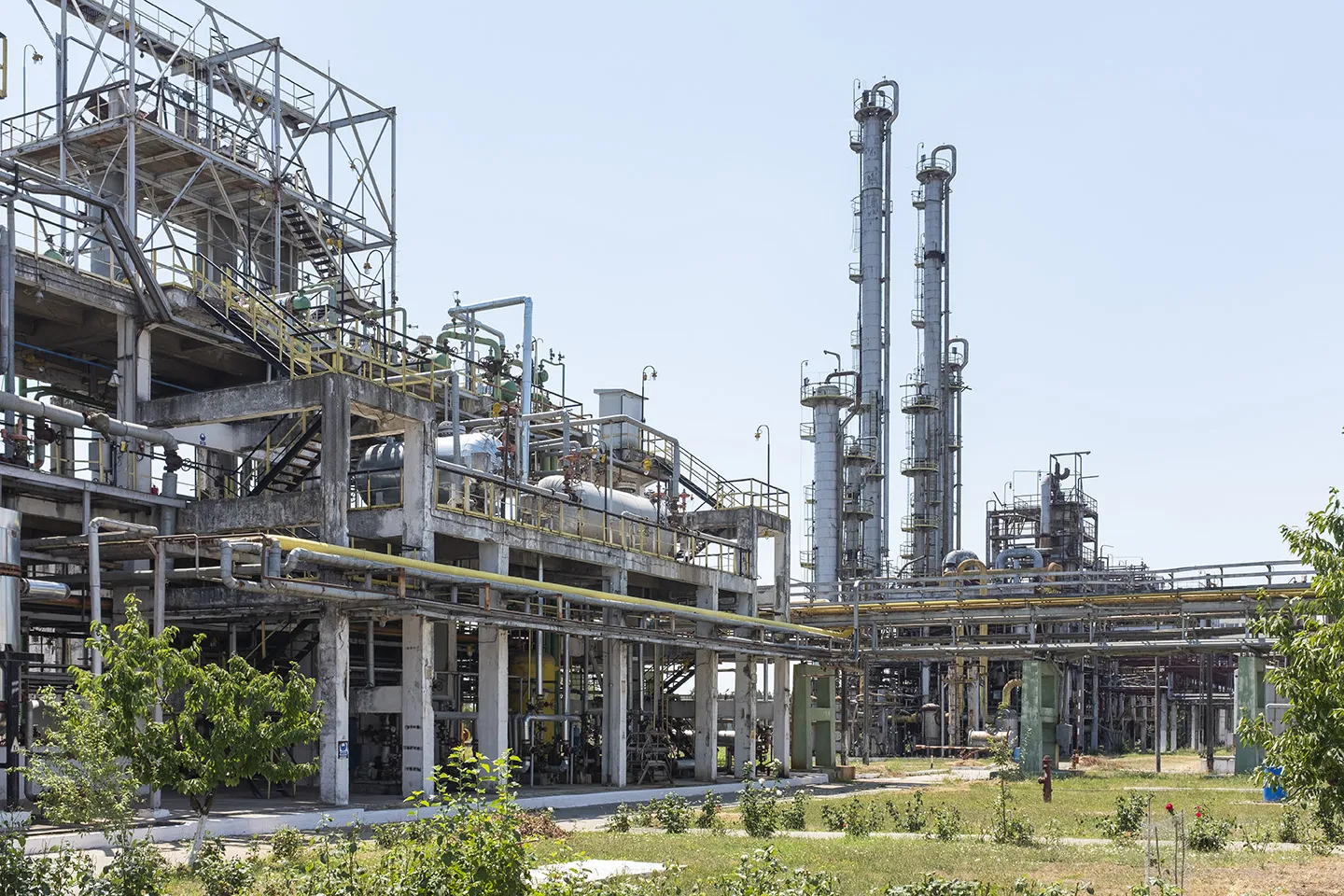
Chimcomplex’s original beginning started as Borzești Chemical Plant on the Borzești Industrial Platform, a project that changed the face of the back-then village Onești, into an important industrial city dubbed in the 1960s ‘the citadel of Romanian petrochemistry’. The emergence of the platform was connected to the opening of an oil refinery, but its activities span beyond that, including facilities for rubber and chemical processes that first produced chlorine, sodium hydroxide and hydrogen gas.
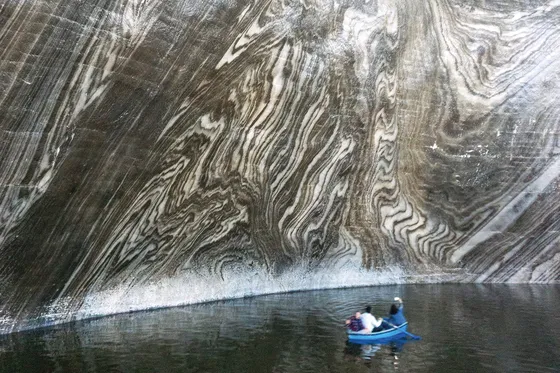
The Chemical Plant is just one of the facilities of the platform, along with a thermal power plant, a refinery and a rubber plant, all well connected to the region. The salt, a component that to this day powers the chemical plant, came from the Târgu Ocna Salt Mine, methane gas from Mediaș, water from the Valea Uzului reservoir, and thermal energy from the Borzești thermal power plant.
Not long after its opening, in 1966, on the other side of the country, another industrial complex was constructed in Râmnicu Vâlcea - Oltchim. Both platforms were producing chlorosodic, oxo alcohols, vinyl chloride (VCM), polyvinyl chloride (PVC), and HCH lindane, used in key industries such as: construction (for pipes and wires), pharmaceutics, agriculture (insecticides) and others.
Immediately after the fall of communism, the Borzești Chemical Plant became Chimcomplex, primarily with public capital, and in 2003 it went fully private, saving it from bankruptcy. Oltchim was later on partly bought by Chimcomplex after a few years of insolvency, linking Onești and Râmnicu Vâlcea as two of the facilities of the company and becoming thus a powerful industrial player in Romania in the chemical sector.
The cost of producing
The effort to keep Chimcomplex alive has cost a lot of money. In the first ten years, over 300 million euros were invested in the development of the company and its facilities. Then, in 2018, 168 million euros were used to buy Oltchim’s stocks, just to mention two figures. At this scale of business, nothing out of the ordinary. But money isn’t the only cost one should look at. Every economic activity has an environmental impact and Chimcomplex is no exception.
Industry has been for decades one of the major polluters in Romania. In 1990, it accounted for almost 38% of the national emissions, releasing into the air 84,146 Kt CO2 equivalent (equal to 19.2 years of emissions of civil aviation in France, in nowadays terms).
This has drastically changed over the course of years. Since 2005, the EU has installed a system of limitations for certain installations and operators, such as heat and electricity generation or aviation. Additionally, there is also a market for companies to trade emissions allowances, between those who exceed the cap and those who decarbonise.
Industrial manufacturing is included in this scheme, called EU Trading System - ETS in short. In 2022, Romania accounted for 28,200 Kt CO2 equivalent in this sector, almost three times less than in 1990. Still, in relative terms, industry equals to 26% of national greenhouse gas (GHG) emissions. Chimcomplex falls under the system and, in its first publicly available sustainability report, declared emitting approximately 464 Kt CO2 equivalent in 2022.
Holistically, this means they are responsible for 3.8% of emissions at the sectoral level and 0.43% at national level. Might look insignificant, but it isn’t. One single company has the footprint of a city with a population of 58,000 people, like Reștița or Călărași. And most of it comes from its energy consumption.
Energy transformation
Long before the European Green Deal came into place in 2019, Chimcomplex started its energy transition, mostly driven by economic reasons, due to high energy bills. In 2006, they accounted for approximately 33% of total production costs and approximately 46% of total operating costs.
Thus, in 2008, the company invested in a cogeneration plant, that produces both electricity and useful heat at the same time. A study from 2014 showed that the new installed system had ‘a positive impact on the environment, consisting in a 28.8% reduction of the direct and induced CO2 emissions’. While electricity production increased, it is worth noting that gas consumption also increased.
Chimcomplex continued to invest in co-generation. If in 2015 had an energy capacity of 7.6 MW, this year they’re planning to reach a capacity of 108 MW, with the support of the European Union. They’re producing so much, covering the majority of their internal needs, that they’re also selling it to consumers. The thermal power, of minimum capacity of 89 MW, is planned to be connected to the district heating network of Râmnicu Vâlcea.
New technology, same issues
While co-generation plants powered by fossil gas bring flexibility to the grid, being way more easily detachable than nuclear, and less dependent on weather like renewables, they also raise a series of problems.
One is related to methane emissions, which are 80 times more potent in warming the atmosphere than CO2, in the first 20 years. Chimcomplex enjoys institutional support, the development of gas infrastructure being a primary strategy for decarbonisation. At the same time, decision-makers ignore that Romania has signed the Global Methane Pledge, which supports a reduction of global methane emissions of at least 30 percent from 2020 levels by 2030.
Another issue is related to costs. Gas prices are still very high in Europe and the resources are not so abundant. In 2022, when Russia invaded Ukraine and the continent was struggling with an energy crisis, Chimcomplex was also under pressure and they eventually fired 400 employees.
When used to produce electricity, gas drives the prices up considerably higher than those set by renewables. And consumers have to pay the bill, because of the merit-order system in which every electricity producer receives the price of the last bidder, the most expensive one.
Moving forward
Chimcomplex’s latest sustainability report from 2024 shows a sad reality of the industry: while Paris Agreement was signed in 2015 and the European Green Deal introduced at the end of 2019, the company declared that they ‘do not yet have a transition plan in place to address the challenges related to climate change, in line with the climate neutrality goals’.
The national political reality might explain why this is the case. Constantin Rudnițchi of RFI reported last year that Romania doesn’t have one industrial strategy, but two. In 2023 the government published the strategic document for 2023-2027, but hardly introduced any incentives or conditionalities for industrial companies to adopt top-notch, less polluting technologies. Then, a year later, the government published a new strategy, this time with a longer time span from 2024-2030, and including a set of benefits for developing industry, such as tax cuts, fastened approval procedures and a dedicated budget.
But this lack of clarity and stability in governmental plans goes beyond national borders. The EU has been on a crusade of deregulation in the past months and continues to extend it even today. While companies like Chimcomplex were just starting to adjust to the requirements of the Corporate Sustainability Reporting Directive (CSRD), for example, the regulation has been reduced in scope. Chimcomplex might still be subjected to it, as it has over 1000 employees, but 85% of the initially targeted companies will not. Moreover, the Commission even proposed the removal of adopting and implementing a transition plan for climate change mitigation.
But the climate crisis disregards policy
Whether Chimcomplex will implement a net zero plan does not change the fact that climate change will impact the chemical sector. A presentation by Lux Research points out that ‘extreme events will only grow more frequent as global average temperatures continue to rise’ and this will continue to disrupt the chemical production and distribution as extreme storm events, temperature change, and drought will only continue to increase over the next 50 years. ‘Serious impacts will include damage to capital assets, disruptions to transport and raw materials availability, and impacts on labor productivity and safety’ add the authors.
The EU regulation was valuable in that sense because it obliged companies to identify its material sustainability impacts, risks and opportunities from a double perspective. One one hand, looking at how sustainability matters may pose either a prospective material risk or opportunity that could affect a company’s financial performance and position over time. On the other hand, assess an “inside out” view on the actual or potential impacts on people or the environment that are directly linked to a company’s operations and its value chain.
If Chimcomplex will continue to treat climate change and the green transition seriously, disregarding the change of attitude from Brussels, it might be able to adapt to potential disruptions and win the race to competitiveness. Other factors have to play in their favour too, such as financial support and market adaptation. While the journey is not easy, the transformation is inevitable.
An important piece in the chemical industry puzzle
Will Chimcomplex hold up? The answer weighs on the hundreds of workers that are, year by year, slowly laid-off. But also on the chemical industry overall. Nationally, 60% of the raw materials they use come from the local market and many of their products dominate the market share up to 90%. Globally, Chimcomplex’s products are being exported to 60 countries across 5 continents. It feeds the local and global chemical industry and even sustains chemical processes that otherwise might find it hard to conduct business.
While the economy thrives on the idea of scarcity, losing a player like Chimcomplex will reverberate deep into the web of interactions that sustain the company and the industry daily.
Overcoming the challenging green transition will as well entail losses. Innovations and higher efficiency rates will push personnel out of the organisational chart. Markets adapted to green products will potentially mean sourcing from different, less polluting stakeholders. And the list goes on.
But the trade off is worth it. Working on achieving a ‘clean industry’ is improving the life of workers and locals, decreases pollution, and helps reaching net zero targets, essential in the fight to mitigate the climate crisis.
And even more importantly, perhaps it will prove that even big industrial actors can flourish in this transition. Just in different ways: quality over quantity, recyclability and renewable power are just a few examples. The rest is yet to be told by companies just like Chimcomplex.