
Bianca Schick
Designer, image creator

Federico Santarini
Informational designer

Martina Muzi
Curator, designer
Data story-telling and visualisations, AI-generated visuals and glossaries
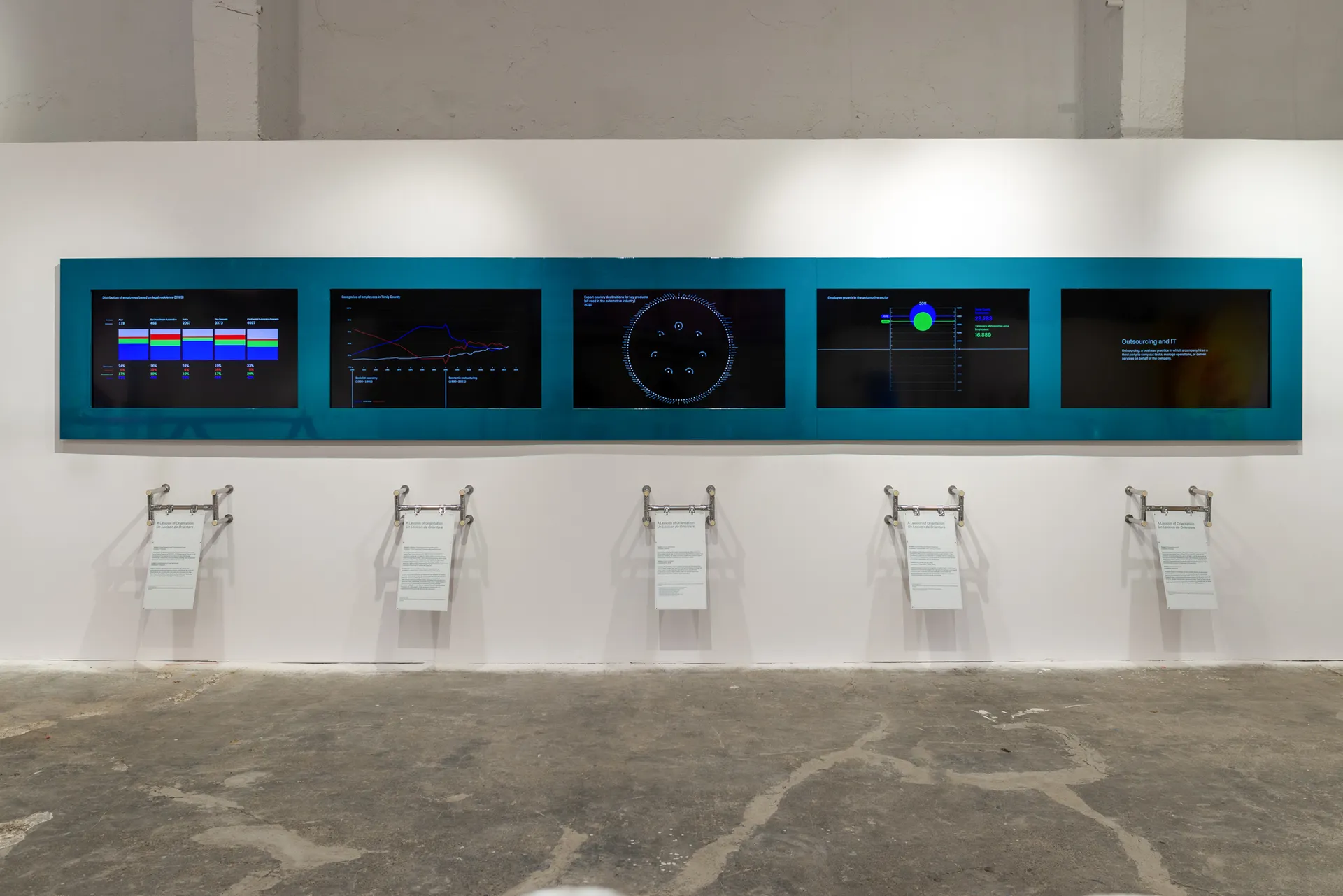
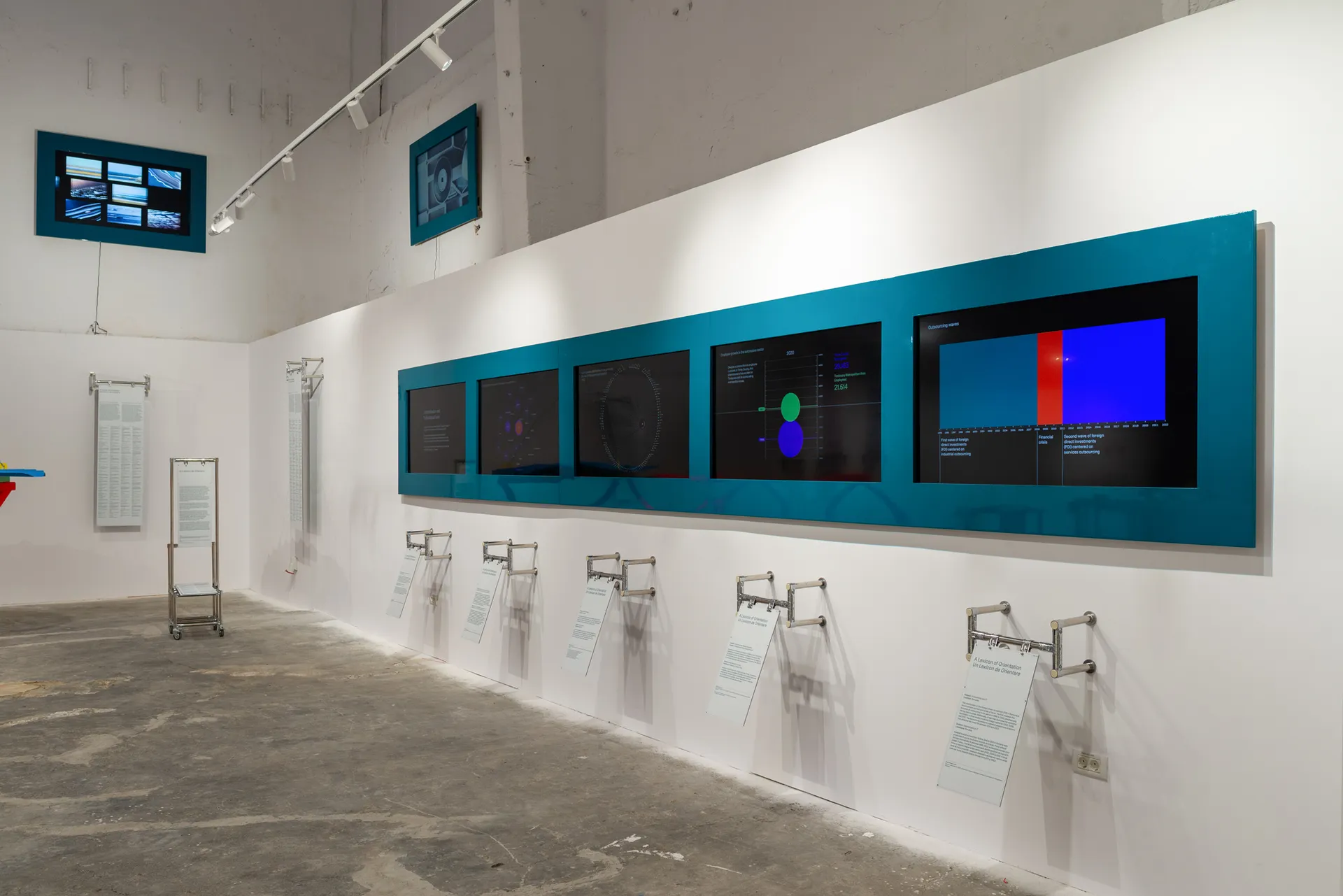
‘A Lexicon of Orientation’ is a set of visual and linguistic vocabularies that articulate Timișoara’s economy and geography. Drawing on a commissioned report, ‘Economy in Timișoara: Territorial Distribution of the Economy in the Timișoara Metropolitan Area’, the lexicon identified five pivotal subjects: Industrialisation and Technological Level, Workers, Commuting and Internal Migration, Import and Export, Automotive and Related Industries, and Outsourcing and IT.
These subjects have informed the creation of five glossaries, five data visualisations, and five AI-generated visuals. Through these distinct analytical, semantic, and visual representations, ‘A Lexicon of Orientation’ serves to connect shared concepts, index complex phenomena, and establish a semantic foundation for collaboration across information asymmetries between disciplines, industries, and audiences.
For the data visualisations, original data from the report was used to develop a detailed narrative for each main theme. This involved investigating distinct phenomena within the data, constructing precise timelines to trace the sequence of events, and unpacking the intricate relationships and linkages between various data points.
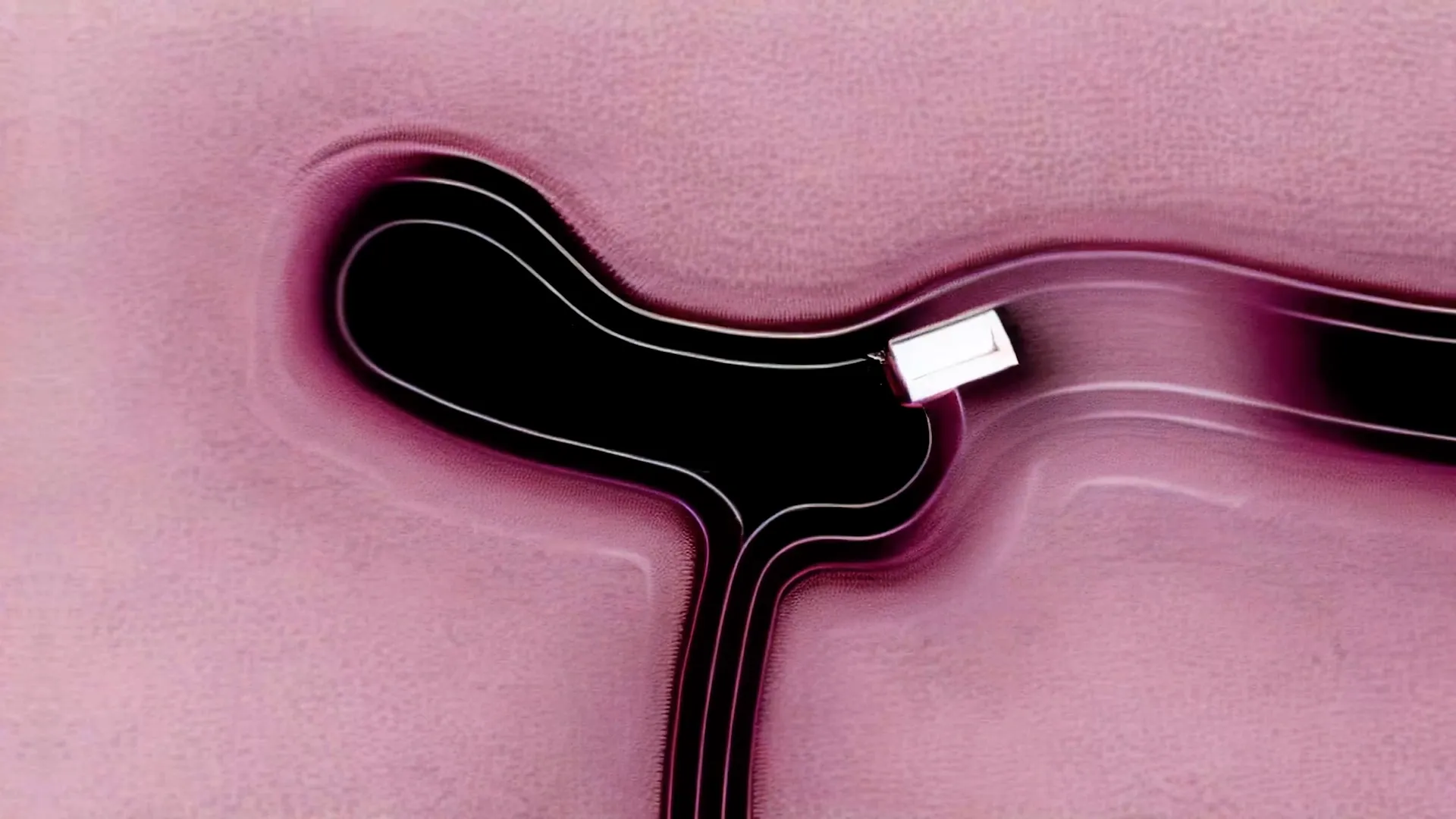
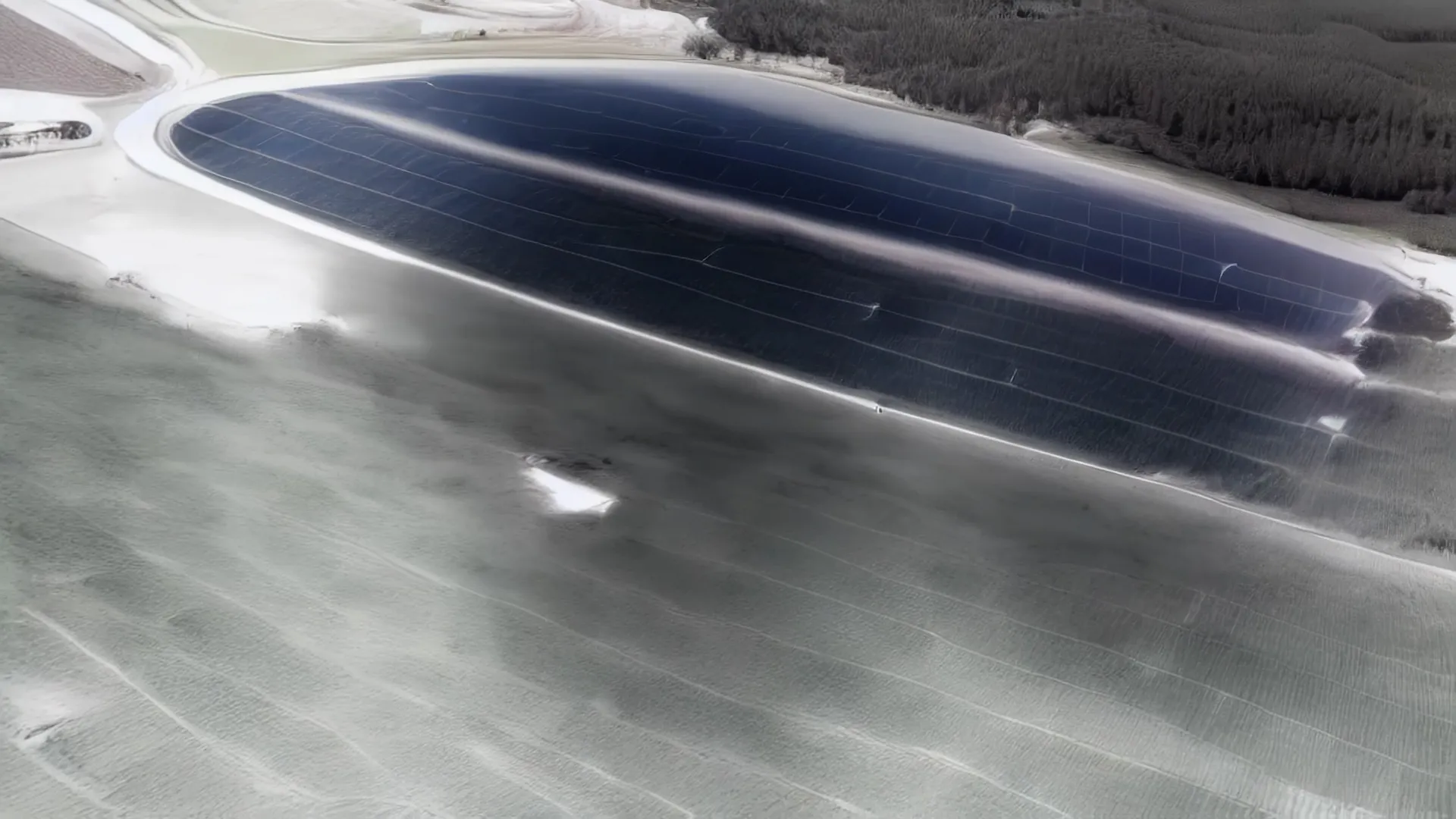
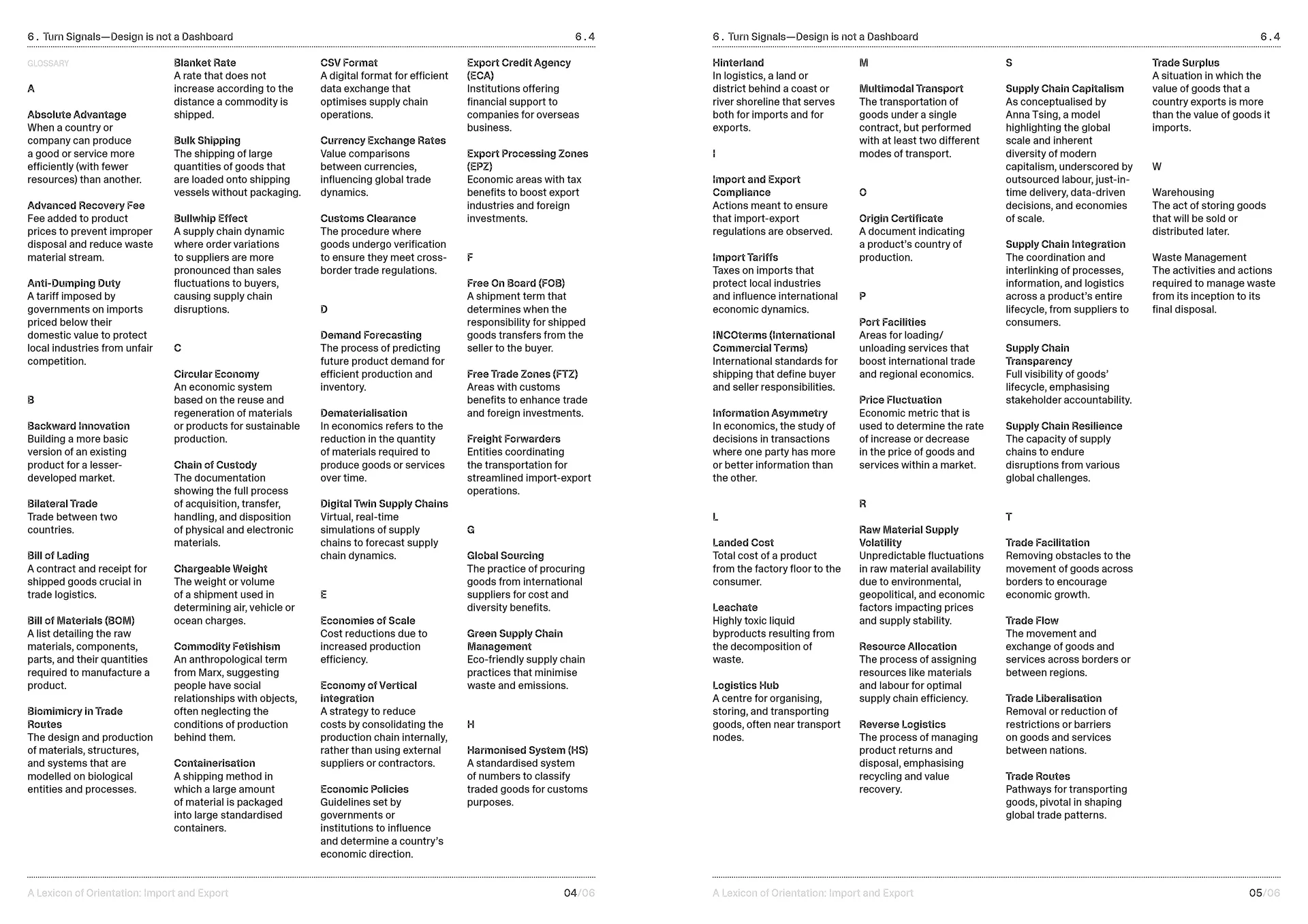
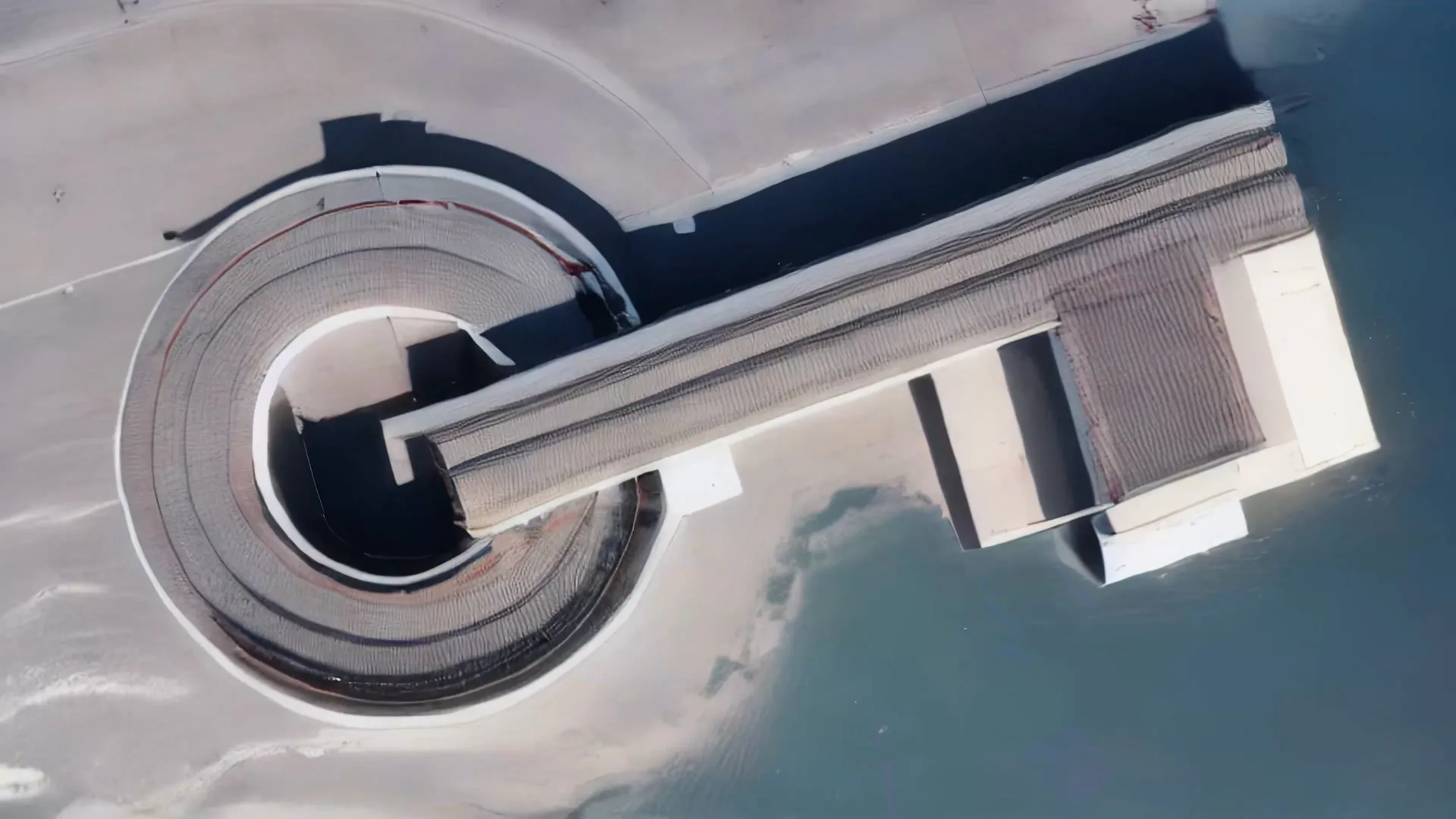
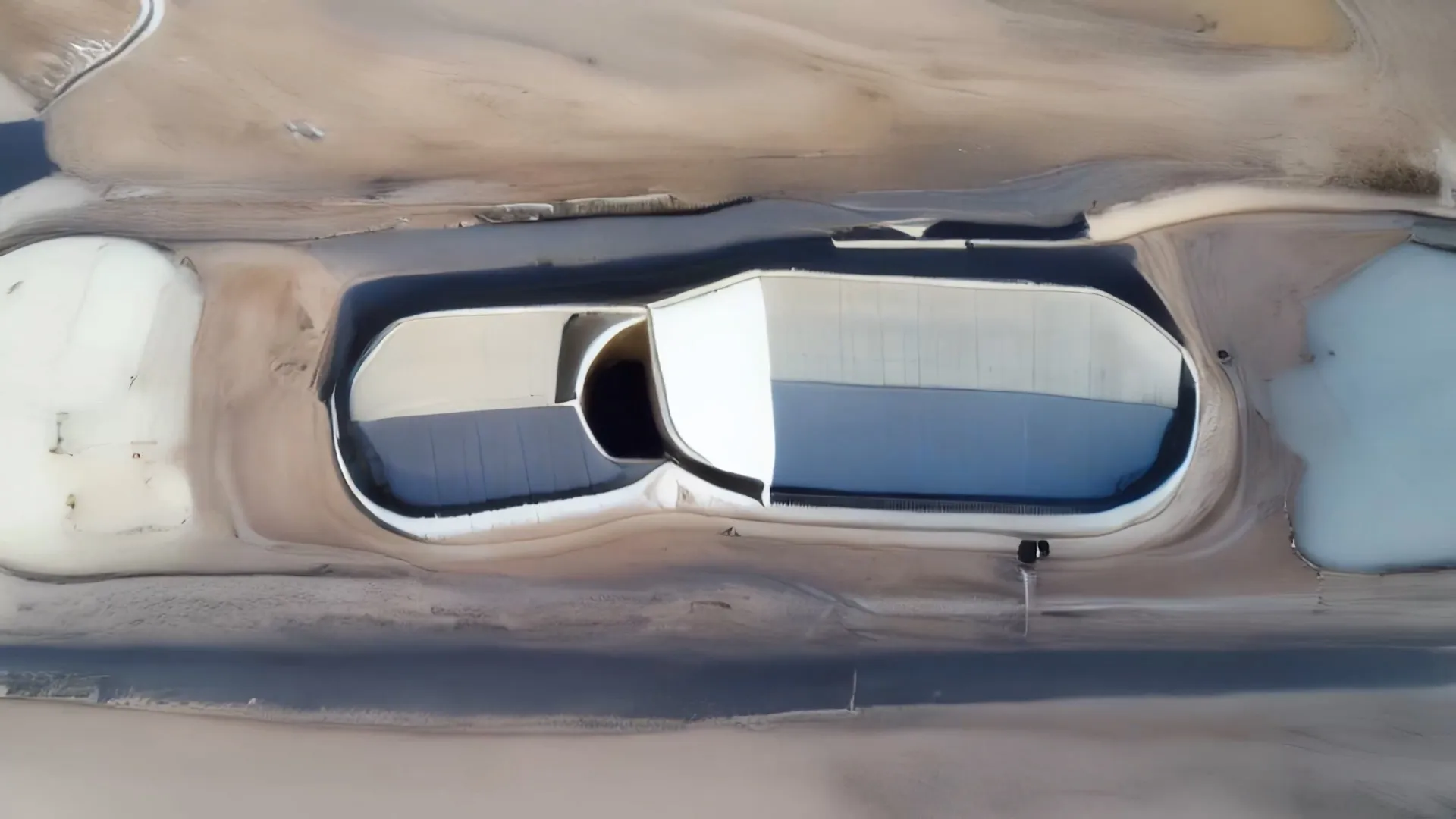
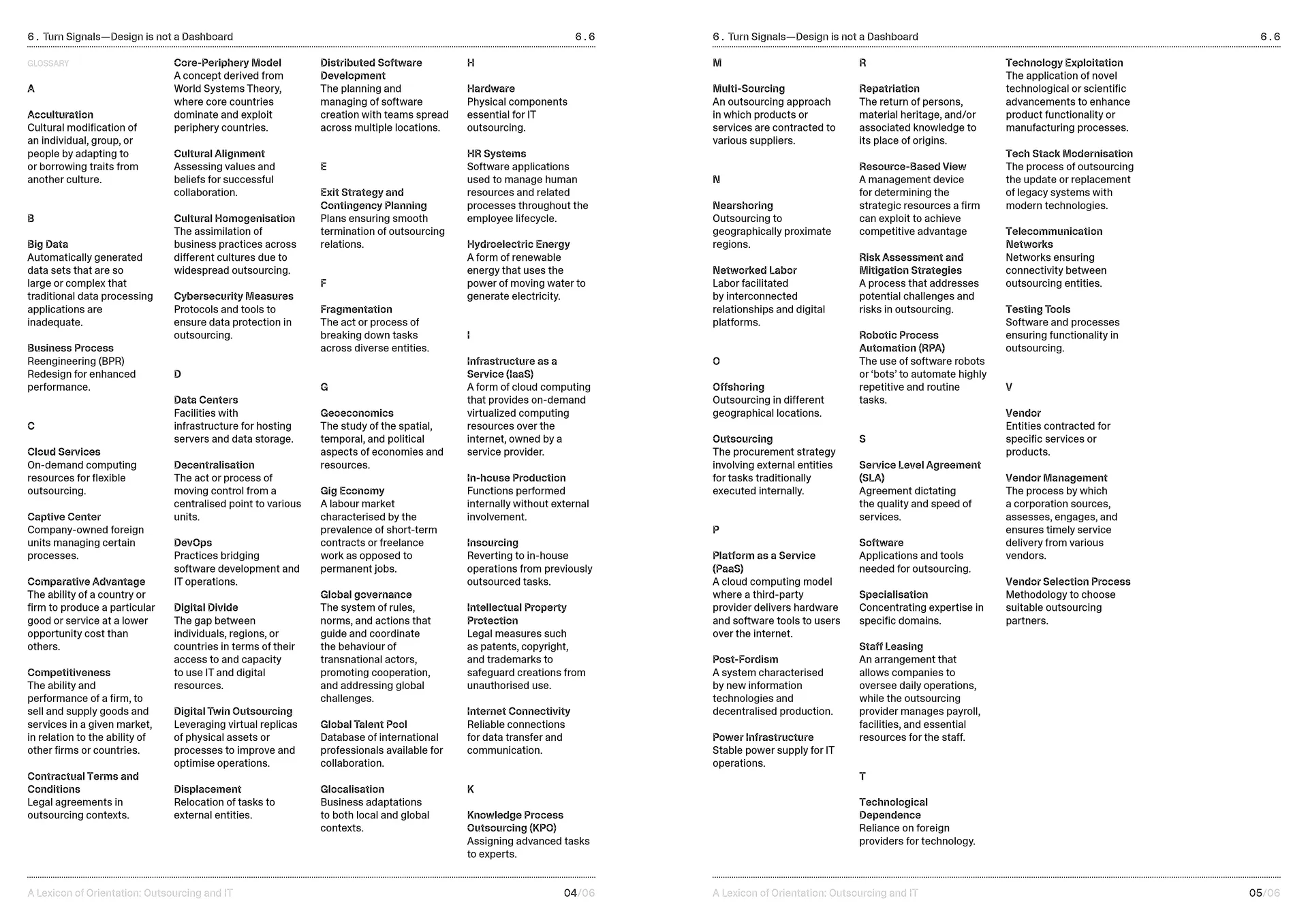
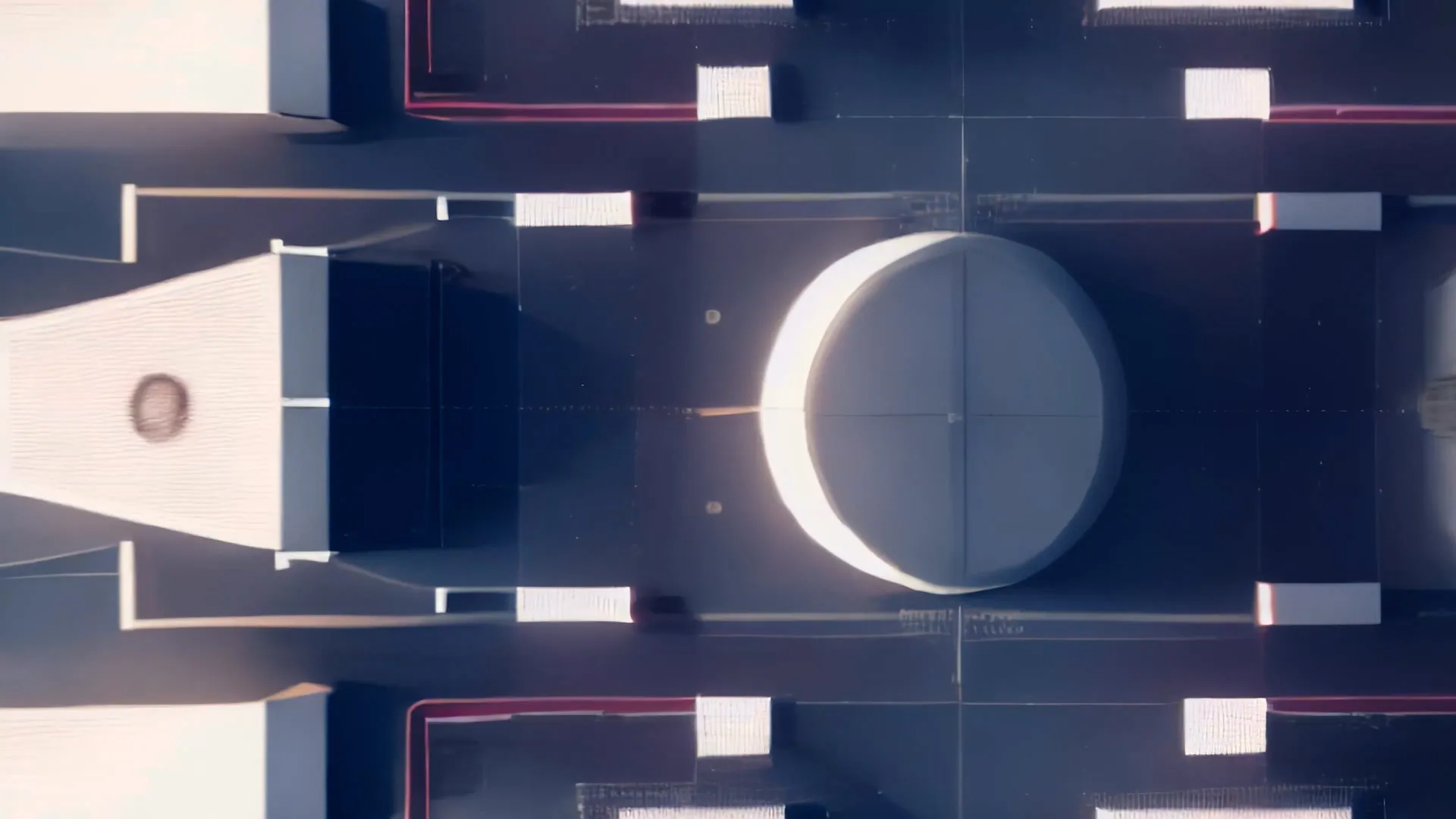
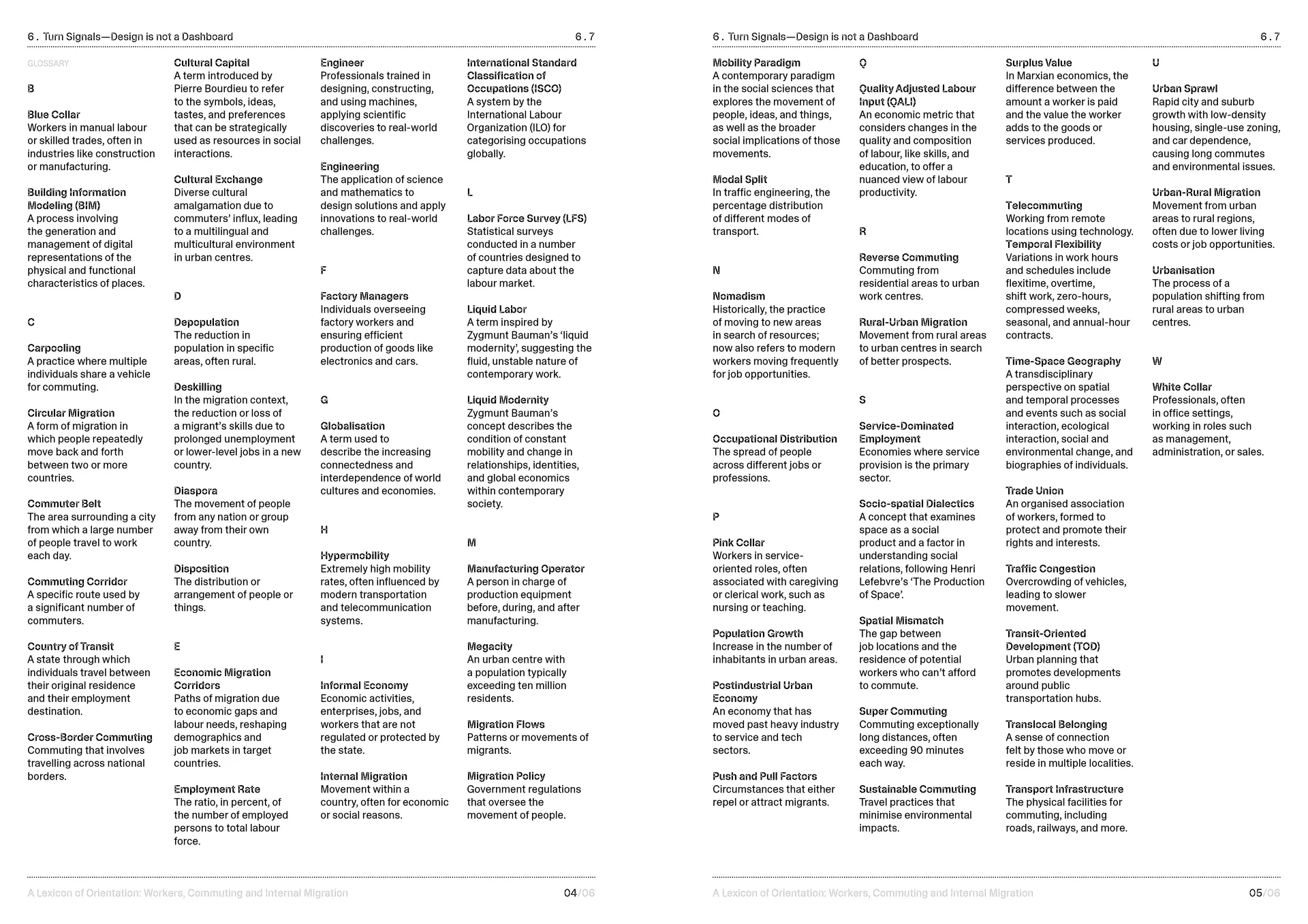
Although the glossary’s terms and their explanations are not exhaustive or definitive, they shed light on the nuances of evolving processes, temporal-spatial dynamics, standards, infrastructures, models, and their socio-economic consequences. These terms also served as the prompts for the animated films generated by AI using multimodal neural networks, Stable Diffusion Web UI and Gen-2. By transforming both text prompts and visual inputs into moving images, five fictional landscapes have been created.
Within the Turn Signals—Design is not a Dashboard exhibition, ‘A Lexicon of Orientation’ serves to provide an interpretative narrative of the ‘Economy in Timișoara: Territorial Distribution of the Economy in the Timișoara Metropolitan Area’ report, which directly and indirectly informed each of the designers’ showcased works. Through the multiplicity of vocabularies, the lexicon refrains from offering an absolute representation of the report, re-emphasising that design and data are always subject to interpretation and application beyond mere market-based optimisation.

1/3
2/3
3/3
Automotive and Related Industries
DATA VISUALISATION
Subject: Automotive and Related Industries
Location: Timișoara and Timiș County, Romania
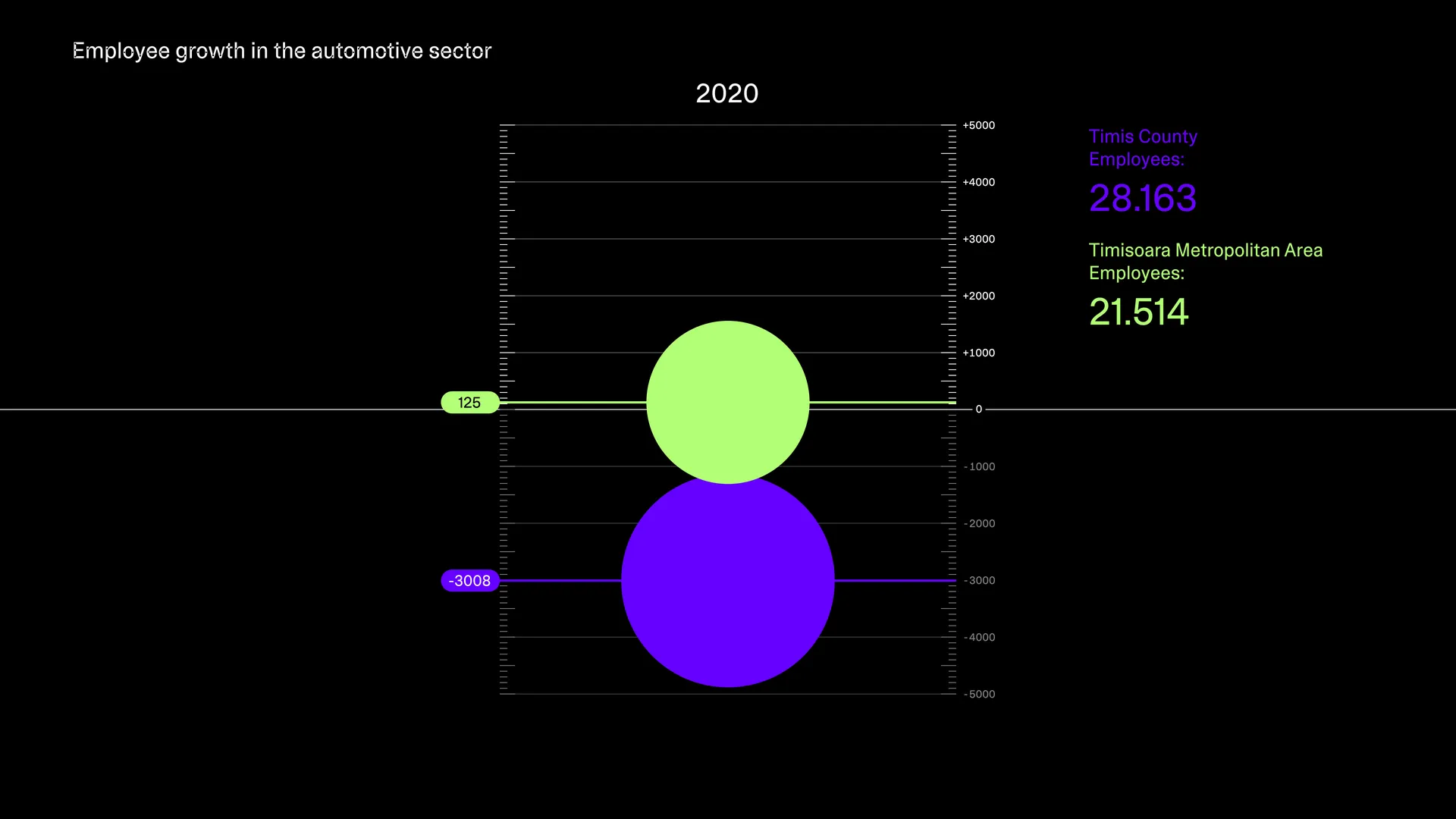
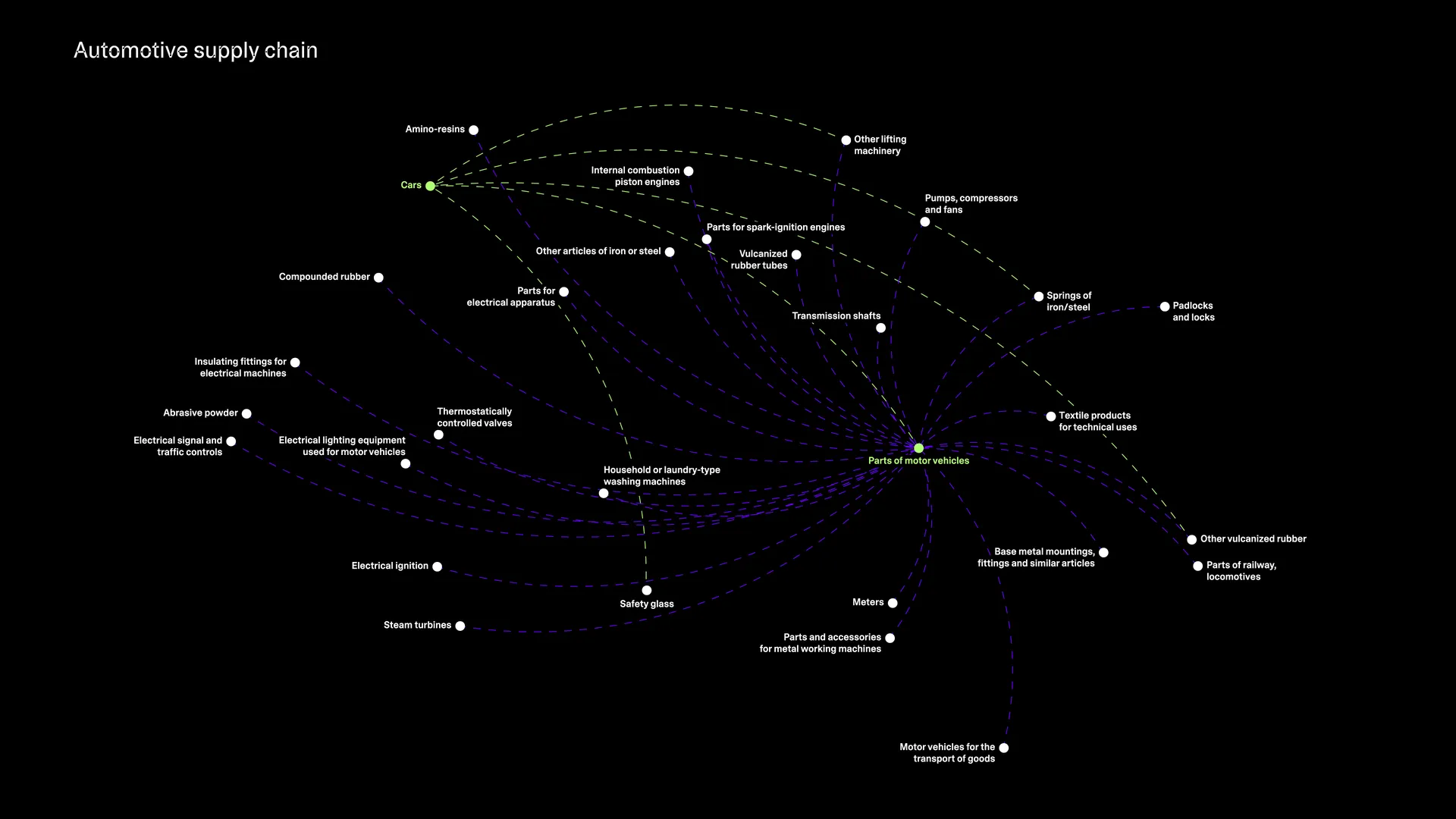
An analysis of the automotive sector in Timișoara and Timiș County, highlighting the growth in employee numbers in the industry. The visualisation explores the industries in Timișoara that are integral to the automotive supply chain and presents an overview of the network of industries associated with car production.
INSIGHTS BY SOCIOLOGIST NORBERT PETROVICI
Timișoara Automotive Industry: A Global Driver
In Timișoara, the automotive industry stands as the main economic driver, with sectors such as chemical and electronics serving as integral components, either as direct suppliers or indirectly associated entities in the global market. This interconnection has positioned Timișoara as an important node in both the national and global automotive supply chains.
Privatisation Transformations and Strategic Benefits
The economic landscape of the region experienced considerable transformations through various privatisation initiatives. Among these, the successful privatisation of Dacia/Renault during Romania’s EU pre-accession negotiations is of particular importance. This privatisation had a particularly positive impact on Timișoara as it maintained the national supply chain, including the chemical, electrical, and electronics sectors. This strategic move enabled companies based in Timișoara, including Elba, a key player in the lighting industry, to expand internationally while continuing their service to Dacia. Additionally, engineering service providers like Continental and Bosch relocated to Timișoara, offering their expertise and contributing to the growing complexity of the supply chain within the national economy.
Timisoara’s Skilled Workforce in the Automotive Sector
These progressions have resulted in a significant portion of Timișoara’s workforce, including over 25 000 engineers, either directly or indirectly involved in the dominant industrial sector. This achievement was made possible through the employment of available human resources and efficient infrastructure developed during the 1970s and 1980s.
AI-GENERATED VISUALS
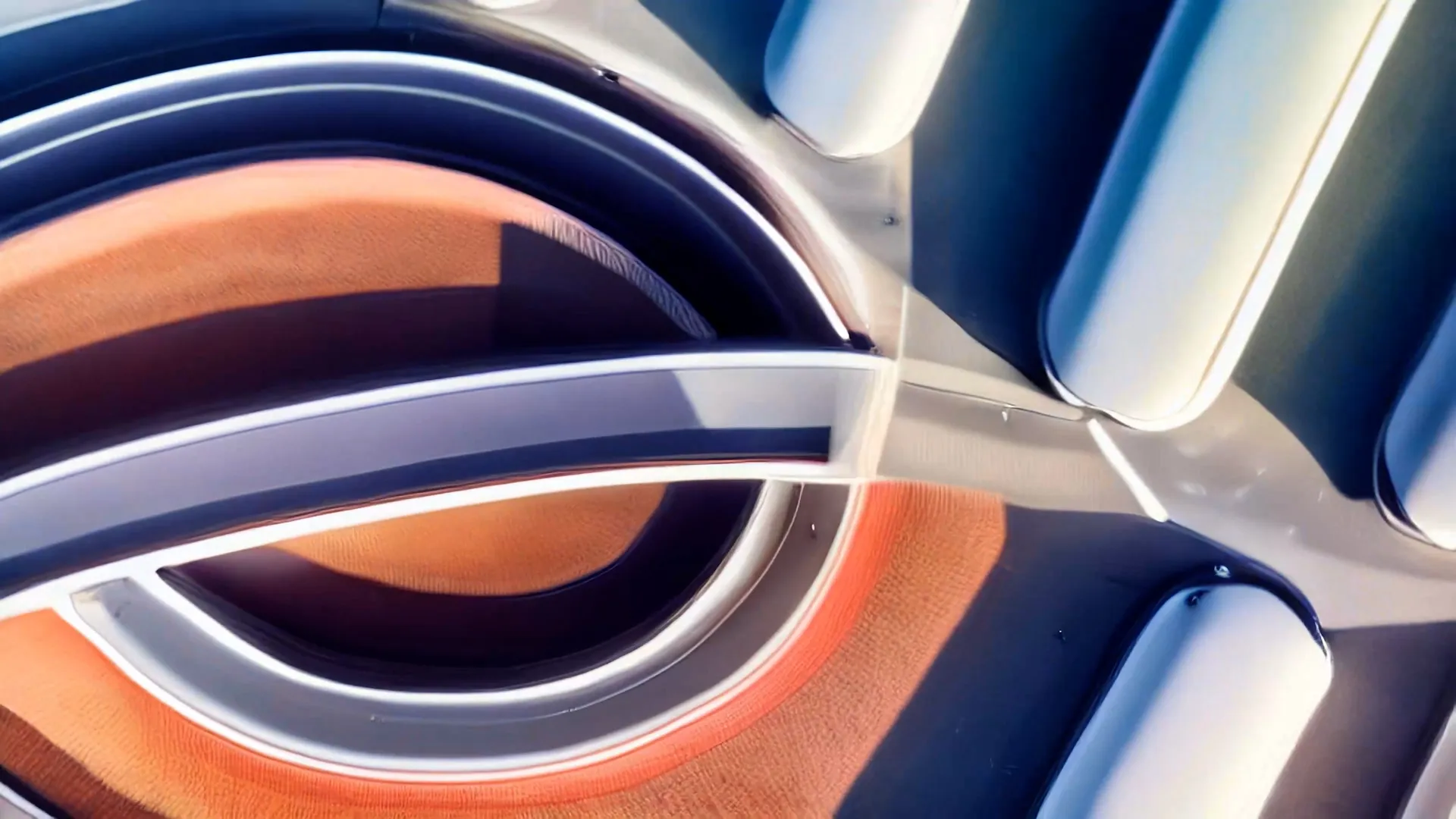
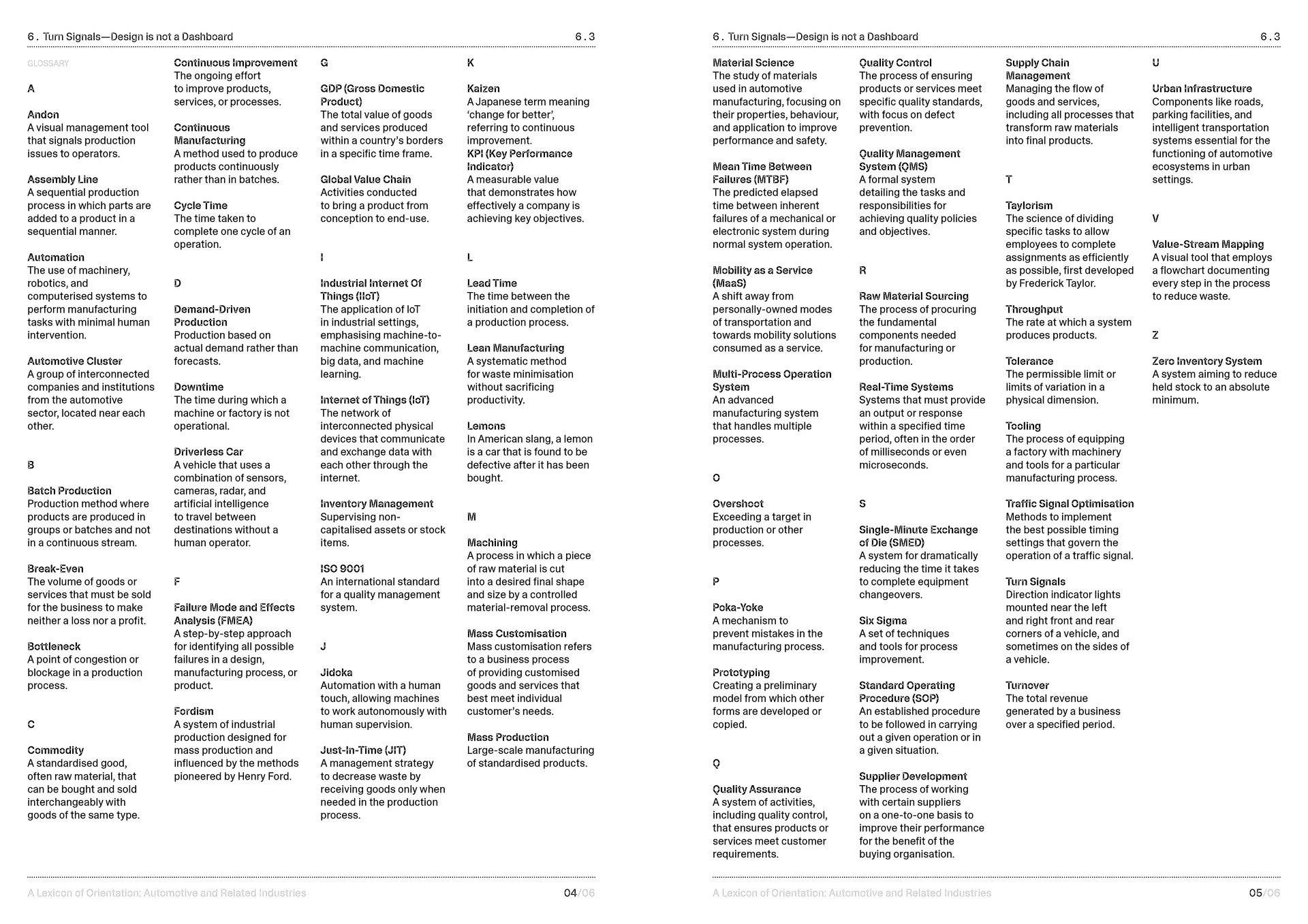
./prompt: the, automobile, industry, marked, by, rapid, evolution, embraces, technological, innovation, Foreign Direct Investment (FDI), fosters, global, collaboration, promoting, expansion, and, diversification, while, lean manufacturing, and, the, Just-in-Time (JIT) model, optimises, speed, and, standardisation, real-time systems, ensure, rapid, responsiveness, to, changes, and, demands, steel, aluminum, plastics, rubber, magnesium, and, glass, undergo, repeated, manufacturing, processes, creating, precise, components, as, the, industry, shapes, urban infrastructure, a, transformation, unfolds, optimising, road networks, parking, and, traffic, control, bridges, tunnels, and, EV, charging, stations, support, efficient, transport, as, repetition, and, noise, resonate, within, the, landscape, standardisation, and, reproducibility, drive, assembly line, mass production, and, mass distribution, emphasising, large-scale, efficiency, through, automation, syncronisation, and, optimisation, the, industry, maintains, a, consistent, and, efficient, production, flow
Data Sources
Petrovici, Alexe, Bejinariu, 2023. ‘Economy in Timișoara: Territorial Distribution of the Economy in the Timișoara Metropolitan Area’The Growth Lab at Harvard University. The Atlas of Economic Complexity: Romania’s Product Space, 2020
1/6

2/6

3/6
4/6
5/6
6/6
Import and Export
DATA VISUALISATION
Subject: Import and Export
Location: Romania
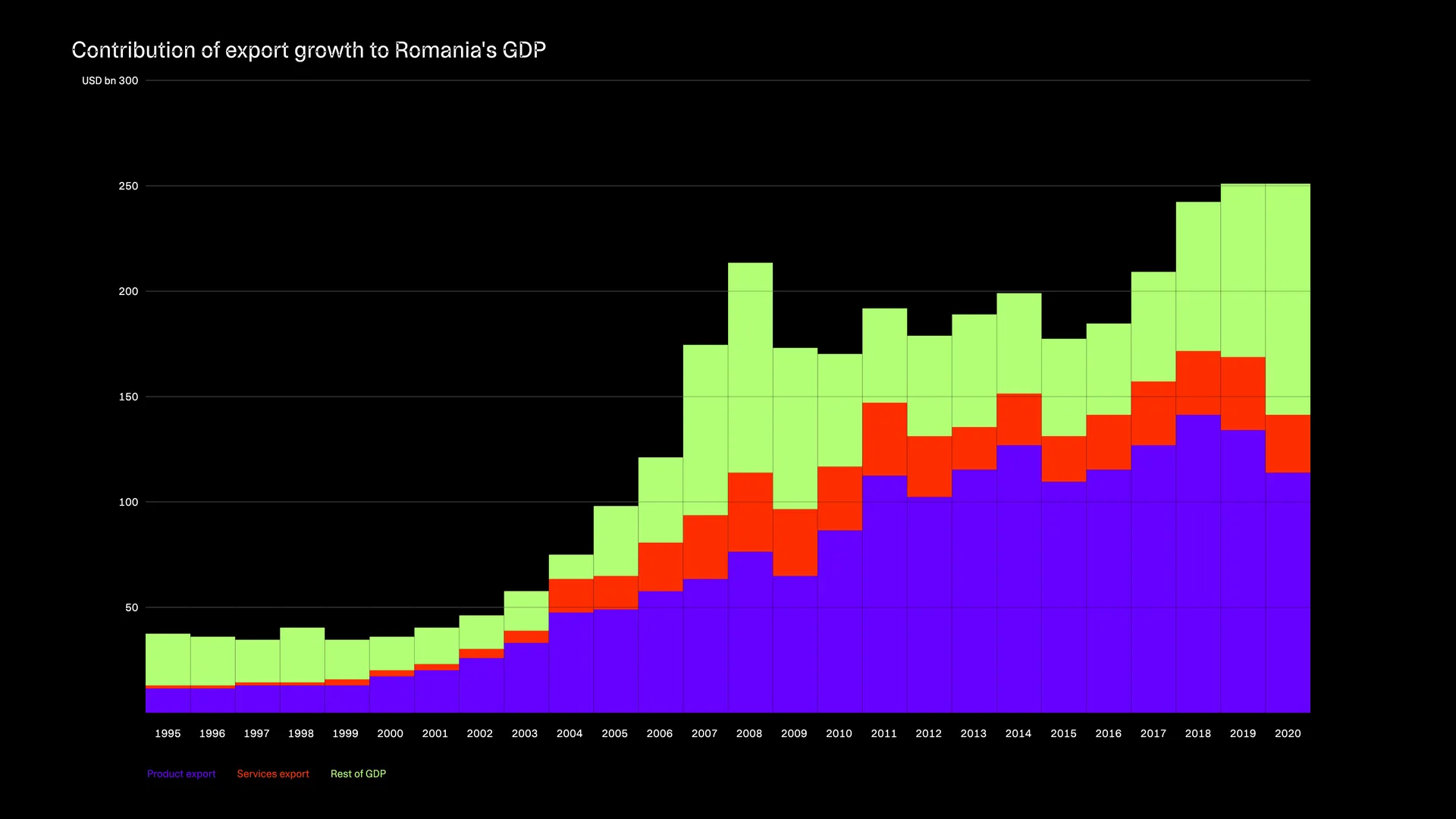
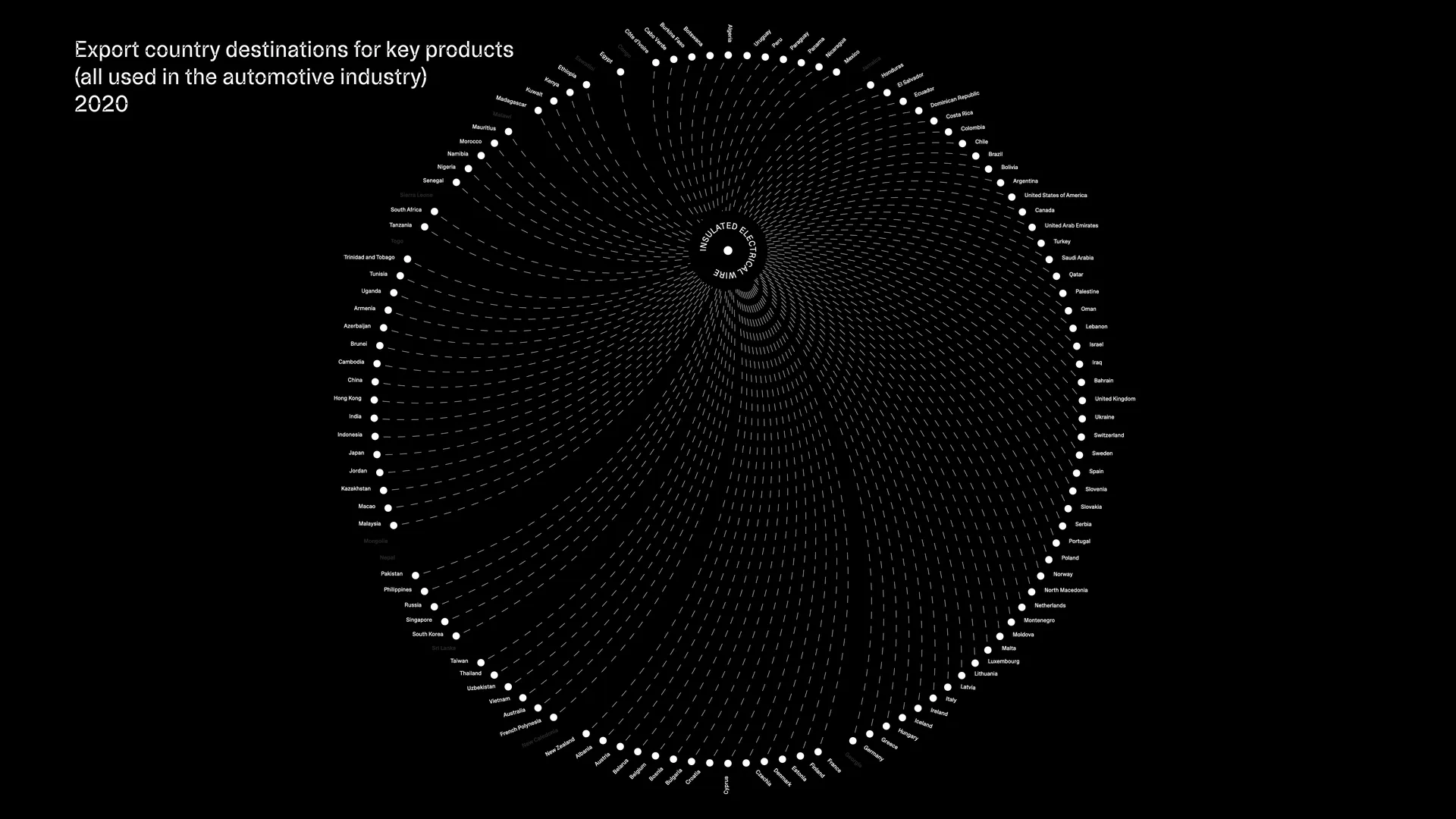
An overview of Romania’s export growth between 1995 and 2020, paired with insights into the primary export destinations for seven key products, including car lights, car seats, rubber tires, refined copper, PCB boards, electrical insulated wire, and epoxy resins.
INSIGHTS BY SOCIOLOGIST NORBERT PETROVICI
Romania’s Export-Driven Transformation
From the 1990s onwards, Romania underwent a significant economic transformation. Initially characterised by slow growth, due to internal consumption from both the government and the population, the country underwent substantial changes after the 2008 economic crisis. This transformation was accelerated by its entry into the EU in 2007 and gained momentum in 2011. During this time, Romania redirected its attention towards exports, prompting cities like Timișoara to transform into global, market-oriented entities with a strong capability for industrial exports.
The Complexity of Timișoara’s Economic Growth
The economic expansion of Timișoara is remarkable for its diversification into services, encompassing engineering and software production in Shared Service Centers. However, this diversification frequently goes overlooked in economic categorisations. Numerous FDI companies in Timișoara identify themselves as industrial due to their dual functions—of industrial manufacturing and service delivery—to manufacturing processes. This starkly contrasts with cities like Cluj, where different companies are primarily involved in software production, leading to their prominent categorisation in the IT sector. In Timișoara, the IT sector is interwoven with engineering services, predominantly supplied in-house to FDI industrial conglomerates.
Import-Export Dynamics and Romania’s Automotive Role
The economic growth of Romania is significantly shaped by its import and export dynamics. A considerable portion of imports consists of intermediate goods, often semi-finished products that are completed locally and then exported. While officially classified under various sectors, these products are predominantly used in the automotive industry, highlighting Romania’s key role within the continental supply chains. Timișoara is pivotal in this regard, making significant contributions to the automotive supply chain and thereby enhancing the prominence of the automotive sector within Romania’s export portfolio.
AI-GENERATED VISUALS
./prompt:
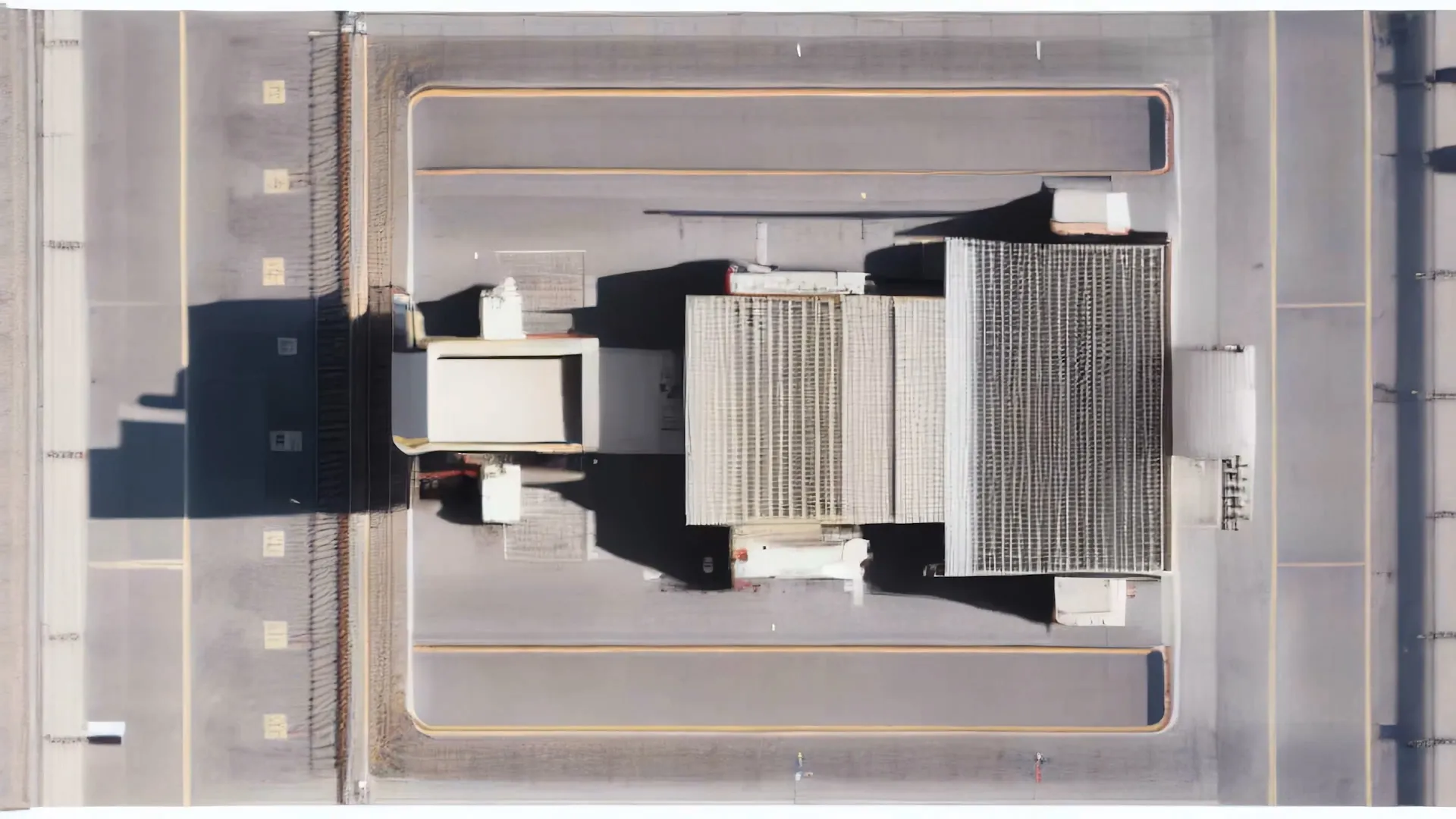
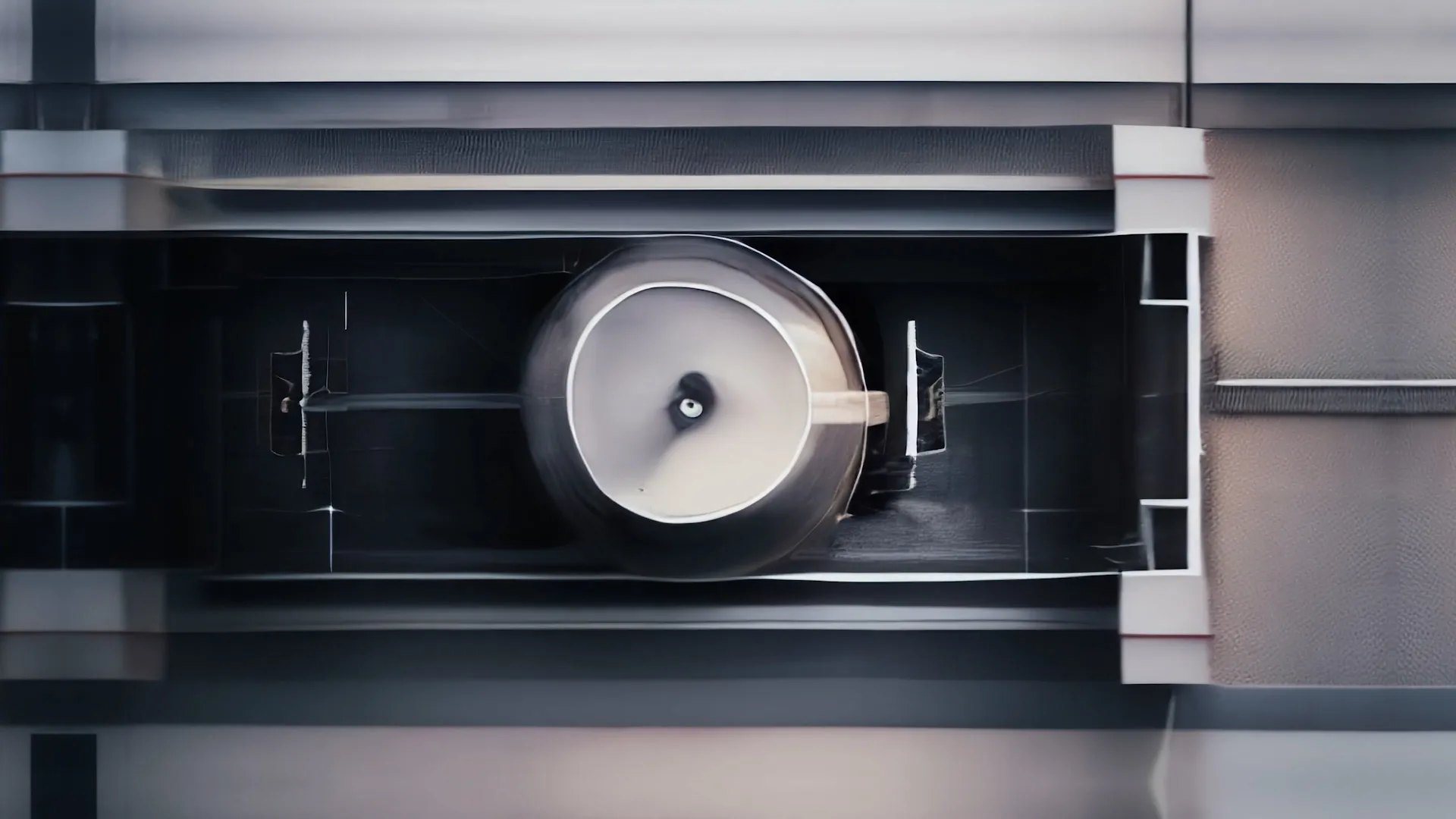
in, global, commerce, logistics, hubs, and, port, facilities, form, the, foundation, of, trade, routes, dictating, the, rhythm, of, international, exchanges, guided, by, INCOterms, transactions, receive, validation, through, bills of lading, while, freight forwarders, and, multimodal transport, ensure, streamlined, coordination, containerisation, optimises, transport, and, as, products, return, or, deviate, reverse logistics, manages, their, trajectory, practices, such, as, global sourcing, exploit, international, diversities, while, digital twin supply chains, envision, real-time, scenarios, for, optimal, decision making, demand forecasting, anticipates, market, needs, and, the, intricate, global value chain, seamlessly, integrates, products, such, as, rubber, PCBs, and, refined, copper, economies of scale, come, into, play, maximising, efficiency, and, profits, while, policy-driven, aspects, like, import tariffs, and, free trade zones, shape, economic dynamics, all, integrated, in, the, vast, network, of, supply, and, demand
Data Sources
Petrovici, Alexe, Bejinariu, 2023. ‘Economy in Timișoara: Territorial Distribution of the Economy in the Timișoara Metropolitan Area’The Growth Lab at Harvard University. The Atlas of Economic Complexity:
- Where did Romania export Electronic Printed Circuits in 2020
- Where did Romania export Epoxide Resins in 2020
- Where did Romania export Refined Copper in 2020
- Where did Romania export Rubber Tyres in 2020
- Where did Romania export Car Seats in 2020
- Where did Romania export Insulated Electrical Wire in 2020
- Where did Romania export Car Lights in 2020
1/6

2/6
3/6
4/6
5/6
6/6
Industrialisation and Technological Level
DATA VISUALISATION
Subject: Industrialisation and Technological Level
Location: Timișoara
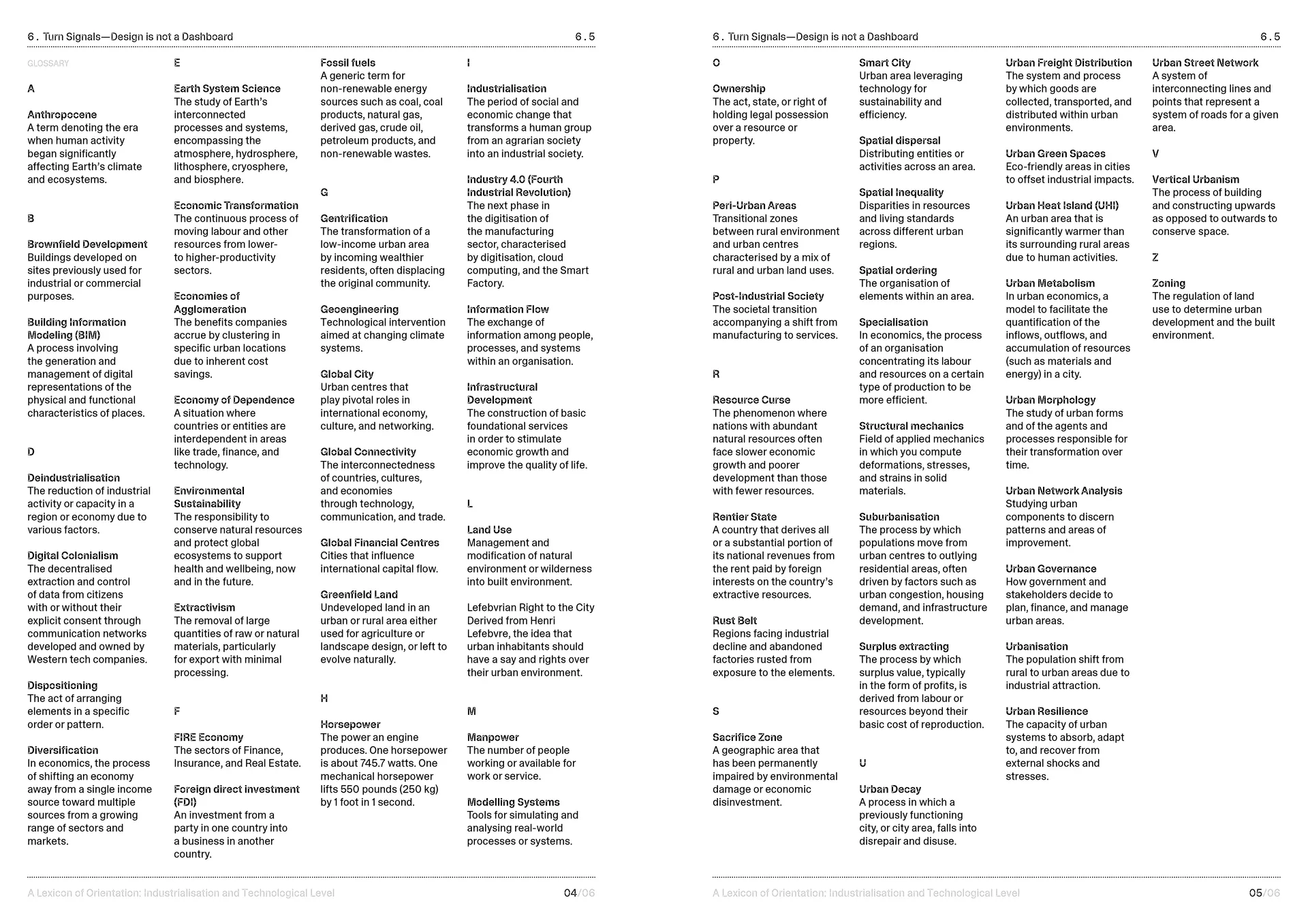
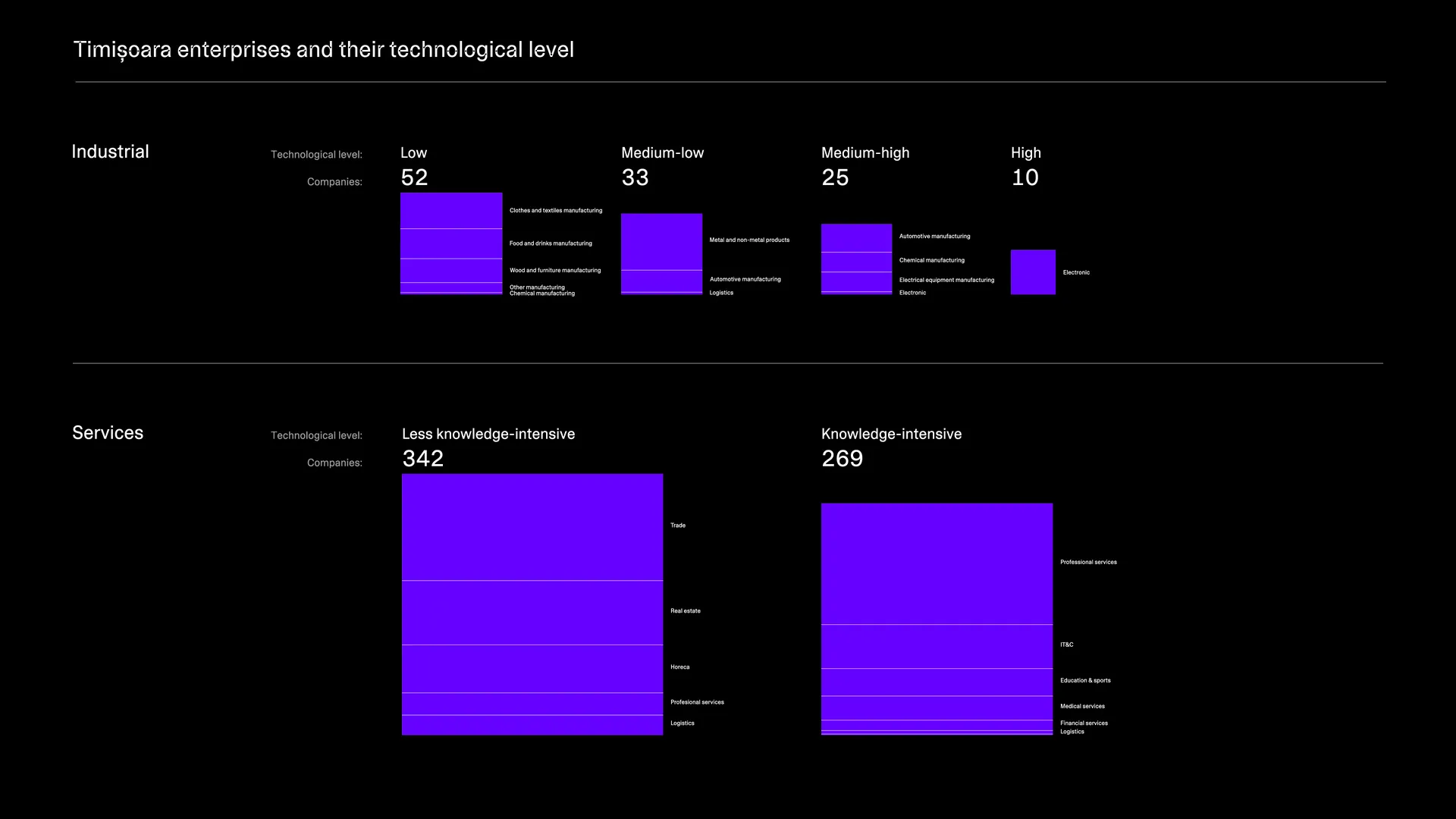
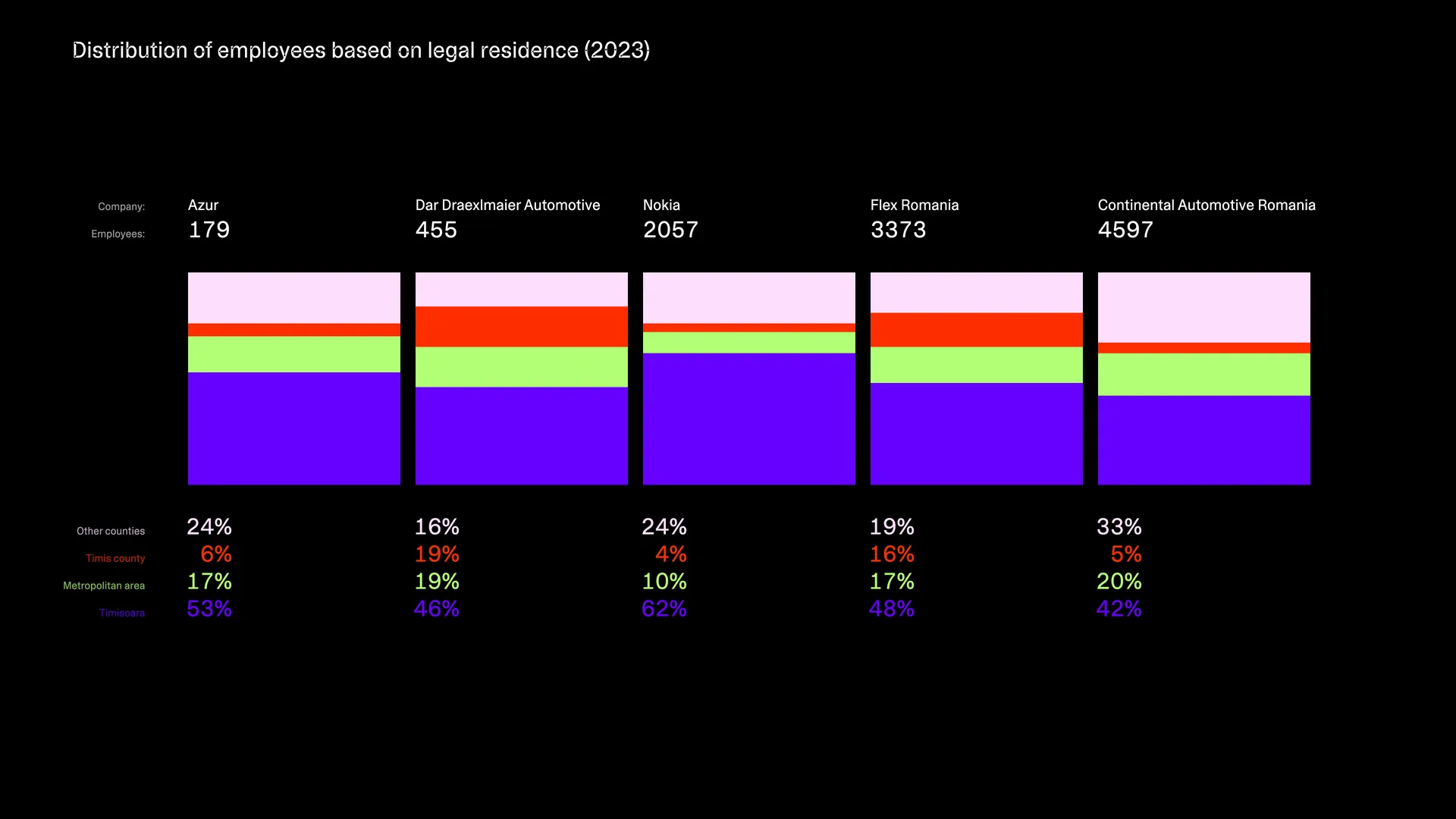
An analysis of the technological level of enterprises in Timișoara across various economic sectors, complemented by a study on the workforce of five leading companies in the city: Dräxlmaier, Continental, Flextronics, Azur, and Nokia, detailing their employees’ places ofresidence and educational backgrounds.
INSIGHTS BY SOCIOLOGIST NORBERT PETROVICI
Technological Levels and Ownership Ties
Foreign corporations have been crucial in driving technological progress in the industrial areas of Timișoara since 2012. Recent foreign investments have elevated factories to medium-high technological levels, and numerous companies in the business service sector have adopted advanced technologies. These foreign investments have been the key force behind the technological upgrade in Timișoara.
Unravelling Investment Dynamics
While foreign companies and those in certain industries are more prone to form alliances, the complexity of these relationships should not be overlooked. New ownership is key in supplying businesses with an influx of capital and investments. Numerous patterns affect the ties between domestic and foreign companies, shedding light on the dynamics that shape the corporate landscape in Timișoara, Romania, and the global economy.
Patterns in Technological Collaboration
Our research reveals interesting patterns in the technological levels of business collaborations. Companies with higher or medium technological levels usually make alliances with others possessing comparable technological capabilities. This inclination towards collaboration based on technological prowess is especially prominent among foreign companies, which often invest in firms that equal or exceed their own technology levels.
Networking Preferences in Business Partnerships
As indicated in the ‘Economy in Timișoara: Territorial Distribution of the Economy in the Timișoara Metropolitan Area’ research report conducted for Bright Cityscapes, there is a preference among companies to link with well-connected nodes, entities with a broad range of connections, while consciously steering clear of partners with existing shared business associations. The size of a company is also a crucial factor in the dynamics of business partnerships, as firms of comparable sizes are more inclined to form ownership ties.
Foreign Dominance in Timiș County’s Corporate Landscape
In Timiș County, large companies are more likely to be foreign-owned than domestic, and these larger foreign companies usually form ties with other large companies. Moreover, foreign companies often form ownership relationships with fellow foreign entities. This highlights the importance of attaining balance and compatibility in fostering collaborations, as well as the inclination of foreign companies to operate somewhat in isolation, creating clusters disconnected from the wider economy due to the lack of domestic counterparts with comparable technological capacities.
Sectors Attracting Foreign Investment
Certain economic sectors in Romania are particularly appealing for foreign direct investment. These sectors include electrical and electronic, chemical, real estate, automotive, clothing and textile, and ITC. Although the general belief is that foreign firms mainly focus on goods and services for foreign markets, the thriving automotive sector in Timișoara reveals a more complex narrative. Foreign investments in Timișoara are drawn to sectors closely linked to the automotive supply chain, which includes electrical and electronic manufacturing as well as the chemical industry.
Ownership Ties in Sectoral Spotlight
In Timiș County, sectors such as medical, financial, energy, education, and sports are primarily composed of domestic enterprises. Additionally, certain sectors such as medical, financial, real estate, and ITC have a strong tendency towards forming ownership connections. On the other hand, such connections are less likely to be created in sectors such as education, sports, automotive, electrical and electronic, energy, construction, clothing and textile, and chemical. For companies in this latter category, establishing relationships may pose more challenges.
Domestically-Driven Technological Advancements
In sectors not directed towards exports, domestic capital is at the forefront, although the situation in Timișoara provides a more nuanced view. The financial sector, largely made up of financial companies rather than banks, has experienced a significant increase in startups since 2020. This growth is driven by a post-pandemic inflow of global funds and a focus on digitalisation. A considerable number of these startups are domestically owned, while others have foreign stakeholders holding significant stakes, highlighting their mutual interest in Romania’s development. The financial sector has emerged as a key investor in Timișoara’s domestic business service startups with notable technological potential, thereby becoming a driving force in the city’s technological upgrade.
AI-GENERATED VISUALS
./prompt:
industrialisation, drives, cities, into, rapid, expansion, decisions, on, land use, are, regulated, by, zoning, shaping, today’s, cityscapes, technological advancements, support, infrastructural development, transforming, urban, landscapes, spatial ordering, plays, a, pivotal, role, in, organising, these, evolving, spaces, while, dispositioning, manages, the, intentional, arrangement, of, resources, as, cities, grow, surplus extracting, is, a, frequent, practice, affecting, regions, differently, some, areas, once, industrial, giants, now, form, the, Rust Belt, bearing, the, scars, of, deindustrialization, a, shift, to, services, announces, the, era, of, post-industrial society, ownership, dynamics, influence, economic specialisation, economic transformation, and, economic diversification, amid, these, shifts, global cities, emerge, acting, as, the, backbone, in, a, complex, network, of, international, relations, and, trade, and, some, with, a, vision, for, the, future, strive, towards, the, ideals, of, smart cities, and urban green spaces
Data Sources
Petrovici, Alexe, Bejinariu, 2023. ‘Economy in Timișoara: Territorial Distribution of the Economy in the Timișoara Metropolitan Area’

1/5
2/5

3/5
4/5
5/5
Outsourcing and IT
DATA VISUALISATION
Subject: Outsourcing and IT
Location: Romania
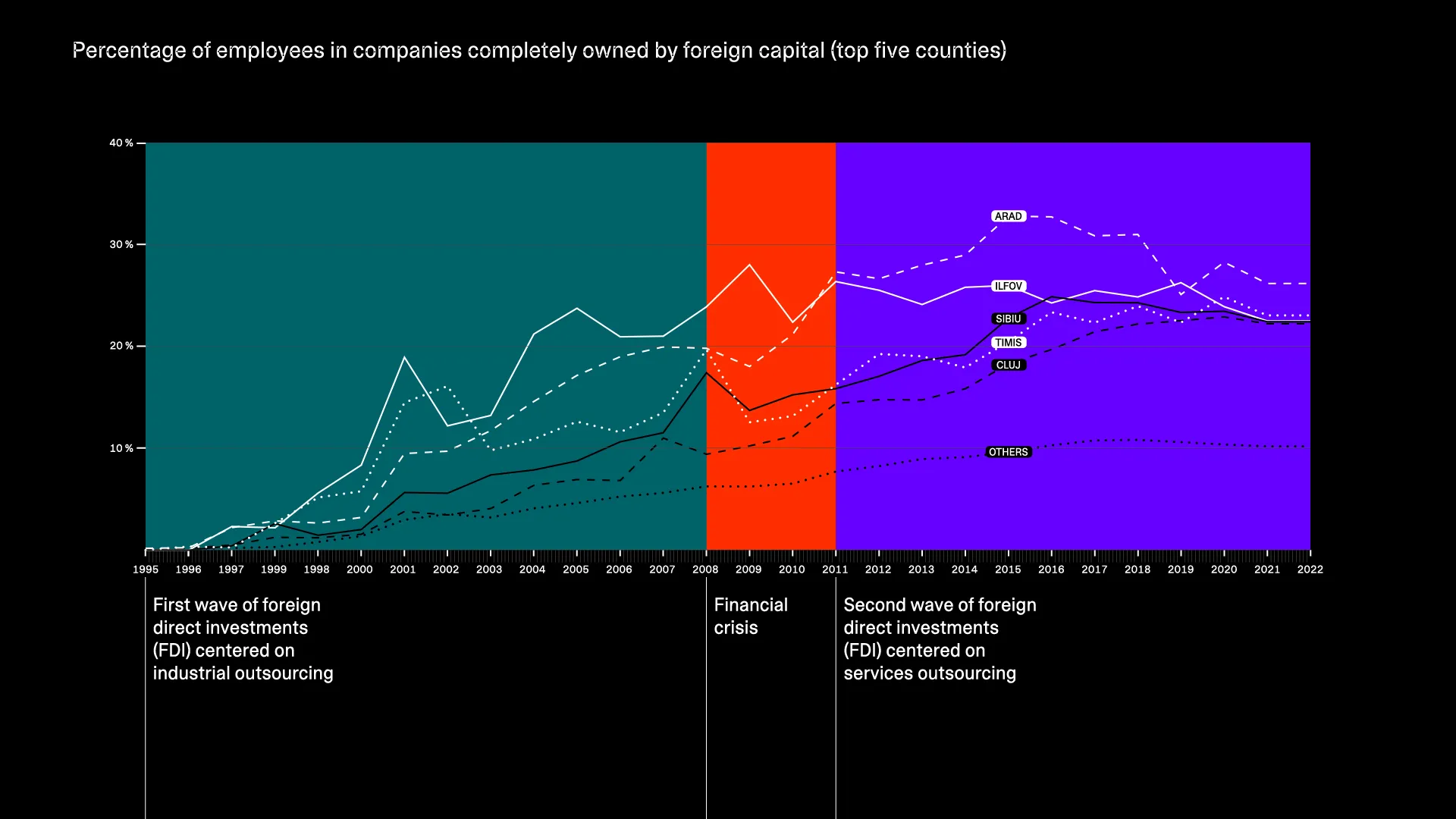
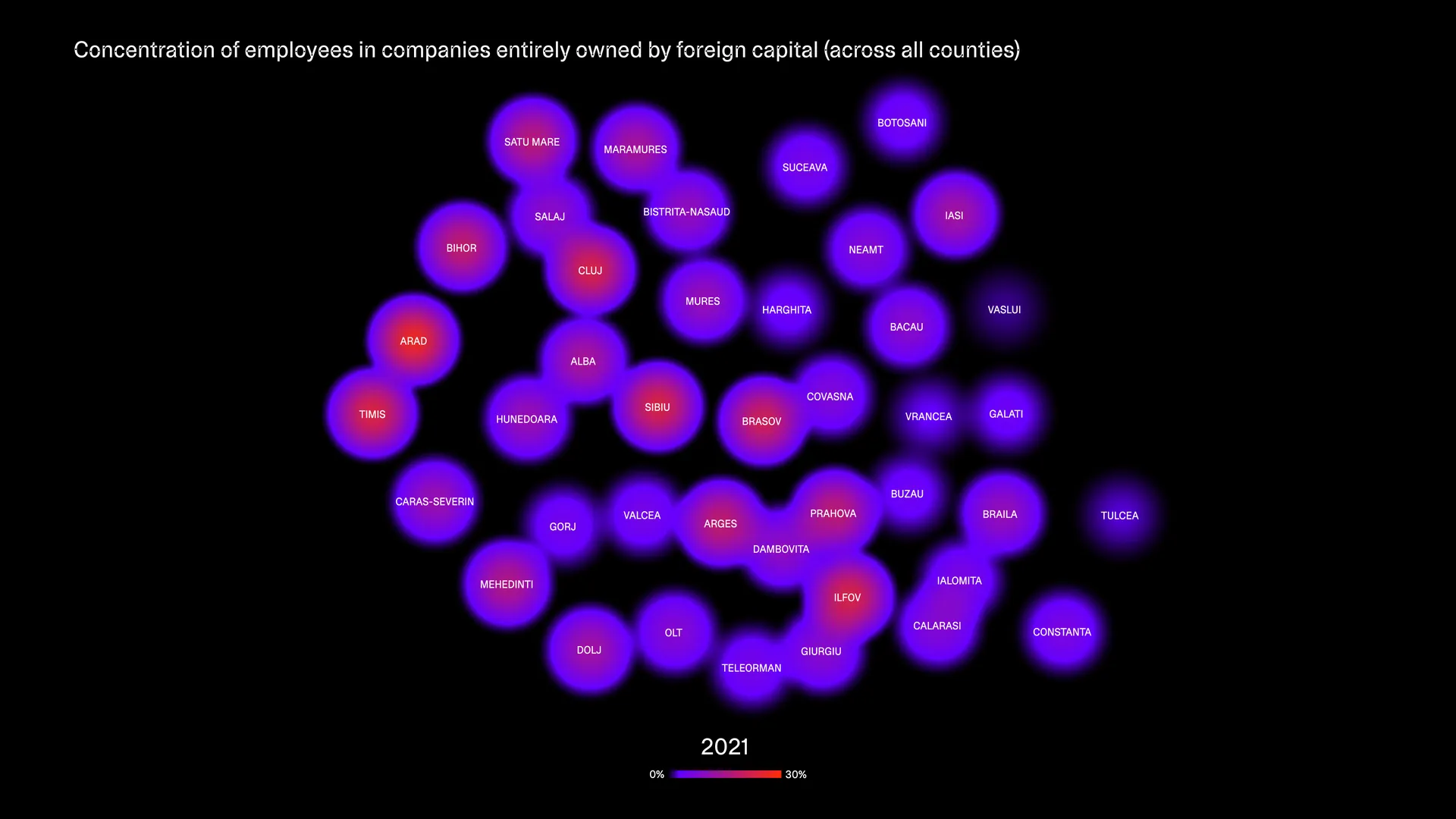
This examination of the Foreign Direct Investment (FDI) in Romania is structured around two core areas of focus. The first analyses the evolution of outsourcing in the period of 1995 to 2022, emphasising the top five counties. Additionally, a heat map illustrates the workforce distribution in firms wholly owned by foreign capital for 2002, 2008, 2012 and 2021. The second area presents a detailed assessment of sectors that attracted the most FDI between 2011 and 2022.
INSIGHTS BY SOCIOLOGIST NORBERT PETROVICI
2003–2008 FDI Transformation in Western Romania
Until 2003, the industrial sector of Romania faced significant challenges. Nevertheless, the first wave of FDI from 2003 to 2008 had the most pronounced impact on the Western counties, including Timiș County. These changes were largely driven by advancements in the supplier network of the automotive industry. Furthermore, in Timișoara, its highly mechanised, well-aggregated agricultural lands, and a well-integrated food industry supply chain were crucial in this transformation, drawing a significant influx of FDI.
Post-2008 Recovery and Technological Advancements
After the Global Financial Crisis of 2008, there was a significant wave of factory relocations from Western Europe, especially from supply chains centered in Germany, to Central and Eastern Europe. Romania became a prominent destination for FDI, characterised by a series of technological upgrades that resulted in the production of more advanced and complex products. Although this technological progress increased turnover, it did not correspondingly increase employment levels within the sector. In fact, the number of employees remained relatively stable, accounting for approximately one-third of the total waged workforce.
Rise of White Collar Business Services
As part of the post-2008 industrial upgrade, investments in white collar business services increased, with cities like Timișoara, Bucharest, Cluj, and Iași receiving considerable benefits. Nonetheless, Timișoara continued its unique economic growth trajectory, concentrating on engineering services and an expanding ITC sector. Although these sectors flourished, they frequently functioned independently in terms of supply and demand.
Internationalisation of Construction and Real Estate
After 2008, there was a significant increase in the internationalisation of the construction and real estate sectors, with real estate drawing a considerable portion of FDI. This internationalisation was made possible by converting former industrial sites within cities into large-scale urban reconstruction projects, necessitating substantial capital, capacity, and planning efforts, and generating high returns. Timișoara became a key destination for this wave of global capital, mainly aimed at transforming industrial sites into new neighbourhoods. However, these newly developed areas frequently lacked appropriate social services and infrastructure. Moreover, the shift towards an export-driven economy in the post-2008 period fueled growth in urban retail and logistics. This transformation aligned with the rise of the middle class and an influx of multinational companies.
AI-GENERATED VISUALS
./prompt:
in, the, evolving, IT, sector, outsourcing, becomes, instrumental, in, reshaping, business,
architectures, boundaries, shift, power, dynamics, morph, and, an, emergent, terrain, materialises, this, transformation, integrates, global, tactics, with, local, preferences, through, glocalisation, while, standardising, practices, across, diverse, cultures, highlighting, cultural homogenisation, supported, by, data centres, and, cloud services, businesses, undergo, fragmentation, redistributing, tasks, while, maximising, efficiency, networked labour, emerging, from, a, diversified, global talent pool, intersects, with, traditional, in-house productions, decentralisation, propagates, diffusing, decision-making, authority, DevOps, bridges, software, and, IT, dynamics, and, cybersecurity measures, enhance, technological dependence, the, vast, web, of, telecommunication networks, ensures, seamless, interactions, vital, in, this, digitised, framework, vendor management, refines, the, selection, and, coordination, processes, crafting, the, future, of, IT’s, outsourced, landscape
Data Sources
Petrovici, Alexe, Bejinariu, 2023. ‘Economy in Timișoara: Territorial Distribution of the Economy in the Timișoara Metropolitan Area’
1/6
2/6
3/6
4/6
5/6
6/6
Workers, Commuting and Internal Migration
DATA VISUALISATION
Subject: Workers, Commuting and Internal Migration
Location: Timiș County and Timișoara Metropolitan Area
An analysis of the distribution of population and employment categories in Timiș County from 1950 to 2022 compares the workforce during the Socialist Era (1950-1989) and the Economic Restructuring Period (1990-2021). Distinctions among white-collar, blue-collar, and unwaged labour are emphasised. A map charts employee distribution by residence in the Timișoara Metropolitan Area from 1995 to 2021, highlighting how suburbanisation trajectories have been influenced by capital development.
INSIGHTS BY SOCIOLOGIST NORBERT PETROVICI
Pre-1968: Economic Strategy and Shift
Until 1968, Romania adopted a robust economic strategy focused on strengthening its currency reserves by exporting raw materials like cereals, timber, cement, and oil. At the same time, post-war austerity measures were implemented to control inflation and regulate domestic consumption. Initially, the proceeds from exports were allocated for the renovation of existing factories.
1968: Economic Milestone
By 1962, Romania was well-positioned to initiate its industrial programme, leveraging on export revenues and austerity measures. From 1962 to 1968, new factories were built, propelling industrial expansion and converting the agrarian population into waged industrial workers. This change encompassed not only economic supply-and-demand mechanisms but also forceful actions like land expropriation, mandatory cooperativisation, and low worker wages. In 1968, a crucial economic milestone was achieved in Romania when the number of blue collar workers equalled that of unpaid agricultural workers.
1968–1978: International Monetary Fund (IMF) and Industrial Development
By 1968, the expansion of Romania’s industrial production sectors laid the foundation for its application to the IMF. From 1968 to 1978, Romania obtained loans from over 300 banks, including the European Bank for Reconstruction and Development and the World Bank. This financial support powered bold initiatives to upgrade and diversify the industrial sector, concentrating on exporting intermediate goods to West Germany. The chemical and automotive sectors emerged as new pivotal economic areas.
The 1970s in Timișoara
Timișoara gained considerable advantages from these investments, observing the growth of its chemical industry as it replaced textiles. It also evolved into a hub for manufacturing electrical components for the emerging automotive sector and adopted high-tech innovations such as domestically produced personal computers. This period marked a rise in white collar positions in management, engineering, and education, serving both blue collar and white collar workers.
1978: Second Wave of Austerity
In 1978, a second wave of austerity measures was launched in response to the global economic crisis, with the goal of obtaining new loans for Romania. This period saw a notable increase in the workforce in low-tech sectors such as food production, and a new wave of textile and footwear manufacturing, with farmers who were previously unwaged transitioning to advanced state agri-businesses.
Timișoara’s 1980s Labour Utilisation
The proliferation of factories, especially in the automotive sector throughout Timiș County and the wider metropolitan area of Timișoara, enabled this transition in employment opportunities. Timișoara possessed the most technologically advanced agri-business in Romania and the entire supply chain required for the food industry. Timișoara demonstrated its proficient internal labor force utilisation by harnessing resources from across the country, substantially contributing to its economic development.
1990s: Timișoara and FDI Success
Throughout the 1970s and 1980s, the industrialisation efforts of Timișoara prioritised the training of professionals to manage new machinery, leveraging international knowledge and expertise. This workforce played a crucial role in attracting Foreign Direct Investments (FDI) to the technical-industrial sector in the 1990s. Consequently, both Timișoara and Timiș County emerged as key FDI targets in Romania, marking a pivotal period in the region’s economic development, especially in light of the declining regional and national supply chains of socialist factories.
AI-GENERATED VISUALS
./prompt:
amid, the, complexities, of, global movement, commuting, is, transforming, urban, and, industrial, areas, as, boundaries, blur, cultural exchange, becomes, prominent, defining, a, new, commuter landscape, depopulation, stands, in, contrast, with, urbanisation, and, hypermobility, marks, today’s, era, traffic congestion, escalates, encouraging, transit-oriented development, diaspora, communities, are, influenced, by, push and pull factors, all, under, the, oversight, of, migration, policy, telecommuting, merges, physical, and, virtual, spaces, and, the, changing, occupational distribution, reflects, shifts, in, service-dominated employment, through, temporal, investigation, from, daily, patterns, to, the, span, of, a, year, in, commuting, movement, and, change, is, observed, rural-urban migration, influences, the, growth, of, megacities, and, each, economic, migration corridor, represents, aspirations, and, journeys, amid, these, shifts, the, concept, of, translocal belonging, emerges, bridging, distances, and, weaving, cultures, in, evolving, urban, landscapes
Data Sources
Petrovici, Alexe, Bejinariu, 2023. ‘Economy in Timișoara: Territorial Distribution of the Economy in the Timișoara Metropolitan Area’

1/5
2/5

3/5

4/5

5/5


Credits
Co-edited with the assistance of OpenAI’s ChatGPT
Curator: Martina Muzi
Assistant curator and AI-generated visuals: Bianca Schick
Data story-telling and visualisations: Federico Santarini
AI-generated visuals and editing: Alex Foradori
Data Sources
Petrovici, Alexe, Bejinariu, 2023. ‘ Economy in Timișoara: Territorial Distribution of the Economy in the Timișoara Metropolitan Area’, 2023