
Norbert Petrovici
Sociolog, cercetător
Studio Krisenstab
Giacomo Nanni (Informational designer)
Norbert Petrovici with Krisenstab
The Chemical Trajectories project extends a broader research inquiry into how Romania’s chemical industry evolved from the socialist period’s state-coordinated specialization toward the fragmented, trade-dependent structures of the 2000s. By mapping each sector’s position in terms of product complexity and export-import balance, the visualization reconstructs how industrial capacities advanced, regressed, or disappeared across six decades of integration into global markets.
The analysis builds on a study of learning regimes in the chemical sector, structured around a fivefold classification of knowledge accumulation: execution, technical-task, residual-autonomous, commercial-relay, and interface. These regimes can be read as interpretive coordinates for the visualizations. They trace how different forms of learning, from standardized replication to adaptive repair and cross-domain experimentation, have accumulated within Romania’s industrial fabric. In the charts and tiles, these regimes appear as patterns of motion and constraint: sectors that move upward in complexity signal temporary autonomy, while those oscillating along the import axis reveal structural lock-ins.
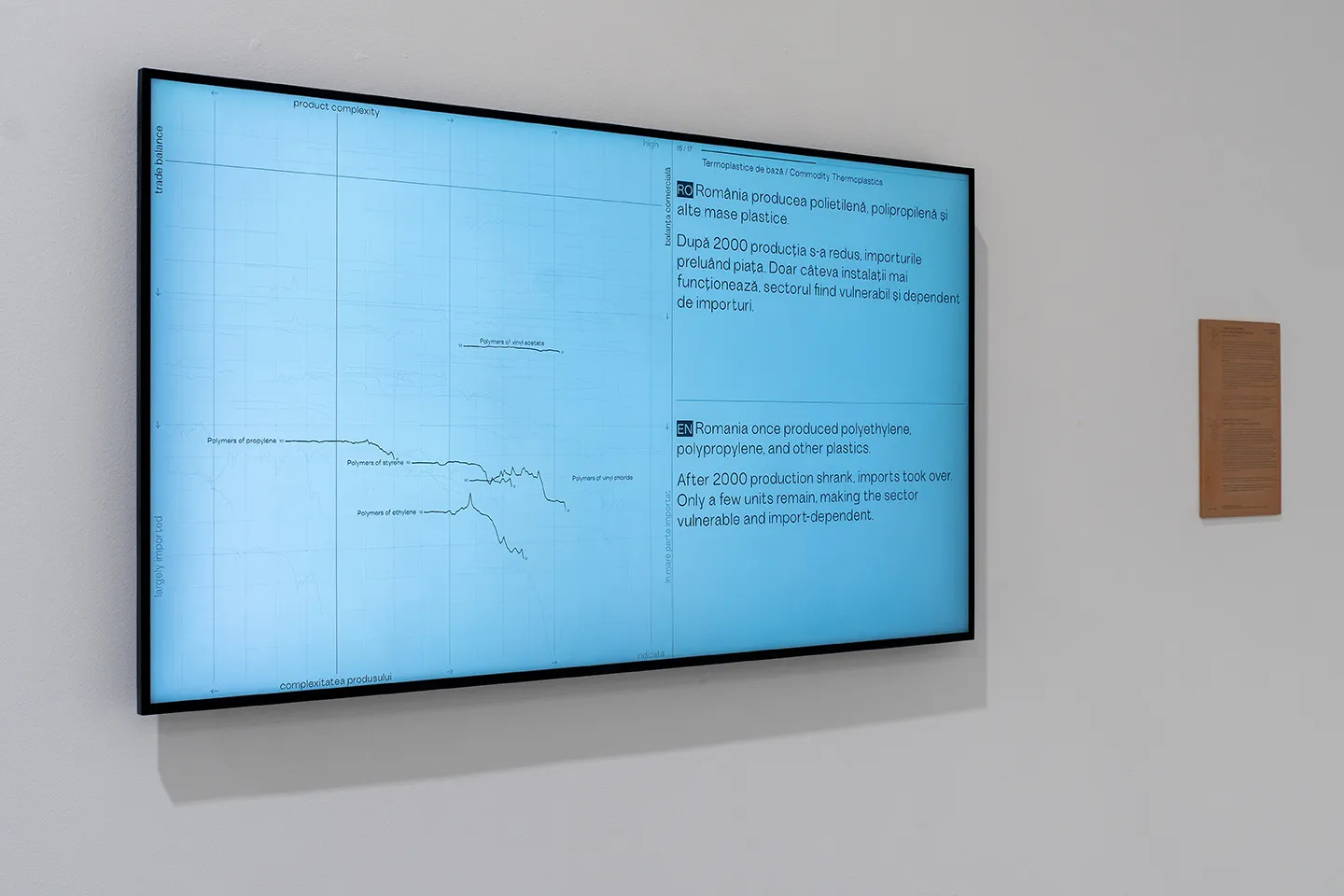
Using international trade data from 1960 onward, each business vertical is represented on a scatter-plot graph according to product complexity and export-import balance. The resulting visualizations animate the shifting trajectories of industries over time: while some advance toward higher technological sophistication and become part of Romania’s export landscape, others remain structurally dependent on imported inputs.
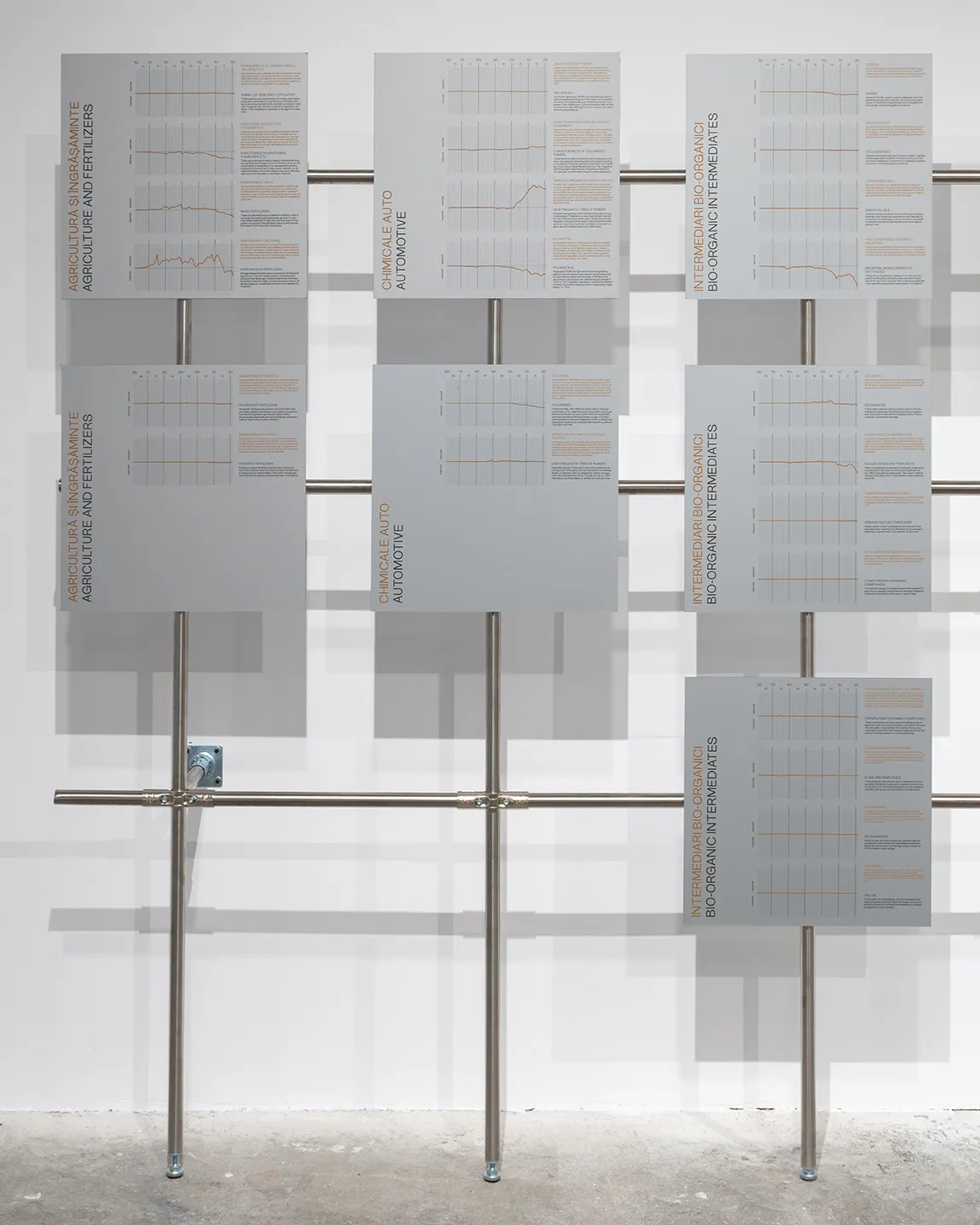
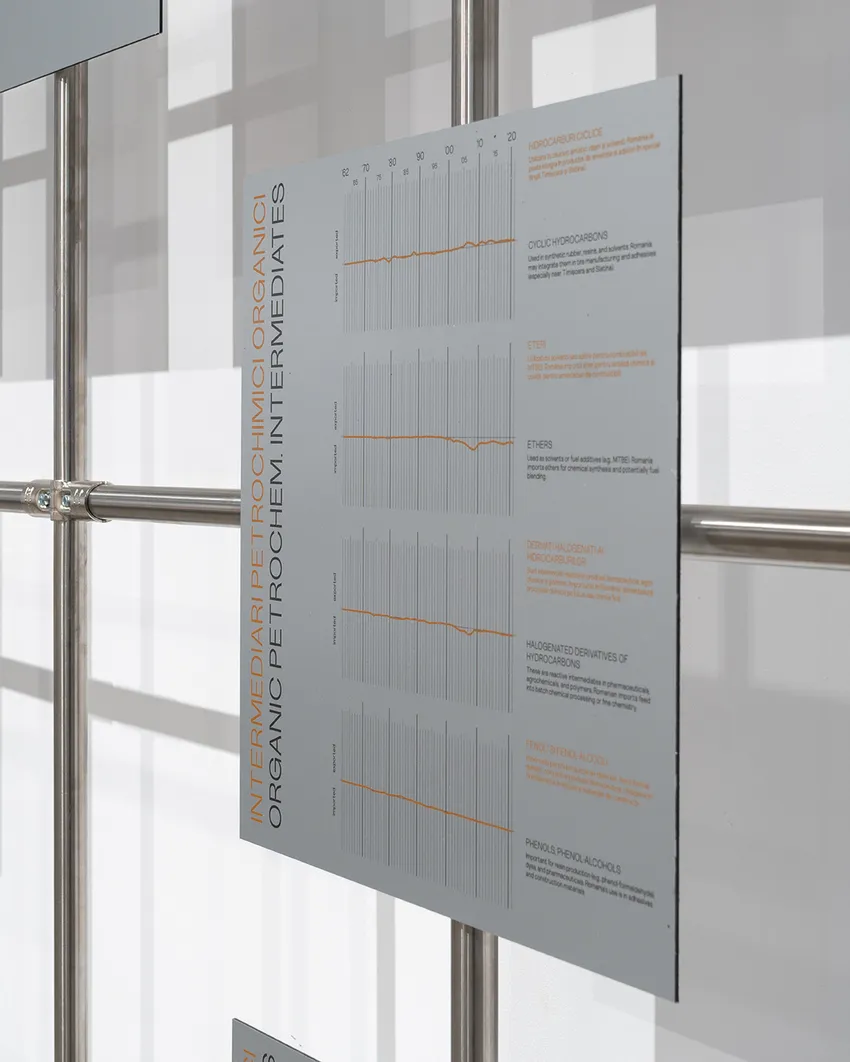
A second layer of visualization presents individual chemical products in a series of tiles. Each column corresponds to a business vertical, like agriculture and fertilizers, automotive chemicals, and plastics, tracing how Romania’s industrial position evolved between 1960 and 2020. Each tile captures both exports and imports, revealing the dependency structures embedded in everyday materials. The fertilizer tiles show the persistence of import reliance for phosphatic and potassic inputs despite localized formulation capacity. The automotive tiles document the rise of intermediate goods, from anti-knock additives to tires and engineering plastics, illustrating how Romania became an assembly node within global value chains. The plastics tiles highlight how synthetic materials, once peripheral, now function as infrastructural substances linking manufacturing, logistics, and consumption. Together, the tiles act as temporal cross-sections of economic integration, translating trade data into tangible material form.
The project makes visible the hidden logic and economic contingencies that continue to shape the chemical sector through asymmetrical modernization. While a few branches have advanced toward higher technological complexity, most remain locked in low-value activities, reliant on imported inputs and volatile external demand. This structural dependence has limited the accumulation of local know-how and constrained the formation of autonomous innovation regimes.
Placed within the exhibition, these visualizations provide an analytical background for the other works. They expose the macroeconomic logic underlying the material and social processes documented through interviews, factory images, and design interventions, from residues and biomaterials to ecological repair, showing how chemistry underpins both industrial transformation and everyday life. The installations can be approached as variations of learning through matter, each translating dependency and invention into distinct material and sensory registers.